



After two long days viewing the 60th Venice Biennale, I snuck off, alone, to the Veneto, the northeast Italian region stretching from the Dolomite Mountains to the Adriatic Sea. “To see my collector,” I told a friend who was scurrying to endless meetings before Art Basel later that week.
“Bunburying,” invented by Oscar Wilde in The Importance of Being Earnest, is the practice of creating a fictitious person in the service of leading a double life. (“I have invented an invaluable permanent invalid called Bunbury, in order that I may be able to go down into the country whenever I choose,” the dashing young character Algernon Moncrieff declares in the play.) Philanderers, high-end imposters, and, naturally, some art dealers do this. From the outside, it might look pretty glam, but the art world can be all-consuming. Unless you’re vigilant, it wolfs down your time, draws you away from family and friends and from your own obsessions and interests.
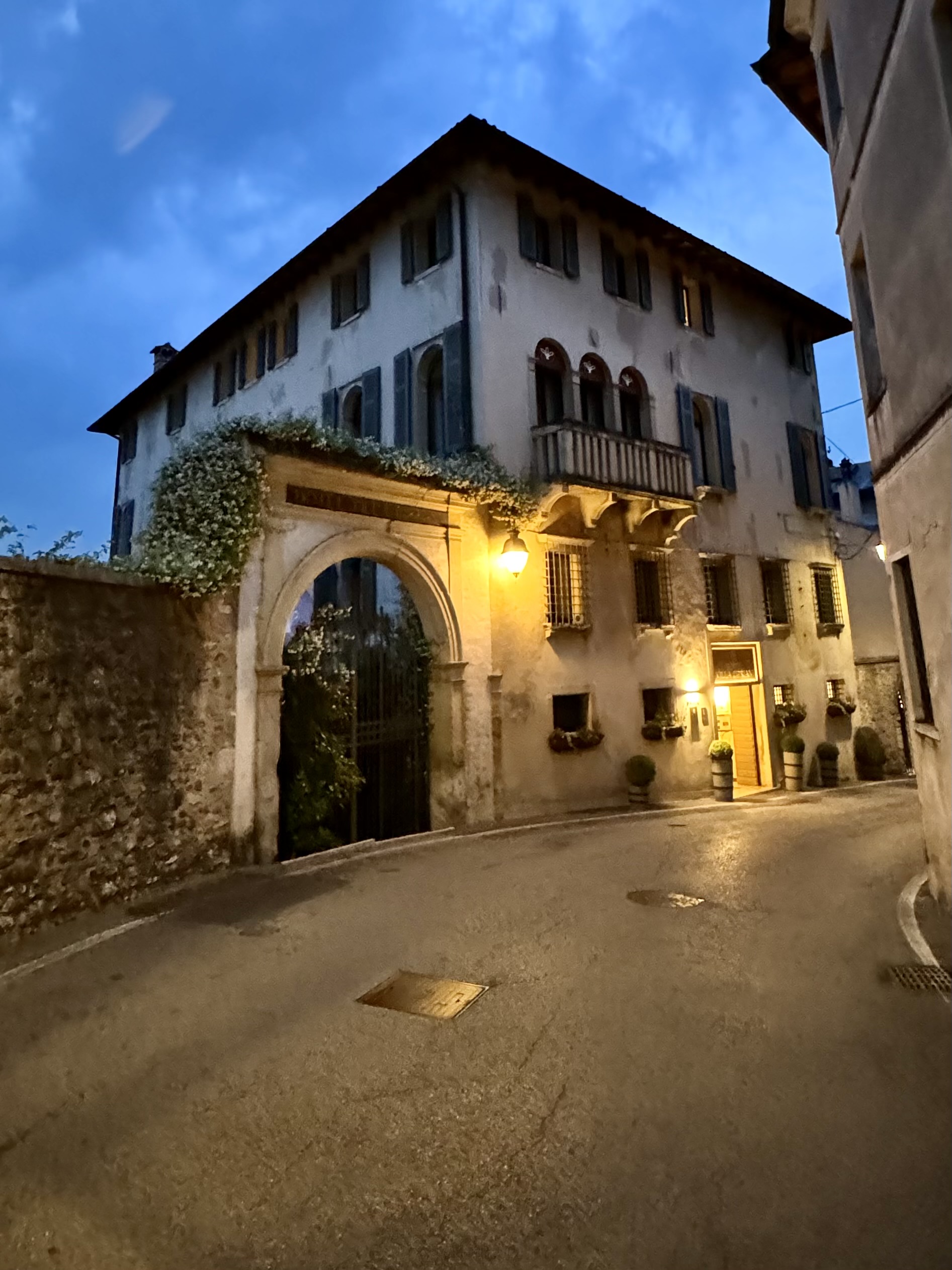
Over lunch one day in New York, the distinguished American interior designer Daniel Romualdez told me about a trip he recently took to see some Palladian villas. He gave me the guide to get: Roberta Parlato. And he said the Hotel Cipriani in Asolo is really the only place to stay. I could, with a little subterfuge, seize this short gap before the art fair. Time alone, looking at architecture, would do me some good. I emailed Roberta and booked the Cipriani.
My “Bunbury” has always been a vaguely drawn European collector: discreet and elegant, impossibly loaded and finical. There’s a whiff of Italian industrialism, a gout of Gotha. People like that do exist and one knows better than to ask for names. Of course, no sales or consignments had ever transpired with this collector. This was a long game.
The first leg of my visit was a quick train from Venice Santa Lucia just over the causeway to Venice Mestre. I then hopped on an hour-long train to Bassano del Grappa. These run every half hour, give or take. After that, I took a taxi (set up by the hotel—have them arrange it) across the foothills of the Monte Grappa to the Hotel Cipriani nestled up on a ridge of the Asolan hills. Total time from Venice: Under two hours, including waiting around.
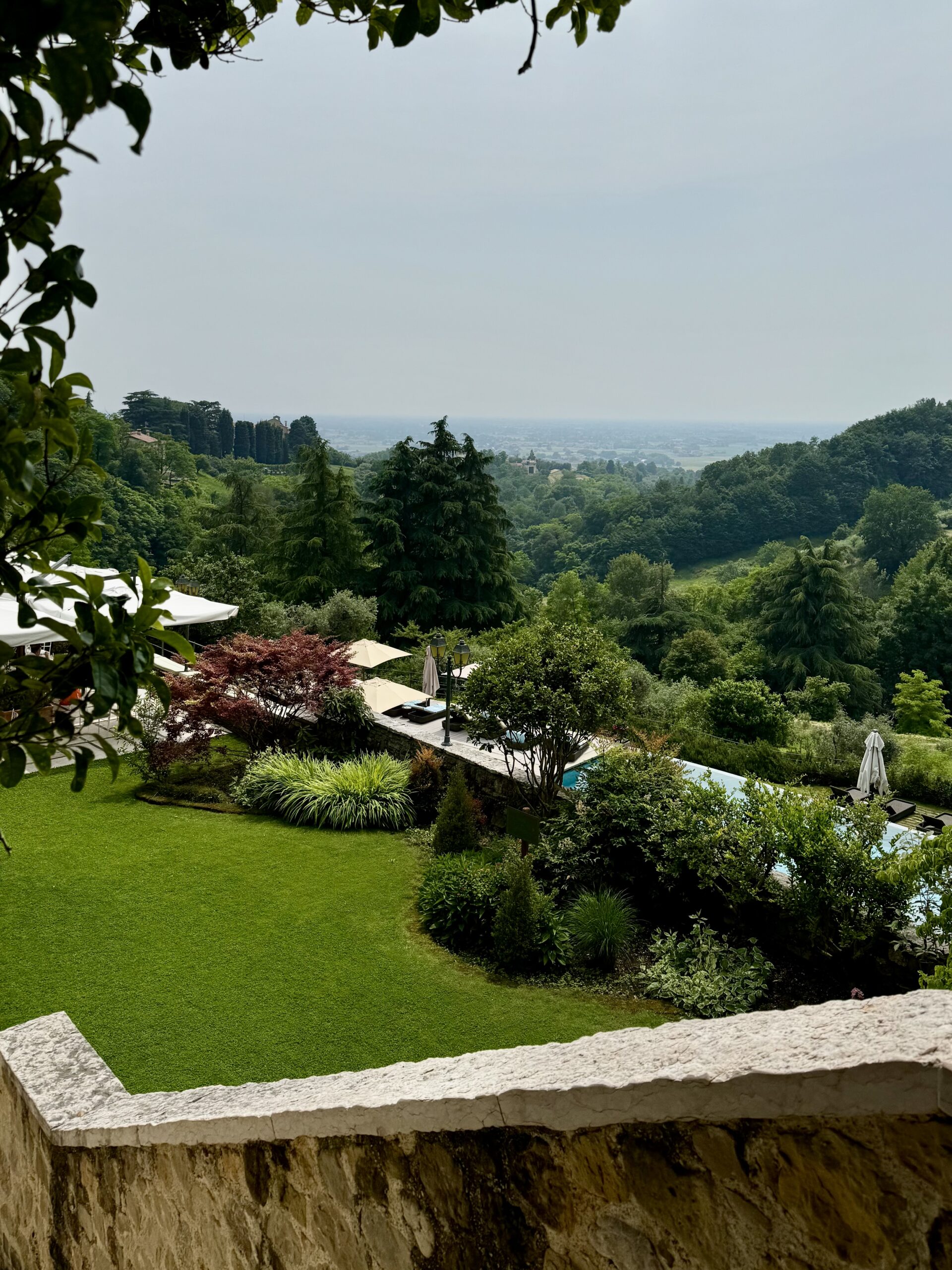
The Cipriani in Asolo (once owned by Robert Browning) shares close DNA with the Venice Cipriani: a 16th-century villa purchased in the 1960s by the philanthropist Rupert Guinness and run by the chef Giuseppe Cipriani as a hotel. In the mid-1970s, their ownership diverged and today they offer very different experiences. In Venice, you’re in a billionaire’s lair, a field HQ for splendacious mummeries like the Bezos and Clooney weddings. In Asolo, you’re in an amiable, patinated pile of good taste and old school hospitality.
In June, the notable English gardens are full of ripening pomegranate trees, climbing jasmine and senescent roses. The pool overlooks flowering Prosecco vineyards. Guests mumble quiet thanks more than they bark or complain. There is no such thing as a quick meal: When I arrived in the afternoon, a multi-generational family of American academics were finishing a three-hour lunch and in snippets, I overheard them speculating on Marco Polo’s Venetian upbringing and planning their evening amble.
The next morning, my guide, Roberta, picked me up with a driver I’d hired. One day gave us time for three Palladio villas, the Teatro Olimpico, and the Tomba Brion just outside of Treviso designed by Carlo Scarpa.
You can’t overestimate the importance of Andrea Palladio, a Venetian born in Padua in 1508, to our contemporary visual and built world. Just some of the buildings we can thank Palladio for directly or indirectly: the White House, Monticello, Graceland, Chiswick House in London, Caesars Palace in Vegas, and the Team Disney Building in Burbank. Between 1910 and 1930, 40 percent of new American buildings were built in the “Colonial Revival” style, a descendant of Palladio. In 2010, the United States Congress officially named Palladio the “Father of American Architecture.”
The global craze for Palladio didn’t really kick off until Inigo Jones visited Palladian villas on his grand tour in 1613. In 1615, Jones was appointed Surveyor of the King’s works, which essentially made him the chief architect for the United Kingdom. He dropped elegant Palladian bombs of simplicity and classical order into the rabbit warrens of Tudor and Jacobean sensibilities, most notably in the Banqueting House at Whitehall and the Queens House at Greenwich, completed in 1635. By then 18th Century Palladian architecture had swept across the United Kingdon.
Architecture is political (even, say, a bloated ballroom with stairs leading nowhere), and Palladianism has taken some dark roads. In the 1930s, the architects working under Italian fascism considered Palladio their spiritual ancestor. Look at almost any of Albert Speer’s monstrously scaled designs for Nazi Germany and you’ll see Palladian principles divorced from human scale. Fast forward 50 years and Robert Venturi, Michael Graves, and Philip Johnson impudently re-introduced Palladio’s pediments, porticos, and entablatures in absurd and colorful modes, filtering his designs into a contemporary world that, after the horrors of the 20th century, couldn’t be anything but deeply skeptical of utopian ideals.
Back to the Veneto, where I went to see the real McCoy. UNESCO lists 47 buildings that can be definitively attributed to Palladio, but there are a mere 12 villas that are in close to original condition. There is also the ingenious Teatro Olimpico in Vicenza, his last building, which is virtually unchanged since it opened in 1585 and continues to be used as a theater. Do not miss seeing it even though it’s not on the villa short list.
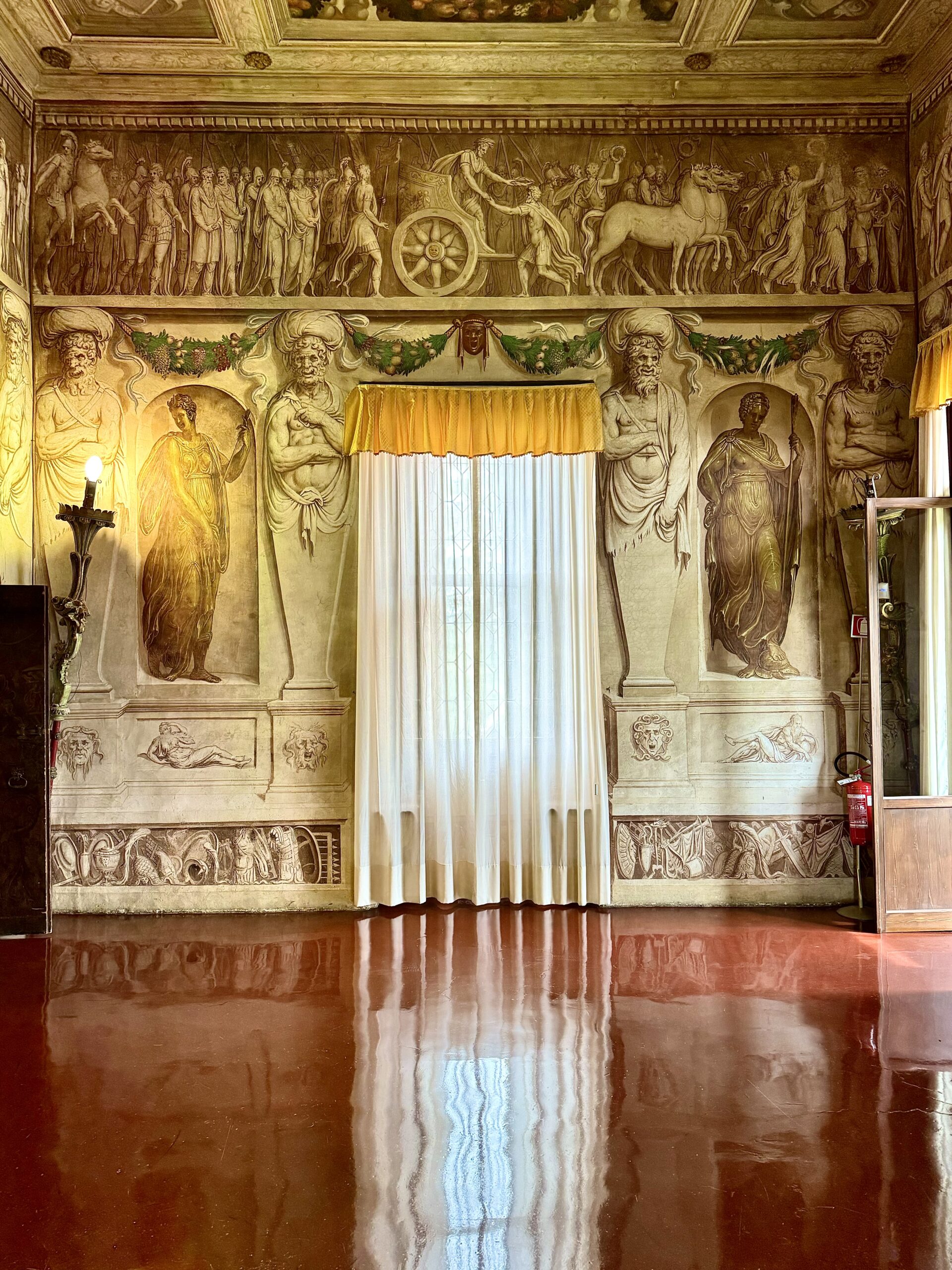
Roberta and I started at Villa Godi, then hit Villa Barbaro-Maser and the Teatro Olimpico and concluded with the Villa La Rotonda, the most iconic of them all. Since 1934, Villa Maser has been inhabited by the family of Count Giuseppe Volpi di Misurata, who founded the Venice Film Festival. His jet-setting granddaughter, Marina Cicogna, lived on and off at the villa, and was the first major female Italian film producer with such titles as Belle de Jour. A fleeting flame of Alain Delon and Warren Beatty, she flouted Italian inheritance laws when she adopted a female lover late in life. She despised sloppy drunks, vulgarians bedewed with luxury brand labels, cooking, Coca-Cola, and bad plastic surgery. Until her death in 2023, she never lost her commanding posture or her child-size Ray Bans, the only sunglasses that wouldn’t slip off her narrow face.
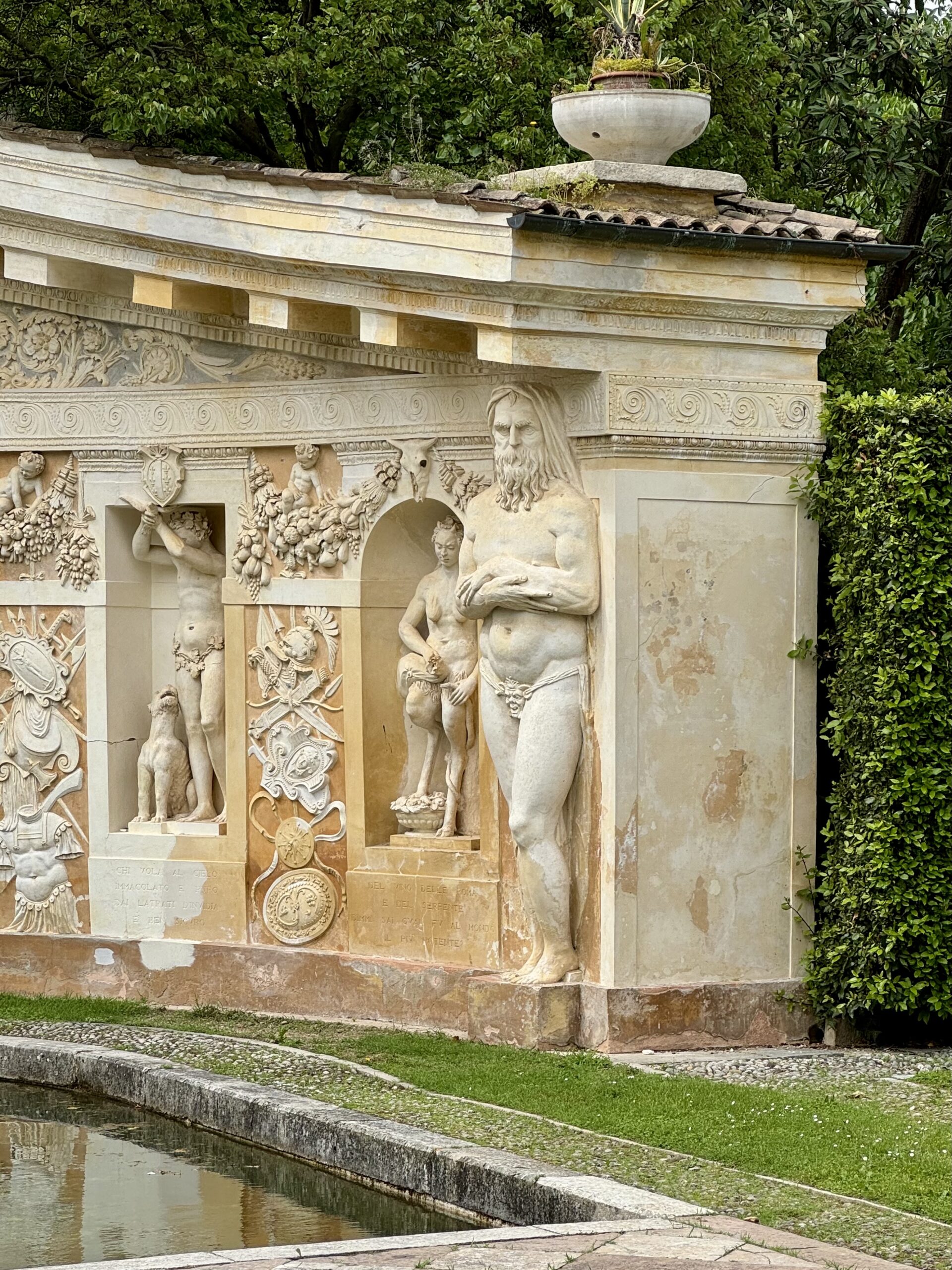
The villa, in all its grandeur, feels livable. It’s filled with frescoes by Paolo Veronese, including trompe l’oeil servants lurking in corners and near hidden doors. The Nymphaeum, a sort of water park lined with classical statues, runs along the back of the house and is fed by a Palladio-designed hydraulic system that pumps water through the kitchens as well as irrigating the gardens. This is exactly the sort of abode in which my Bunbury, my collector, might reside in—part time, like Marina—though she wouldn’t have public hours.
The main features of a Palladian structure are a symmetrical façade, a pedimented entry, a columned portico, and tripartite windows—a central window with a semi-circular curve atop it directly flanked by identical narrower windows with flat tops that are attached to the central arch. More than the sum of its parts, a Palladian villa conveys harmony, humanity, and pleasure.
The building that hews most closely to these principles is Villa La Rotonda, designed in 1566. The structure is a circular, domed hall enclosed by a perfect square. It has an ingenious air-cooling system: As the sun heats the dome, hot air in the house rises and escapes through the oculus, sucking up cool air from subterranean vaults through a stone grate, carved in the form of the wind god Boreas. Thomas Jefferson used the blueprint of the house to create a nearly exact copy in Monticello.
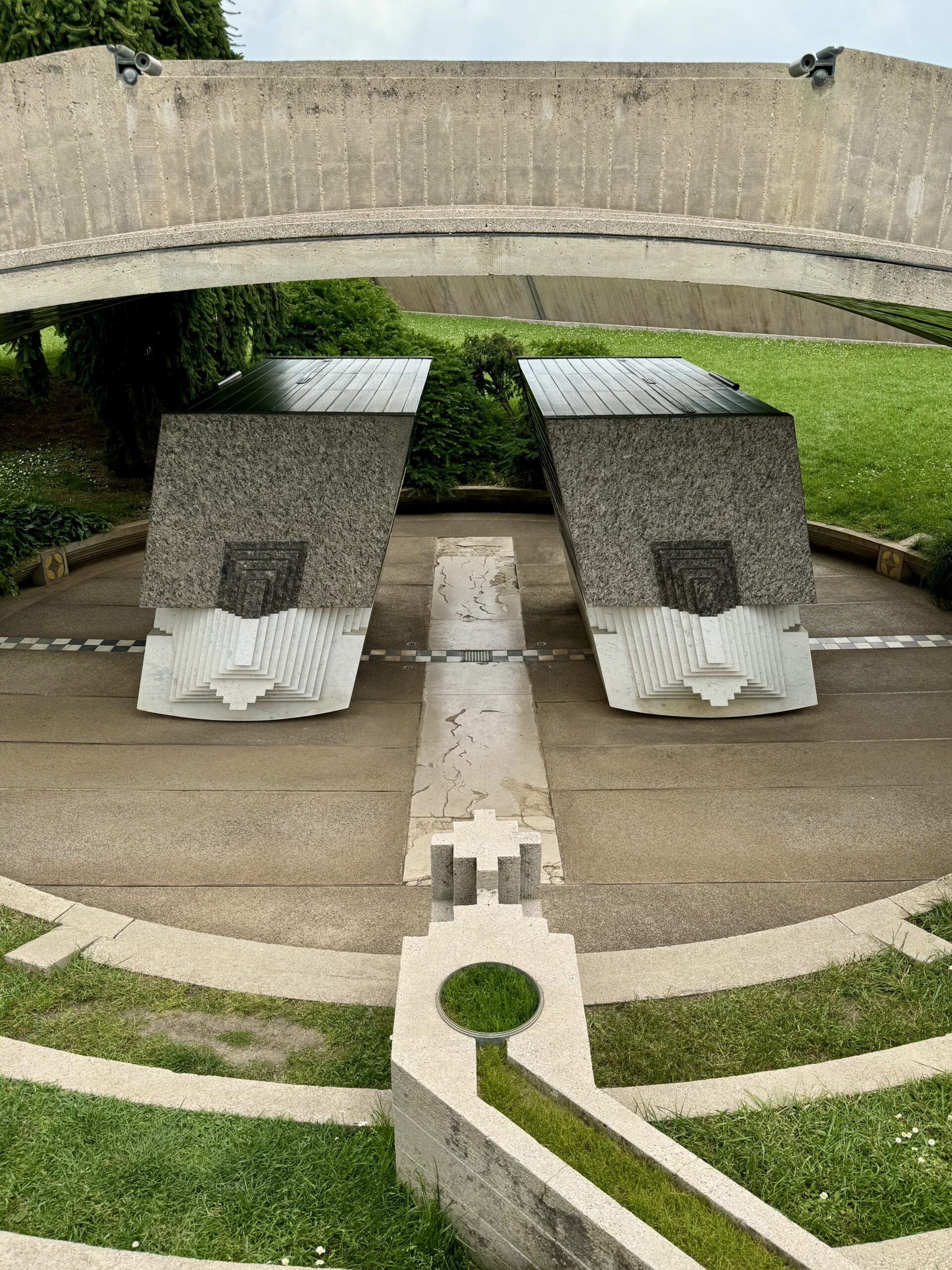
My day with Roberta was coming to an end. In the late afternoon, we made our way to San Vito d’Altivole to see the Tomba Brion. Commissioned by the wife of an Italian television manufacturer, this elaborate burial ground is more accurately a verdant 22,000-square-foot Brutalist necropolis walled within a larger municipal cemetery. “The place for the dead is a garden,” declared Scarpa.
There is a Palladian precision underlying the complex and its surrounding landscape. But an equal inspiration was Japanese: the meditation pavilion is modeled after a tearoom, and the meandering pathways recall Zen Garden design. Within the structures are transcendent details inlaid into the raw concrete made from brass, bronze, and antique Murano glass tiles. The chapel’s brass and marble holy water dispenser alone nearly overwhelmed my agnosticism.

Thirty-six hours in the Veneto was enough to transform and restore me. Any longer and my brief disappearance might have attracted questions from my husband or colleagues. To paraphrase Graham Greene: don’t let your absence rise to the level of being noticed. Of course, I would have loved to stay and see more villas, walk the hills, and eat at the many excellent restaurants in the region. But Bunburying, and stealing time for oneself, is often a quick business.
Guide
Stay
Read
In 1570, Palladio published I Quattro Libri dell’Architettura (the Four Books of Architecture), which provided detailed illustrations for his ideas along with exact measurements. He meant his buildings to be replicated, and with relative ease.
The Perfect House by Witold Rybczynski
Andrea Palladio: The Architect in His Time by Bruce Boucher
“Countess Marina Cicogna: A Woman of the World” by Vanessa Grigoriadis
Carlo Scarpa’s Tomba Brion by Guido Guidi
Carlo Scarpa by Robert McCarter
“Carlo Scarpa: A Virtuous Architect of Water” by Borja Fernandez:
Asolando: Fancies and Facts by Robert Browning
The Importance of Being Earnest by Oscar Wilde
Watch
Palladio: The Power of Architecture (2019)
Carlo Scarpa: The Pavilion on the Water (2023)
More of our favorite stories from CULTURED
‘I Live in Your Piss’: Florentina Holzinger on Venice, Violence, and Why Nudity Still Scares Us
Which ‘Odyssey’ Actors Have a Chance at the Oscar? Christopher Nolan’s Casting Director Weighs In.
‘Synthetic, Easy, Lethal’: A Psychoanalyst and a Boxer on Why We Can’t Quit Betting
A Year After Bob Wilson’s Passing, Six Artists and Collaborators Reflect on His Legacy
Sign up for our newsletter here to get these stories direct to your inbox.




 in your life?
