


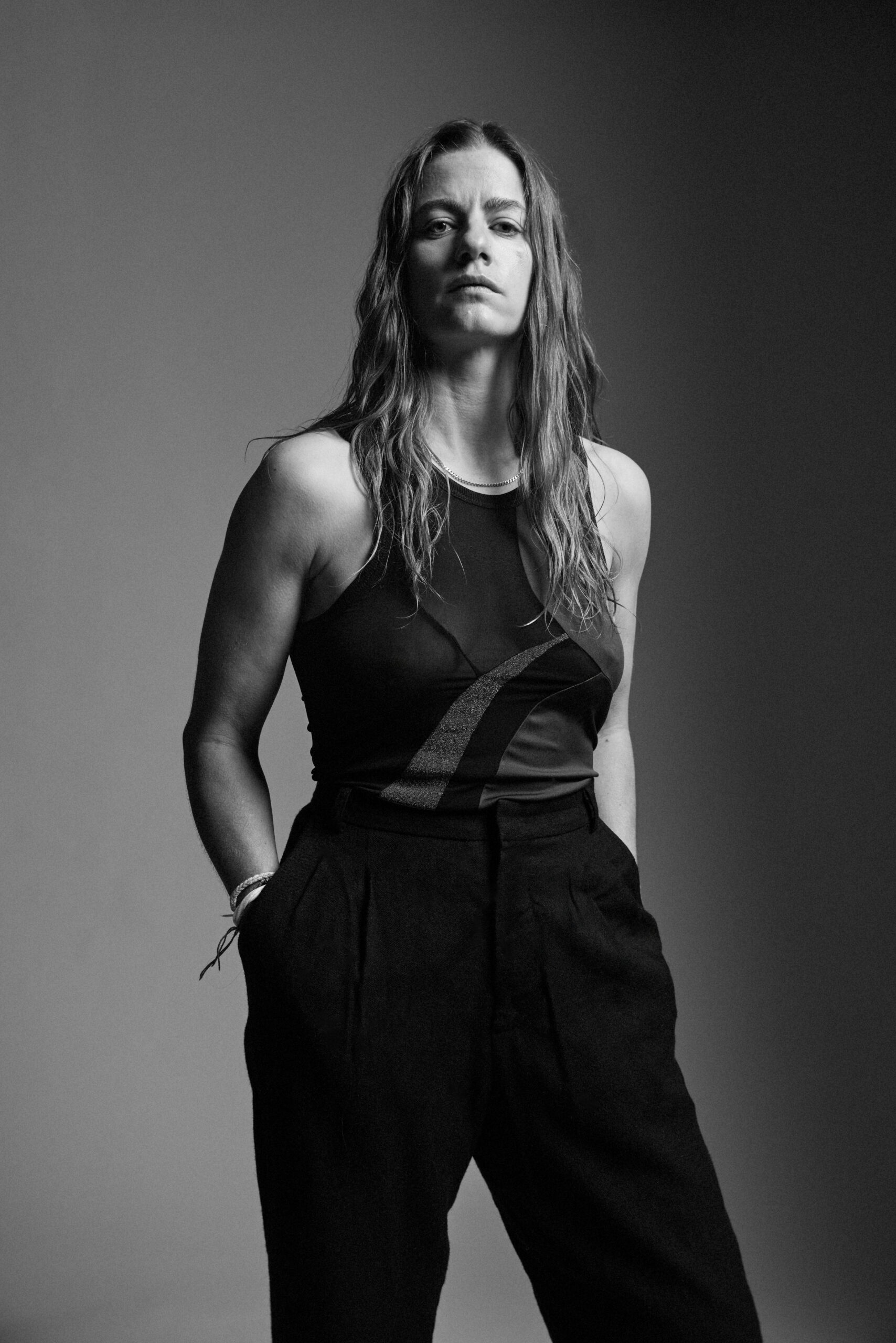
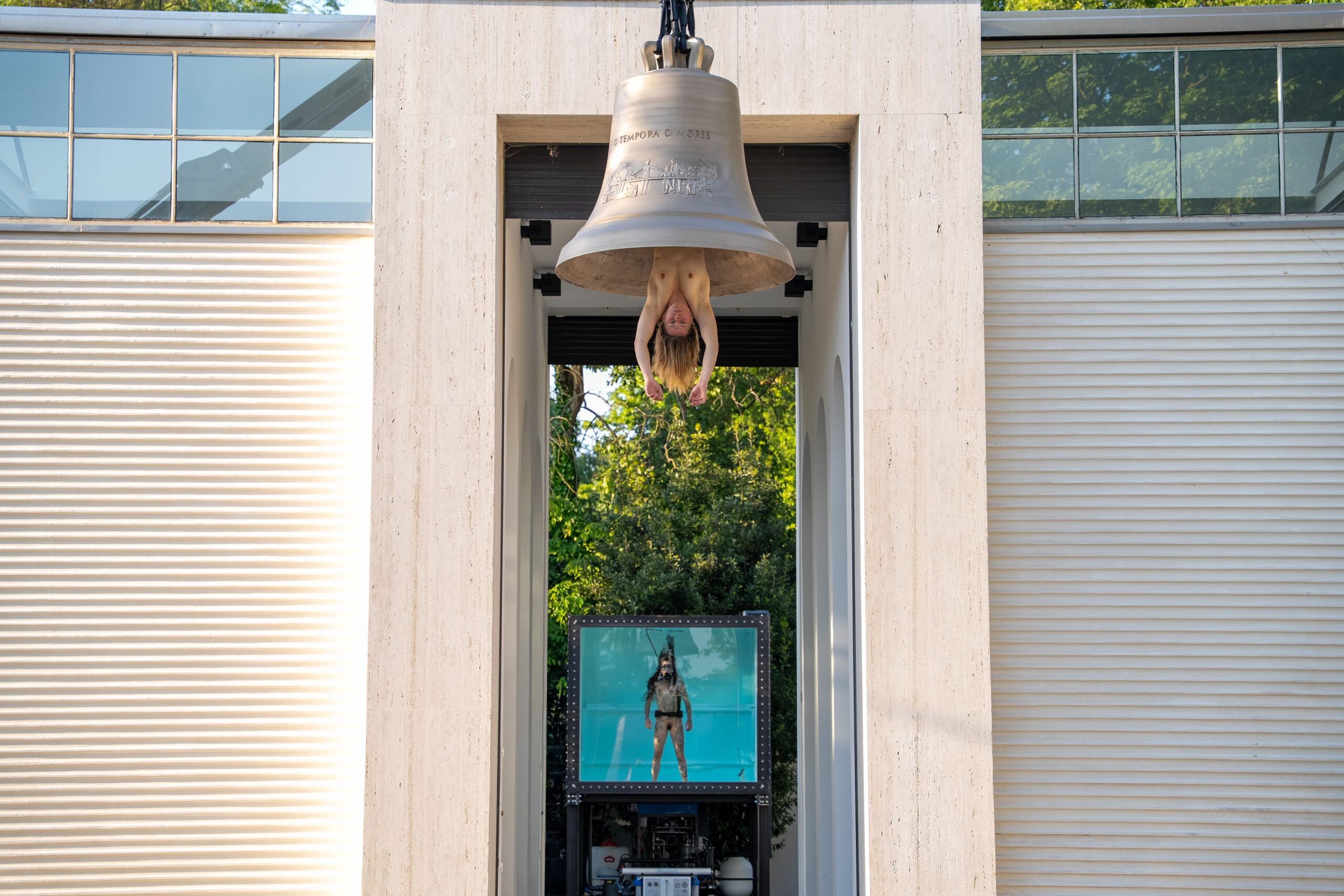
When Florentina Holzinger meets me at a cafe in Venice on a steaming hot afternoon in late June, she has a large, colorful water gun slung over her shoulder. Since May, she’s used it to spray the scorching insides of the giant church bell she climbs up into, dangles from upside down, and strikes by swinging her body back and forth. This extreme action is part of “Seaworld Venice,” her viral presentation at the Austrian Pavilion of this year’s Venice Biennale.
Holzinger, 40, has gained a cult following for her controversial performances on avant-garde theater and opera stages around the world. Nudity, bodily contortions, and extreme acrobatics are mainstays. Body modification is also on the menu: Skin is pierced live. Sometimes, there is blood. Other times, there is urine.
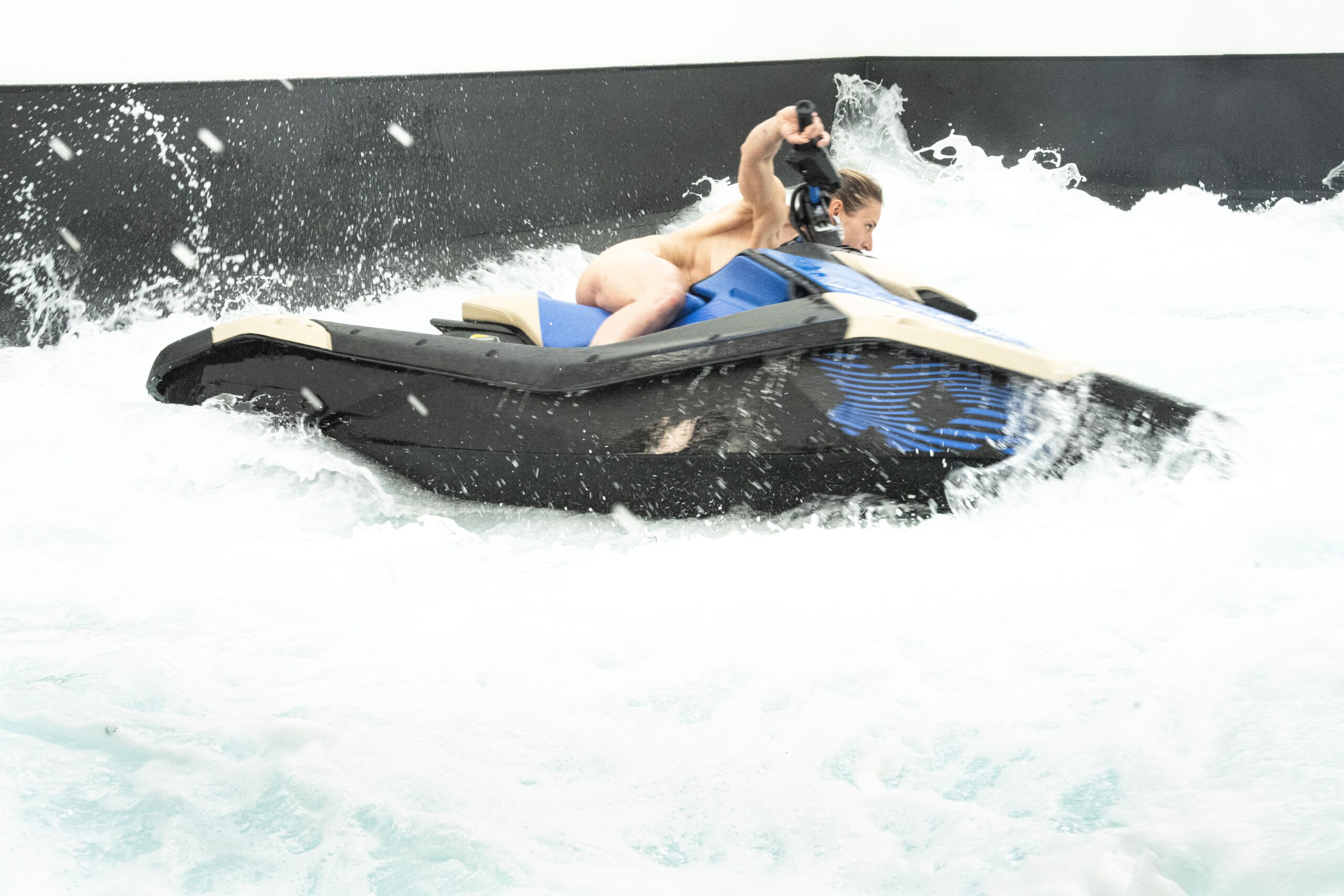
Now, the Viennese dancer, choreographer, and director has made the art world her rapt audience with the Venice Biennale. Inspired by the city’s waterways, she filled Austria’s modernist pavilion with water; in one gallery, a naked woman on a jet-ski spins in dizzying circles. Just outside the pavilion, visitors are invited to urinate in a porta potty. The fluid is then filtered and passed into a neighboring tank, where another performer—naked, of course, except for scuba gear—sits underwater, staring straight ahead. The pavilion has drawn snaking lines to the Giardini and attracted an estimated 2,000 visitors daily.
Holzinger—who, when we meet, is outfitted in a long black t-shirt and shorts—has been living in Lido for the duration of the Biennale. But she retains a busy travel schedule, with additional performances throughout Europe all summer. (From her cool relaxed demeanor, one would never know she’s booked solid.) After the Biennale closes in November, she will take the show on the road, adapting it for presentations at the Gropius Bau in Berlin and the Kunsthalle Wien in Vienna in 2027, and Amant in Brooklyn in 2028.
CULTURED spoke with Holzinger about nudity, structural violence, feminism, and her recent foray into the art world.
What’s your current state of mind?
I’m good. We are no longer in the hot phase of the project here, though temperature-wise, it’s very hot. I’m actually now thinking of other things, but I really enjoy being here and just letting things sink in and have a chance to reflect on it.
Your schedule sounds insane. How do you keep yourself grounded?
Movement helps a lot, which is why I ended up investing so much in the body. And the work itself keeps me grounded. A lot of my friends are part of each production, so, to a certain degree, it’s chill.
How would you describe the importance of the female body in your work?
For any dancer, the body is your medium. So, you work on it, you train with it, and you think with it. I come from this postmodern lineage of dance, where it’s about the thinking body, and not just the body doing random shapes. Where skill becomes a totally different thing, somehow. All of my work is very autobiographical too, so I deal with my own experiences, as a woman, living with this body for 40 years now.
In past interviews, you talked about how, throughout your career, you were made to feel like an outsider. They told you what you did was not dance. In opera, similar reactions. How has being an outsider become part of your work’s identity?
I have grown to like this outsider perspective somehow. I feel it also offers me an excuse to fuck things up. One can only really make radical choices if one is fearless. I like having a little bit of this impostor complex. Even here, at the Biennale, we went in with an attitude to fuck around, because nobody knows us. We have nothing to lose in this world.
I’m interested to understand what goes on in your mind. Let’s take “Seaworld Venice” as an example. Where does your thinking begin?
I try to work quite intuitively and desire-based. I mean, I try to; I don’t know if I actually manage. In a way, I need to come into a space and really feel a strong motivation to want to do something here. I don’t want to torture myself as an artist. For the Biennale, I wanted to bring a real body into its context. It felt like an accomplishment and a challenge. I like the specific architecture of the Austrian Pavilion. I was curious about it. It was striking, too, how a lot of topics here in Venice are topics we have been working on for a long time: climate change, for example. Coming here and seeing the role water plays in Venice, a very amphibious city, it just came together naturally.
Interesting—tell me more about that.
We have worked around similar concerns in the past, so I thought it could be very interesting to take all of our research and see what we can do with it. Of course, I was also provoked by the many paradoxes that arise when doing something in Venice. We are dealing with a city that makes most of its revenue from tourists, but is equally suffering because of tourism. I like when things are complicated, and when you have to question your own role. Should I actually be doing something here? Should I actually be attracting more people to come here? Is this a good or a bad thing for the art, for the city, for myself? All that pretty quickly enabled us to come up with this proposal. The question was, what does the city of Venice need? It doesn’t need anything, of course, but…

The technical side—the engineering, the research—is massive here. Take the filtration system: It converts visitors’ urine into clean water, filling the scuba lady’s tank. Who are the people on your speed dial for such ideas?
We have a big technical team. I work with stunt coordinators, all types of experts. Here in Venice, what brought us to this specific idea was the application procedure. I think you had to hand in about four different papers, one whole page about your sustainability concept. People want to make sure there is some awareness around the topic. Describing our sustainability concept is where this urine idea came from. I mean, we describe it in a visceral and graphic way on purpose, of course: “I live in your piss.” But a lot of people “live” in other people’s urine. I mean, let’s not forget that most water that comes out of taps worldwide has gone through many human bodies prior.
Another theme in your work that comes up is nudity. Why do you think that female nudity is still such a trigger in society?
I don’t know. I try to wrack my brain about it. We learn that many places, the Internet as an example, cannot deal with the naked body. The naked body can only really exist in pornography, and that’s why it needs to be censored beyond those platforms. People seem to be really provoked by seeing a female body without clothes. A body that is not there to either sell itself or to please in the kind of pornographic gaze. We have been experiencing a lot of misogynistic reviews: Why would a woman take her clothes off in an art context? Literally 99.9 percent of the Internet comments have been saying, “You do this to sell yourselves.” I think it’s a bit sad that people would think a woman only has one reason to take off her clothes.
It begs the question, what would your reception be if you were a man?
Oh yes, people would review this very differently. I have been working with naked female bodies for 20 years, so it’s not the first time. What’s interesting here in Venice is that we are surrounded by art history full of naked female bodies, similar to Vienna. So, how can people be so offended by seeing the same thing?
It seems to me it’s more and more important to challenge the unrealistic, overly filtered, edited, or enhanced bodies that fill our feeds.
Exactly. In a world of social media, it’s very important to come to terms with the unfiltered body. For teenagers especially, dealing with their bodies has become hardcore. How can you have self-esteem when everything you see is a polished and sanitized or falsified version of reality? Going to museums, seeing a lot of Venetian paintings of sleeping, naked women. When people come into the pavilion, I’m very often there myself, as a toilet woman [attendants who clean the toilets in the pavilion], and I’m asked every two seconds: “Why are they naked?” I give them a whole art historical lecture about the reclining nude and that it [also] comes from here. Then they are like, “Oh yeah, it’s true, I saw it here at the museum.”
Let’s talk about another big theme in your work: the violence and strain performed on your bodies. There’s so much violence in society, on the news, in our feeds. We can easily become numb, look away. Is shaking us out of our stupor something you aim to do?
That’s definitely something that provokes me. We are living in a very violent world. Especially here in the West, where people would also say things like, “Feminism, that’s a thing of the past, what do you have to complain about?” There is a lot of denial. There is still a lot of structural violence happening. We do work with blood and with notions of pain to point to structural violence. Violence that we have experienced ourselves, in our own lives, which is why we know that it exists.
You mentioned you and many of your cast members are athletes. But how do you train for pain?
It’s not specifically the pain that I train for, but I do have to train for all the individual challenges.
What does hanging upside down in a bell feel like?
That, for me, is not a big deal. It requires some athletic skill because you need to climb up the rope, and then you need to be fine with hanging upside down. And you need to be able to move your body backwards and forwards.
The bashing of your body against steel does look painful.
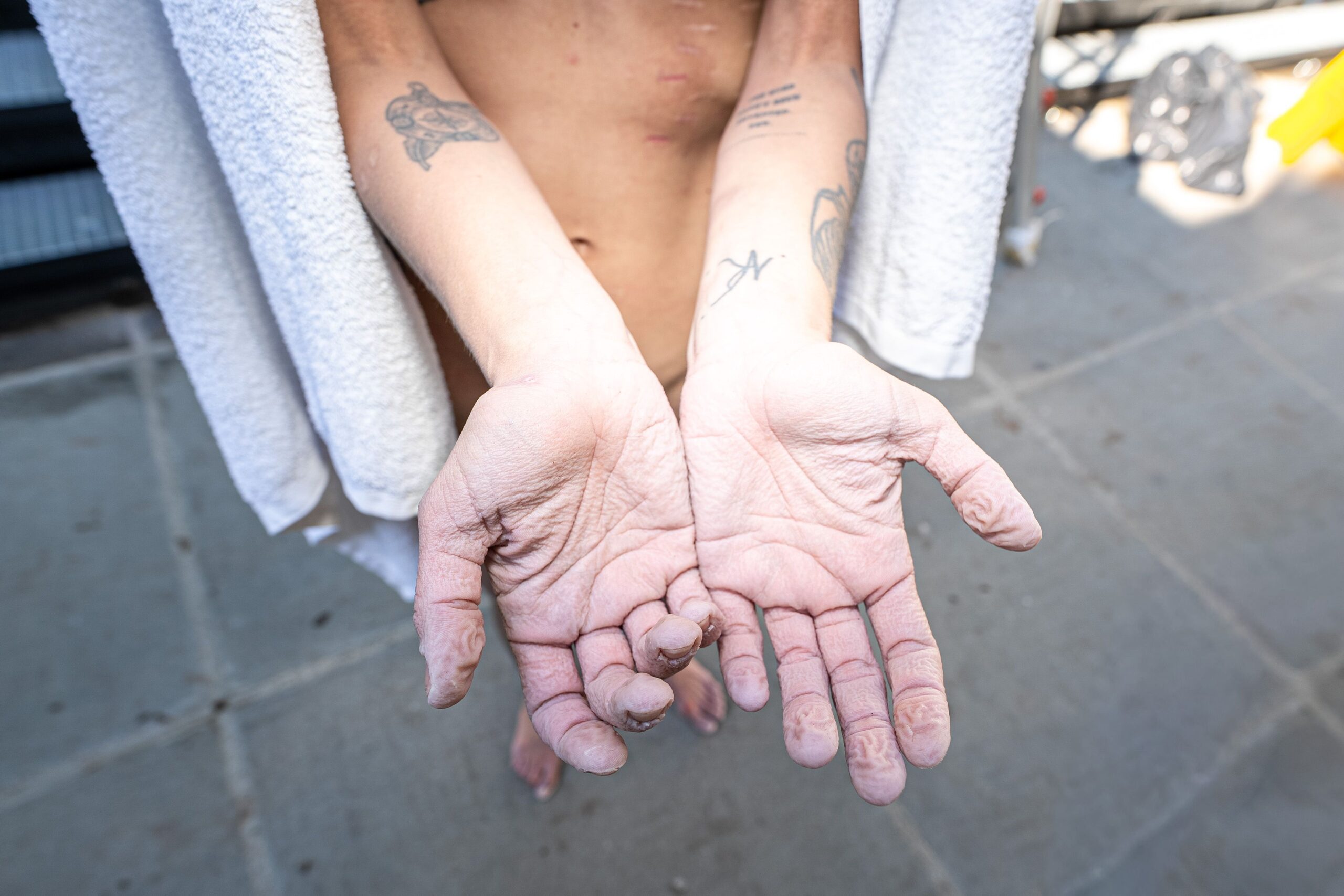
As I said, I do need to train. I guess it’s similar to yoga poses; you just do it and repeat it until it becomes easy for you to do. I’m not saying that it’s ever comfortable. Your harness will always pinch your skin, but that’s a very superficial type of pain, like rock climbing. Some blisters and bruises, not a big deal.
What about hanging from your own flesh, on those meat hooks? That can’t possibly become second nature?
Well, I guess you really need to want to do it, in order to be able to. It’s not for everybody. From my own experience, it has more to do with being mentally very convinced, and then getting to know your body and getting to know how to deal with that kind of unknown pain.
I loved the quote you gave the New York Times: “Kim Kardashian is not considered a pain artist, and she should be.” Any theories on why society finds some self-inflicted pain—i.e., cosmetic surgery—more acceptable than others?
Cultural context tells us what is good pain and what is bad pain. We live in a world where everything that is deemed to optimize the body is considered good pain. It’s great to do CrossFit. You can even pass out or puke. People applaud you because you’re working on your health and fitness. But if somebody would pass out during our performance, people would say you’re completely crazy to be doing this.
Having performed all around the world, have you seen any cultural differences in how your shows are perceived? Have you been surprised by some cultures?
Our most mind-blowing experiences in relation to your question were in Asia. When we were performing in Kyoto, bearing in mind we were performing in an experimental context, we were surprised by how open-minded people were to taking in quite strong imagery. I related this back to the fact that a country like Japan has its own traditions in radical body practices. In Butoh [a form of avant-garde Japanese performance that emerged after World War II], people are doing very extreme stuff with the body. So they were actually less sensitive than many European countries. At the same time, in a country like Japan, misogyny exists to a big degree, you know? So people can really relate to feminist work.
Have you reached any physical limits yet?
Not really. I have quite a good idea about what I can and can’t do. You start small, you build things up, you repeat them over and over. So no limits, but no completely crazy ideas either. I mean, we have lots of crazy ideas, of course, but then we always start small.
It’s clear how big a part your team plays, how much credit you give them, how important they are to you. Can you talk about your cast, your community?
This is a team that has worked together for many, many years, but there are always new people too. I try to keep everyone happy. In the real world, someone usually takes a sanitation job out of economic necessity. However, to clean 2,500 toilets a day in our specific setting, a person truly needs to be conceptually passionate about the work. It is a job that carries so much social stigma.
That’s why it’s been my favorite part. Watching people ask, “Where’s the artist?” while I’m scrubbing the toilet is funny to me, because it exposes a lot of class biases. It’s easy to feel heroic about the bell performance. But to pull off the toilet woman is a whole other level. Many people don’t get to choose this job like us.

I imagine you all sitting together in the evenings and nursing each other’s wounds. Does that ever happen?
With our bigger performances, like the suspension, there is a whole chapter dedicated to aftercare. We do take care of each other, but it’s also quite medical. As I said before, we are not crazy. It’s very important that there is no contamination when dealing with blood. We do a lot of stunts, so we need to heal well. There is a whole healing protocol in place.
What about scarring—how do you feel about that?
Most of us like our scars. My mother is a pharmacist, so she’s always bringing us creams to put on our scars so they disappear. We don’t need our scars to disappear. One of our performers talks about her body being her book. She has a lot of scarification. I’m not working on a book, but it’s okay that my scars are there. They belong to me. Most people’s scars are invisible. Our scars are visible—you can really call them out.
I want to talk about your recent move into the art world, joining Thaddaeus Ropac. Is this a transition, an evolution?
For me, it’s a completely natural evolution. I would never force anything that does not naturally present itself. It made complete sense in relation to doing the Biennale and entering this different world. I always perceived myself as a visual artist anyway.
How did you end up choosing Ropac’s gallery?
To me it was important that Thaddaeus has a passion for the work. And, of course, I checked his list of artists, and thought, wow, that’s just amazing, to be a name among such names.
Was your reception in the art world very different to the reception in the worlds of dance and theater?
It’s been very Biennale specific, you know? The Biennale makes everybody look at you. I’m used to people having opinions about my work, but the visibility here was exceptional. I do believe that the work is very accessible and not just for a small intellectual elite in a cultural bubble. Many people who would not come to our theater shows because they’d be scared end up stumbling into the pavilion. They know they can leave if they want to, but if they are intrigued, they often stay for a long time.
Do you have a vision of what a Florentina Holzinger show in a white cube will look like?
We are planning to take the Biennale show on tour, even though it’s very Venice-specific. We will adapt it a little bit for each setting. Generally, it’s not the nature of our work to take something and just plant it randomly somewhere else, but we have a lot of plans for planting things in exhibition spaces. We are planning something at the Gropius Bau in Berlin and for the Kunsthalle in Vienna. I must say, we have been quite excited thinking about different approaches to show the work in exhibition spaces and white walls. That doesn’t mean that I will turn my back on the theater world.
More of our favorite stories from CULTURED
How Ina Garten, Everyone’s Favorite TV Chef, Learned to Trust Her Appetite
How ‘The Odyssey’ Opening Weekend Birthed Its Own Ticket Resale Black Market
What Do Basketball Stars Talk About in the Locker Room? Fine Art, According to Kevin Love
We Asked 18 Food Insiders Where (and What) to Eat in New York This Summer
Jarrett Earnest on How Lovers Claude Cahun and Marcel Moore Redefined Collaborative Artmaking
Sign up for our newsletter here to get these stories direct to your inbox.





 in your life?
