


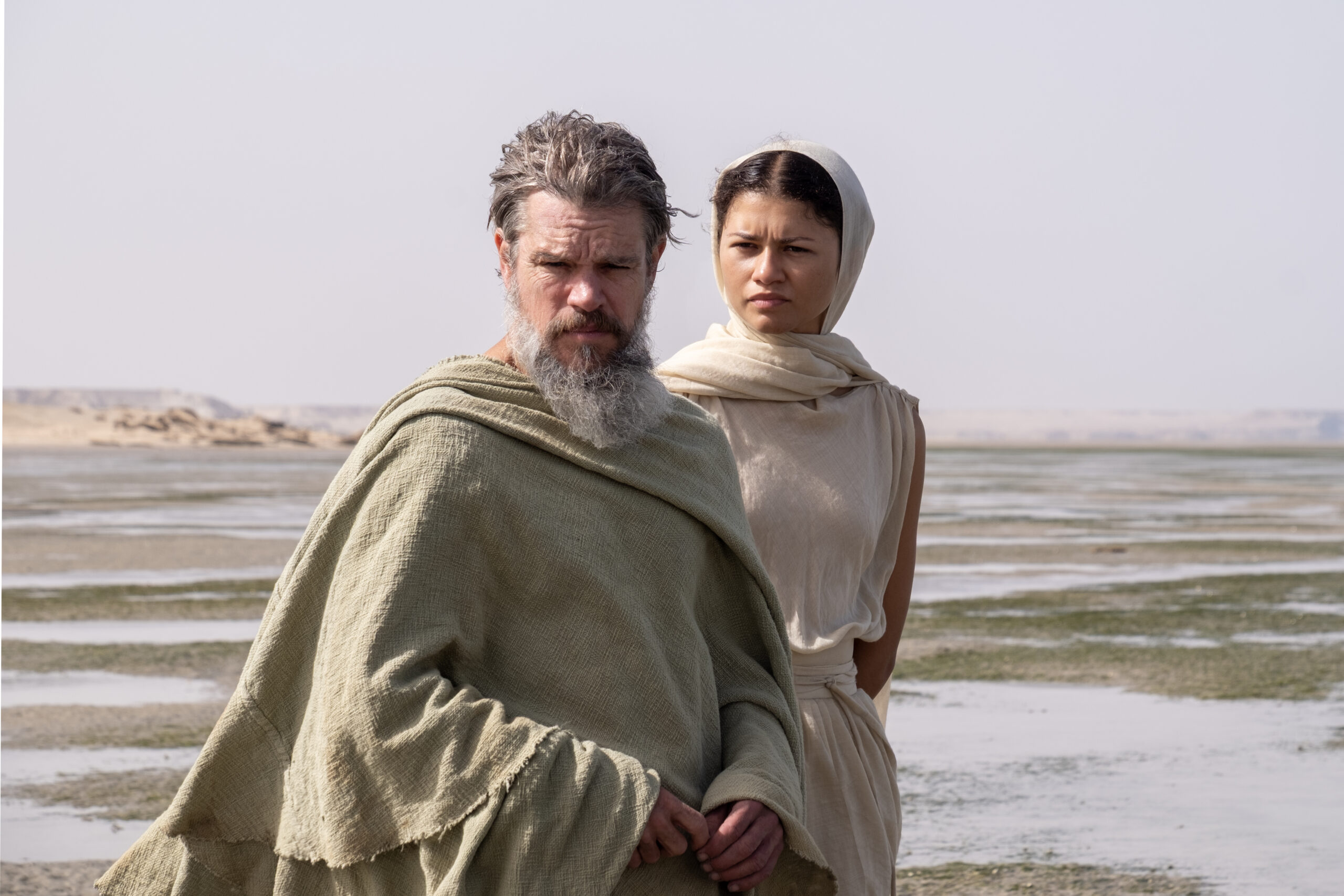
Christopher Nolan’s The Odyssey has been mired in controversy from the outset. One Internet contingent voiced its tired objection to casting Black and trans actors in ancient Greece, another took issue with the historical accuracy of Agamemnon’s blackened Corinthian armor (which, to some viewers, looked suspiciously like the Batsuit). But when the theater darkens, and the film begins, Nolan’s intentions are clear: audiences are greeted not by Odysseus, but by Travis Scott, cast as a wandering bard, bidding us to listen.
This is no servile remake for trads.
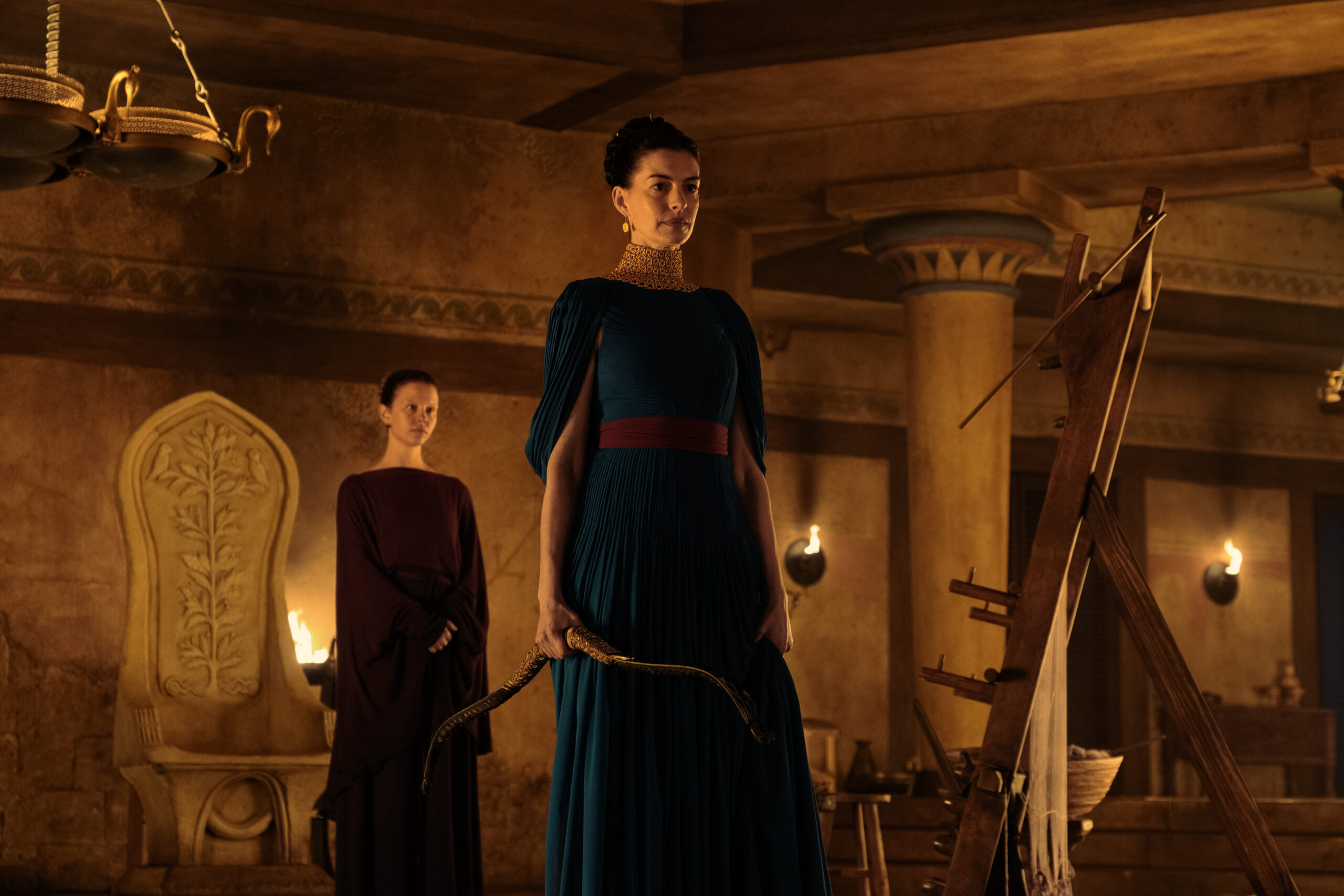
Of course, the story itself remains familiar. Odysseus (Matt Damon, whom the Internet spied shooting, while profoundly chiseled, on the shores of Favignana) is trying to make his way home to Ithaca after the Trojan War. Waiting for him are his wife Penelope (Anne Hathaway)—who is fending off an increasingly aggressive field of suitors—and their son Telemachus, played by an appropriately boyish and green Tom Holland. Chief among the opportunists is Antinous (Robert Pattinson, reliably good). Rather than lay out these threads sequentially, Nolan braids them together in his typical fashion, folding in generous flashbacks—including the fan-favorite Trojan Horse. As the film unfolds, one sees three decades’ worth of Nolan’s obsessions converge: sweeping military logistics (Dunkirk) the globe-spanning spectacle (Inception), mythic heroism (the Dark Knight films), and the fractured chronologies that have defined his films ever since Memento. Time has always been malleable material to Nolan, and Homeric poetry, with its stories nested inside stories, is right in his wheelhouse.
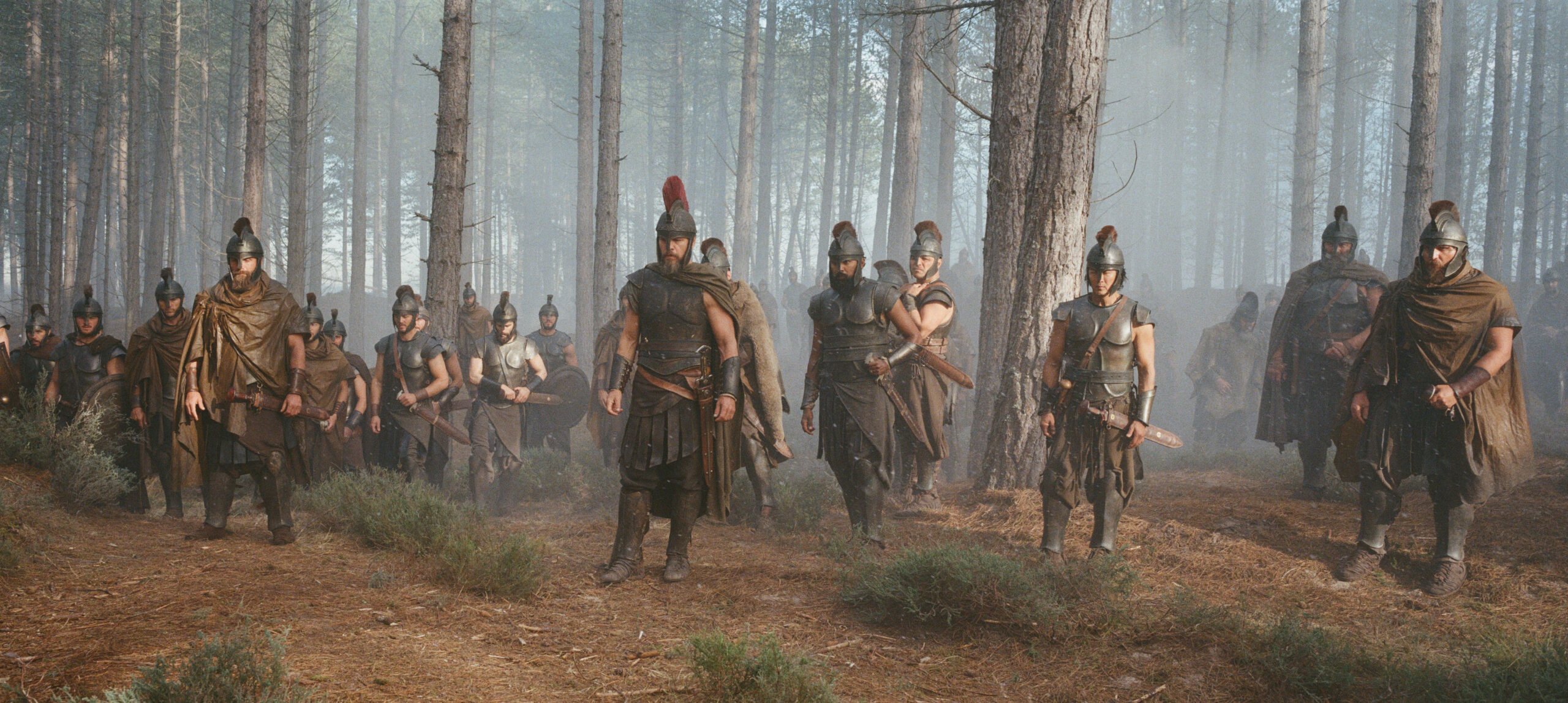
Despite months of frenzied online speculation over who would play whom, the supporting cast remains surprising while never devolving into the usual game of celebrity spot-the-cameo. (Benny Safdie’s Agamemnon, for instance, spends much of his screen time hidden beneath a crested helmet.) This is a markedly less playful ensemble piece than Oppenheimer. Nolan treats his albeit modern take on The Odyssey with almost liturgical solemnity, returning again and again to the Greek idea of nostos—not simply homecoming, but the moral work required to deserve one.
That emphasis is the film’s real kinship with Oppenheimer. Both ultimately center men living with the consequences of their own civilization-altering decisions. If Oppenheimer was haunted by the knowledge of what one man could unleash, The Odyssey is burdened by what one man believes he must carry. Here, Odysseus’s 20-year exile is something he quietly imposes upon himself rather than suffers at the hands of the gods.
The chatter abounds, as do the interpretations. To keep things simple, CULTURED broke down the essentials.
Tickets Might Cost You More Than a Plane Ticket
There are six different ways to watch The Odyssey, each with its own aspect ratio—enough that Universal released explainer videos to help audiences navigate the options. But there’s only one version Nolan actually built the film for: 70mm IMAX. The Odyssey is the first feature-length film ever shot entirely on IMAX film cameras, and only 25 theaters in the U.S. and 41 worldwide are equipped to project it that way.
That scarcity transformed tickets into collectibles months ago, before audiences had seen more than a teaser. Advance sales for the true 70mm screenings disappeared within an hour, while opening-weekend seats at New York’s AMC Lincoln Square soon appeared on resale sites for as much as $999 a pair. At that point, you might as well fly to one of the six countries where the film was primarily shot (Morocco, Italy, Iceland, Scotland, and Greece) and try your luck there.
Matt Damon Is Yoked
The 55 year-old’s bod is functioning as effective guerilla marketing for the film. Looking to get “lean but strong,” as Nolan put it, Matt Damon dropped weight to give the character the look of a body worn down by decades of war and years lost at sea. He got to 167 pounds, a number he hadn’t hit since high school—and the paparazzi liked it. Photos of Damon’s washboard abs on location in Sicily circulated for months.
Casting Controversy Says More About the Internet Than the Movie
Lupita Nyong’o’s casting as Helen of Troy—the face that launched a thousand ships, canonically the most beautiful woman in the world—set off a swath of the right-wing Internet, including Elon Musk, before a single frame had screened. Trans actor Elliot Page drew a similar reaction when fans speculated he’d been cast as Achilles. His actual role is Sinon, who does appear in the wider Trojan War myths—Virgil’s Aeneid, mainly—but not in Homer’s Odyssey at all. Some of the loudest complaints about “historical accuracy,” in other words, came from people invested enough in defending Homer to be furious about the casting, but not enough to know which poem they were referencing.
Nobody Talks Like They’re in a Toga Epic
There’s no faux-Shakespearean cadence here, no “thee” or “thou.” The dialogue is contemporary, and occasionally blunt—a choice that traces directly back to the version of The Odyssey that Nolan built the script on. He’s cited Emily Wilson’s 2017 edition, the first English Odyssey ever translated by a woman, celebrated (and mocked) for rendering Homer in direct modern English. (Her famous opening line calls Odysseus a “complicated man,” a choice she spent years on, and one that some readers still debate.)
Nolan echoed the same plainness in his film’s dialogue, even taking things further: Telemachus calls Odysseus “dad” instead of “father,” a bid for emotional rather than intellectual impact. The effect is dialogue that lands in the chest, rather than holding the audience at a formal, textbook distance.
There’s a Goya Painting Behind the Cyclops’s Face
To bring Polyphemus, aka Cyclops, to life, Nolan skipped CGI almost entirely (a well-known predilection of his) in favor of a 60-foot mechanical puppet, using a combination of animatronics, robotics, and a live performance from Bill Irwin, who also operated and voiced TARS, the robot in Interstellar.
Nolan modeled the creature on Francisco Goya’s Saturn Devouring His Son and took cues for the film’s monsters from Guillermo del Toro, who told him “a monster is not a monster”—it has to be treated like any other character, not a threat in a rubber suit.
Samantha Morton Is An Oscar Contender
If there’s one thing everyone seems to agree on, it’s that English actress Samantha Morton steals the movie as Circe—the witch who turns Odysseus’s men into pigs in one of the film’s more grotesque body-horror sequences, and something of a cult-favorite figure among Homer die-hards despite her small share of the text. Morton’s take earned a round of applause from the cast and crew on set—the first time that’s happened since Heath Ledger played the Joker in The Dark Knight, according to Nolan. He’s gone even further in interviews, telling the L.A. Times that “the film lived or died over that character. She was the fulcrum.”
It’s a startling claim for a handful of scenes in a three-hour epic—and Nolan has notably kept every image of Morton in character out of the marketing so far, which only makes the rush for tickets that much more titillating.
More of our favorite stories from CULTUREDBowties in Public, Rubber Curtains at Home: Inside the NYC Loft of a Revered Modernist Starchitect
Introducing CULTURED’s 2026 Young Collectors List
12 Burgers, 10 Snapper Crudos, 1 Rabbit: These Are the Rarest Dishes in New York
Here Are the Books Young Writers Can’t Stop Turning to for Inspiration
Sign up for our newsletter here to get these stories direct to your inbox.






 in your life?
