


“And I Saw New Heavens and a New Earth: The Partnership, Art, and Activism of Claude Cahun and Marcel Moore”
Contemporary Art Museum St. Louis | 3750 Washington Blvd
Through August 9
Even more so than with most couples, whatever happened between them is essentially unknowable. Strategically, across many decades, the artists who came to be known as Claude Cahun and Marcel Moore made the contours of their relationship tantalizingly opaque. In 1909, they met as schoolgirls in Nantes, in France’s Loire Valley. Lucy Schwob (Cahun) was 14 years old and Suzanne Malherbe (Moore), 16. Their connection was instant—true, teenage, head-over-heels, all-or-nothing mode. We have no idea how Schwob’s father went from being unsettled by their attachment to marrying Malherbe’s mother eight years later, a union that made the young lovers stepsisters, but that’s what happened. It’s emblematic of the strange circumstances and profound ambiguities that would characterize their lives together.
Schwob wrote, Malherbe drew. From the beginning, they took pictures, usually with Schwob in front of, and Malherbe behind, the camera. One early photo, from 1915, shows Schwob with a wavy, jaw-length bob, wearing a sailor suit with a little bow tied at the throat; like a thoughtful student, she studies two large volumes, one open on top of the other. We can see that the bottom spine reads: L’Image de la femme or The Image of Woman. Already, there is that sly humor and slippery self-reflection—the gender-ambiguous adolescents are thinking with, against, and through images. And the set-up is important. The person looking at Schwob, who she is performing with and for, is Malherbe: The resulting photograph is something between them.
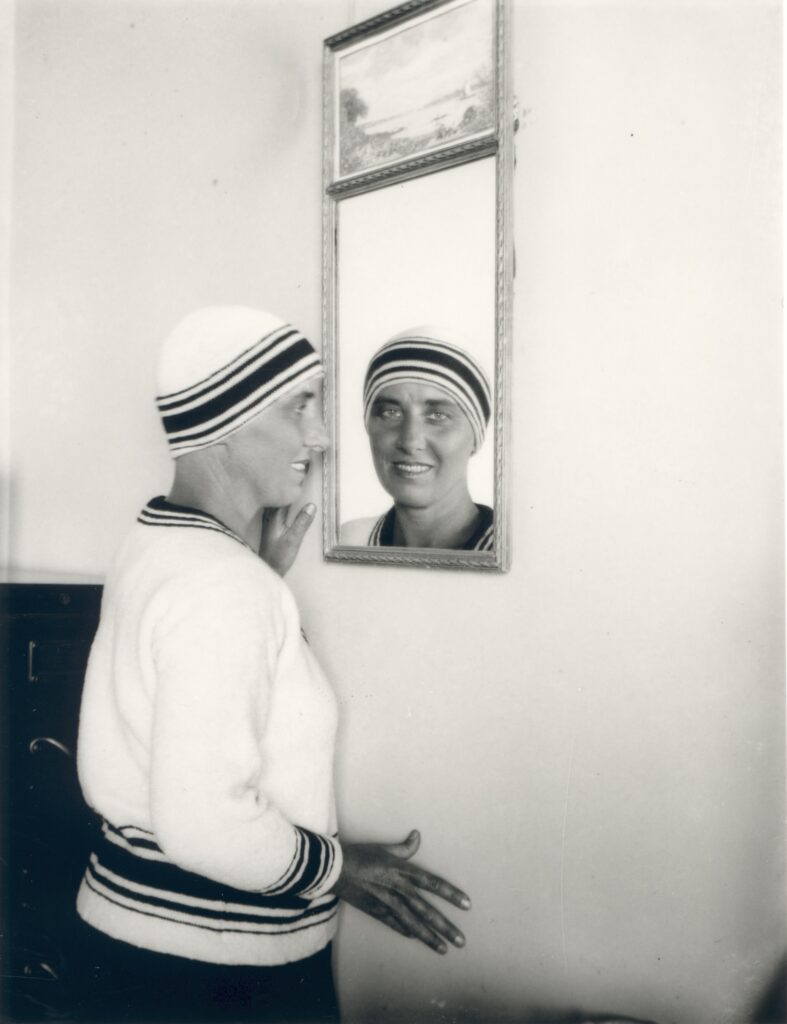
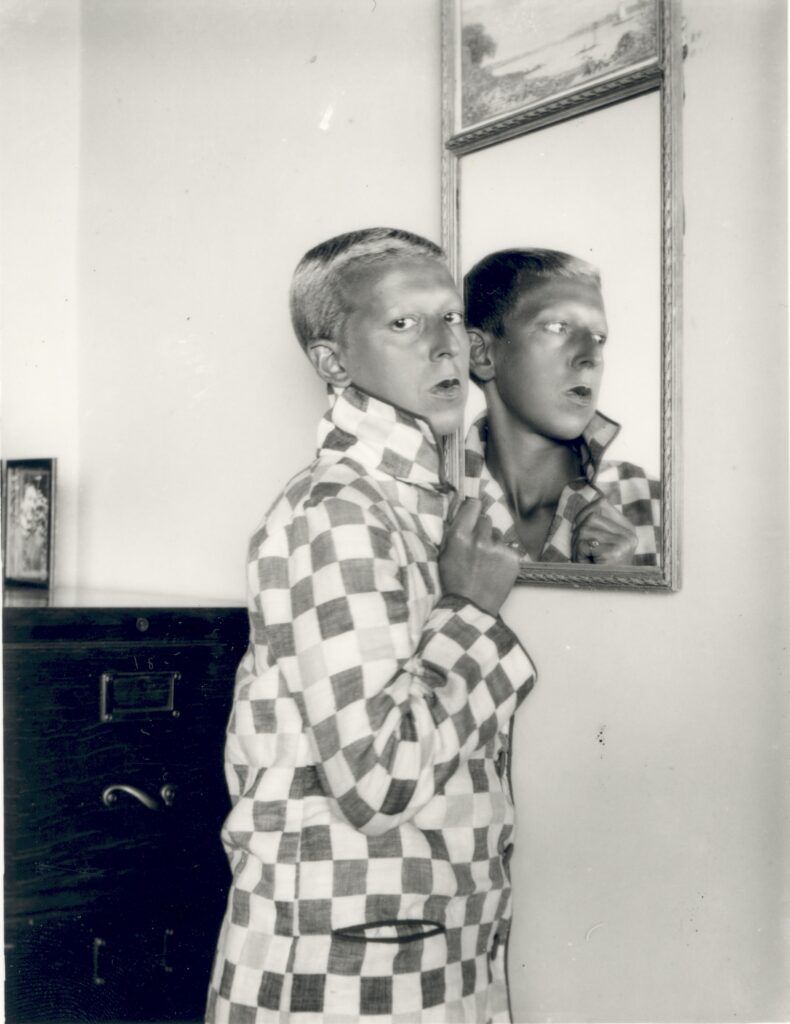
By the 1920s, the pair had adopted their masculine pseudonyms. Well-connected through a famous uncle, Marcel Schwob, and free from the burden of making a living thanks to their prosperous family, the couple seamlessly entered the lesbian literary scene as well as the macho milieu of the Surrealists—otherwise mutually exclusive subcultures. The photos taken in their Paris apartment roil at exactly that intersection: Cahun with a shaved, elongated, alien-like head, or with a bleached crewcut and checkered coat, face pressed against a mirror, looking back at her partner. The photo has a mate, taken at the same time, with Moore standing in profile by the mirror, wearing a tight knitted cap and matching sweater; her smiling reflection stares into the camera. Looking at the picture, we’re meeting her eyes through Cahun’s own.
Virtually all of their works are currently on view in “And I Saw New Heavens and a New Earth: The Partnership, Art, and Activism of Claude Cahun and Marcel Moore” at the Contemporary Art Museum St. Louis. Curated by Dean Daderko and Svetlana Kitto, the exhibition clusters small-scale prints both chronologically and thematically—from their earliest experiments to Moore’s photo-collages for Cahun’s 1930 book Cancelled Confessions or Disavowals, to a section devoted to their cats—contextualizing the couple’s photographic work alongside documents, ephemera, drawings, and the taunting underground propaganda they produced during World War II. Importantly, “New Heavens” is an institutional acknowledgement of the defining collaborative nature of Cahun and Moore’s work, which poetically presents their inextricability as artists.

When a trove of their then-almost-unknown photographs resurfaced in the 1990s art world, the confrontational pictures of a glamorous, non-conforming Cahun—which are today iconic, often-cited images of a queer-Modernist lineage—were deemed “self-portraits.” Or they were understood as burlesque explorations of female identity in the mode of Cindy Sherman, effectively disappearing the co-authorship of Moore to better fit into art-historical and museological frameworks. (Even a book with the best intentions, such as Jennifer L. Shaw’s 2017 biography Exist Otherwise: The Life and Works of Claude Cahun, replicates this bias.)
For decades, lesbian scholars, Tirza True Latimer chief among them, have argued to reframe the work as “co-productions,” a categorization that, on its face, would appear to be irrefutable: There is no way to demarcate the sole creative output of Cahun as a visual artist, nor any evidence that such an authorial distinction mattered to either member of the couple regarding the photographs. Nevertheless, the designation “self-portrait” largely remains (for instance, check Wikipedia).

Cahun and Moore prefigure not an artist like Sherman, who fits neatly into the commodified role of the singular art star; they more closely resemble the almost unclassifiable outliers Genesis and Lady Jaye Breyer P-Orridge in their Pandrogyny Project of the late 1990s and early 2000s. Under the most expansive conception of collage, they “cut up” and recombined words, pictures, sounds, behaviors (private and public), as well as their own bodies through a series of surgeries to become not simply more alike, but newly a plural being, to confuse and collapse binary logic: male and female, self and other, and, most especially, life and art. The lighthearted grandeur of Breyer P-Orridge’s ambitions, emerging as they did from the largely unseen dynamics of daily life, helps us see, as in a mirror, the deeper implications of Cahun and Moore’s all-consuming collaboration.
During World War II, they lived on the Channel Island of Jersey, where they’d vacationed since childhood. As the Nazis invaded France and occupied Jersey, they stayed when they easily could have left for London (they had the means and were fluent in English). When ordered to surrender all cameras, radios, and typewriters, they hid theirs away. For the next four years they waged a quixotic psychological campaign against the Germans, writing hundreds of notes from the vantage of deserting soldiers about the futility of war, altering their vocabulary and the keystrokes on their typewriter to create the illusion of a greater resistance network.
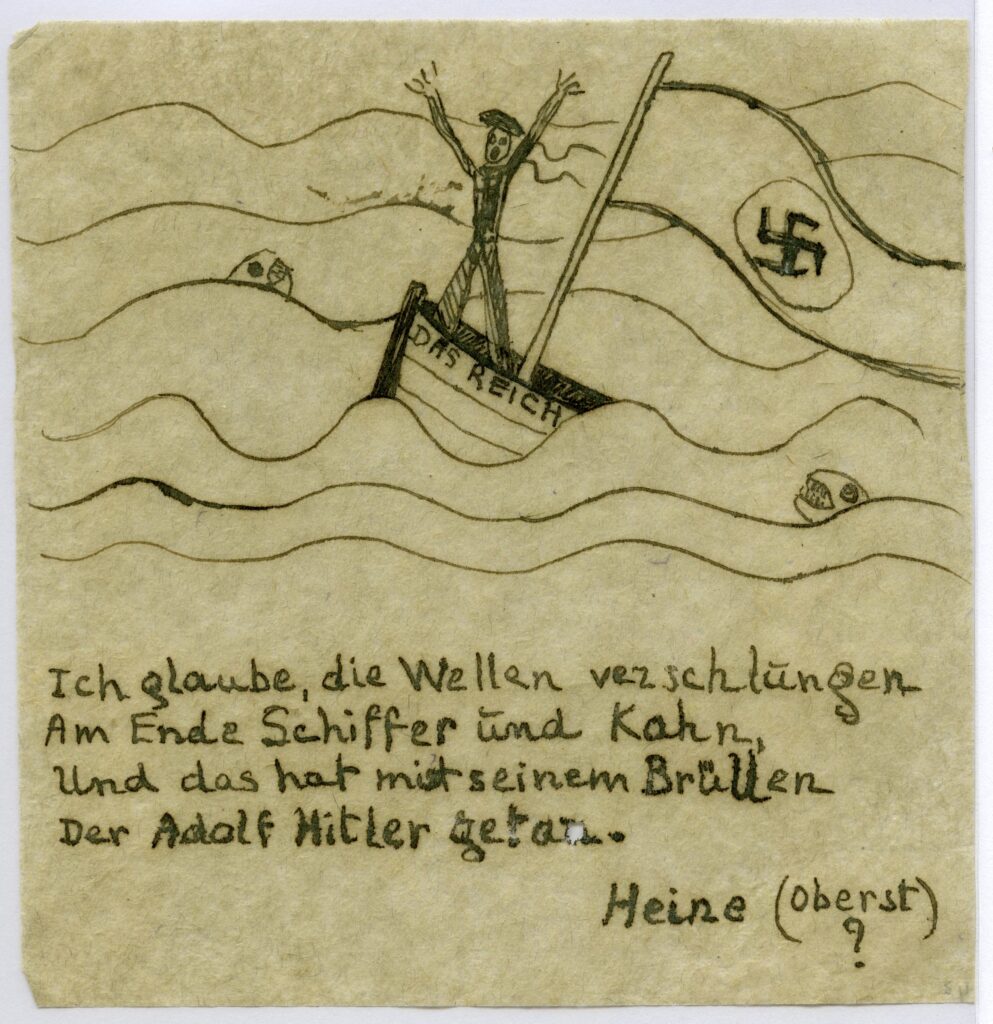
Among the examples of this output in the exhibition’s vitrines is a slip of paper, handwritten in German: “Down with Hitler! Down with your non-German vampire who drinks the blood of our youth! Down with war!” signed in their usual manner from “The Soldiers Without Names.” Another, the size of a Post-it, shows a comic sketch of a sailor waving his hands, his mouth and wide eyes recalling Munch’s Scream, standing on the prow of a sinking ship labeled “DAS REICH” with a large swastika flag. (“I believe the waves swallowed up / Both the sailor and his boat in the end, / and that’s what Adolf Hitler / did with his roaring,” the translated caption reads.)
On the island, Cahun and Moore were familiar characters, regarded as eccentric sisters, and they used this to their advantage, often dressing as harmless old ladies to disseminate their propaganda. A lifetime of questioning societal structures as well as weathering ridicule as both avant-garde artists and lesbians had prepared them to resist fascism like few others. Ultimately, they were arrested in July 1944 and remained imprisoned for the rest of that year, sentenced to death.
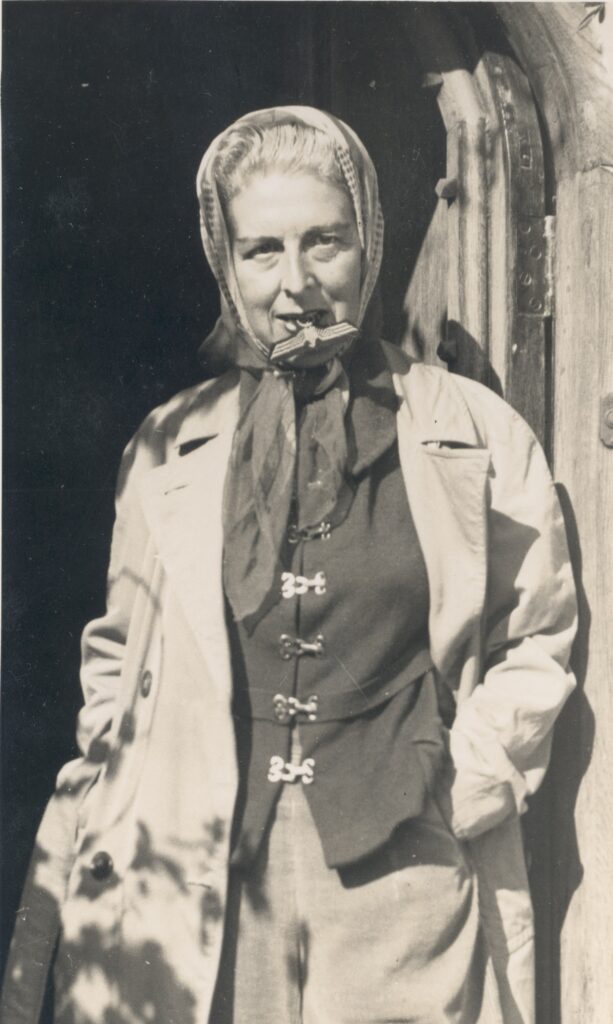
Hanging on the wall above a case displaying their wartime efforts is a photograph they made shortly after their release and the island’s liberation in 1945, which shows Cahun in the doorway of their home wearing a trench coat, kerchief tied beneath her chin. Dangling from her mouth is a Nazi badge, the eagle upside-down, swastika held between her teeth. Looking directly into the lens, her mouth a slight smile, eyes triumphant, she’s like the cat who caught the canary. It is an image of such wry eloquence, and a testament to such authentic bravery, it could be the very definition of Queer Pride, if by queer we mean weirdos seeking an expansion of freedom—erotic, psychic, artistic—a project to which their art and lives attest.
The inscription on Cahun’s tombstone—“And I saw new heavens and a new earth”—provides the beautiful title for the exhibition, and the very last work in the presentation is a photograph of her grave, taken by Moore. Its presence is devastatingly poignant and almost polemical, demonstrating one last time that Moore, the less visible of the artists, was always there—the one clicking the shutter.
Jarrett Earnest is a writer, curator, and the host of “Private Life,” a podcast from the New York Review of Books.
More of our favorite stories from CULTURED
Bowties in Public, Rubber Curtains at Home: Inside the NYC Loft of a Revered Modernist Starchitect
Introducing CULTURED’s 2026 Young Collectors List
12 Burgers, 10 Snapper Crudos, 1 Rabbit: These Are the Rarest Dishes in New York
Here Are the Books Young Writers Can’t Stop Turning to for Inspiration
Sign up for our newsletter here to get these stories direct to your inbox.




 in your life?
