


To map Mallett’s picks and plan your route, enter the Critic’s Table hashtag #TCT in the search bar of the See Saw app.
Not to be all FLINTA about it, but Elizabeth Street has quietly drawn some of the downtown New York gallery scene’s greatest doyennes. Since Sophie Morner’s Company Gallery moved there in 2021 (cross street: Broome) and Lia Gangitano’s Participant Inc. in 2023 (between Broome and Grand), it’s taken vague shape in my mind as a place to be, even if it’s not usually identified as a proper micro-district. And why not makes sense—it’s not as dense as other hotspots where galleries appear one after the other, right next door, and Elizabeth Street isn’t home to a high concentration of the youngest upstarts, like Henry Street (many of the establishments here are 10 or 20 years old).
Nor are its outfits laser-focused on the market (if that’s the game you want to play, you’d move to Chelsea or Tribeca). Instead, what you can find is a decidedly downtown intergenerationality. I could name more than a few examples of galleries steadily supporting mid-career artist’s artists, as beloved at a biennial as they are at the club. They’ve fostered communities (if that word isn’t completely ran through). You know who you might run into if you go to any of their openings. And, even if it’s not by design, they all ended up neighbors; there’s some connective tissue here, a healthy overlap in their social bonds. Usually, the openings on Elizabeth Street are where I most want to be seen.
Ulrike Müller
Hoffman Donahue | 99 Bowery
Through October 24
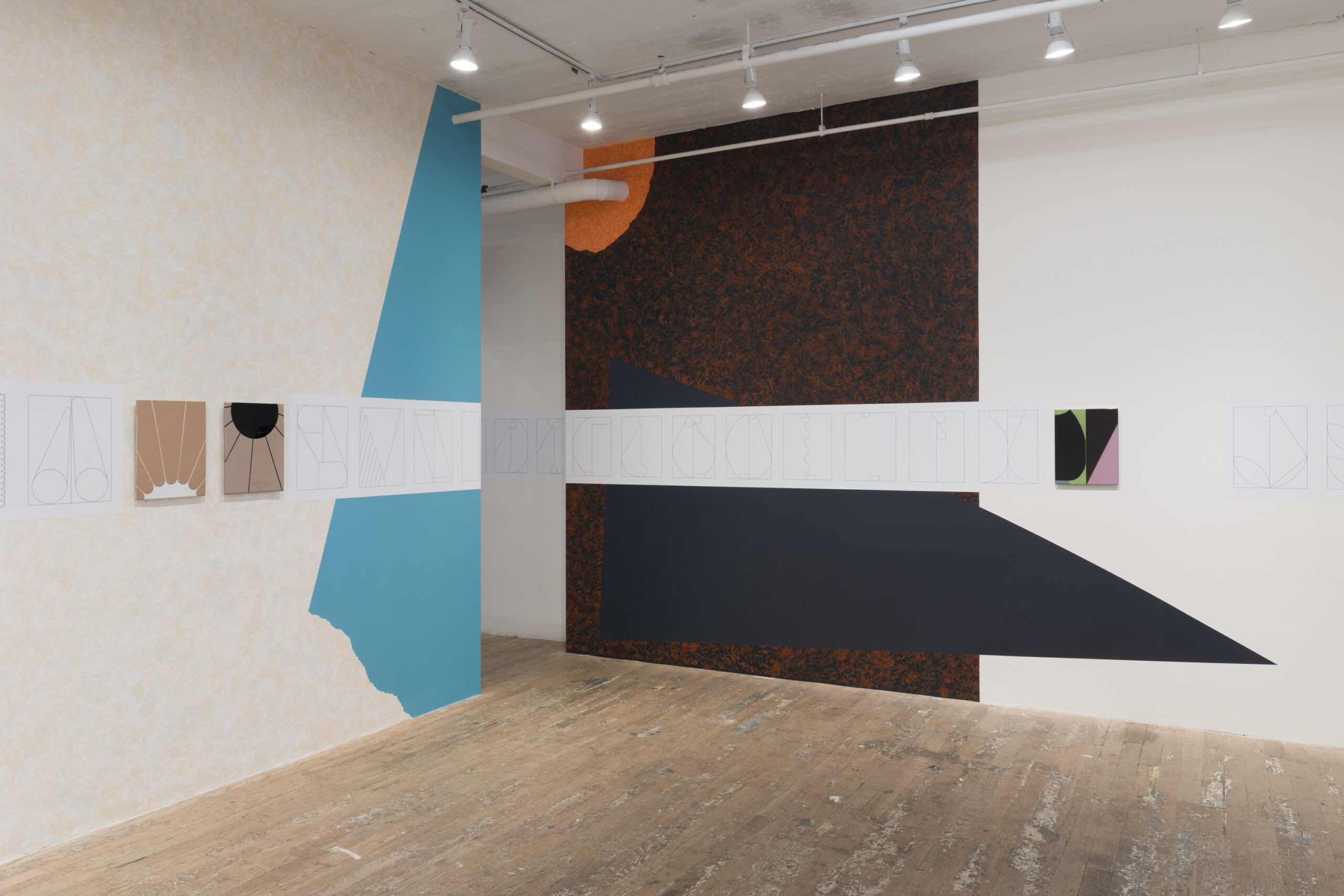
My first stop on this tour is the honorary mention in the Elizabeth Street category, Hoffman Donahue (which is technically a block away, on Bowery). When Hannah Hoffman and Bridget Donahue merged their galleries last fall, the newly bicoastal venture retained the latter’s 99 Bowery address as its New York outpost, as well as many of the artists who’ve long shown with Donahue since she opened her place in 2015—among them Martine Syms and Jessi Reaves, younger stars who ascended under the dealer’s care, and legends like Lynn Hershman Leeson and Susan Cianciolo who made their marks in the 1970s and 1990s respectively. On Wednesday, September 9, as the art season kicked off, I attended the opening of Ulrike Müller’s solo exhibition. In “Walkthrough,” as it’s titled, the geometric language of the artist’s enamel-on-steel wall pieces are magnified in sponge-painted forms on the gallery walls. Big shapes in salmon, lavender, orange, aquamarine, brown, and black refract the funky design motif pipeline from Kandinsky and Eames to Formica countertops and Flora Kung frocks.
It’s a nod to retro, sure, but the treatment here is nothing like vaporwave’s winking appropriation of Jazz solo cups. Müller (b. 1971, Austria) rather taps into the shared language of Modern design as part of an ongoing and earnest investigation into the threshold between figuration and abstraction, edging the line of meaning and needling the collective grammar of visual signification. While the wall murals hover decidedly in the realm of the abstract, some of the sketchbook-scale paintings tilt more representational (a semicircle with radiating lines is a sun… maybe). These paintings are distributed across the gallery’s sponge-painted walls, while a series of black-and-white studies extends in a continuous line between them.
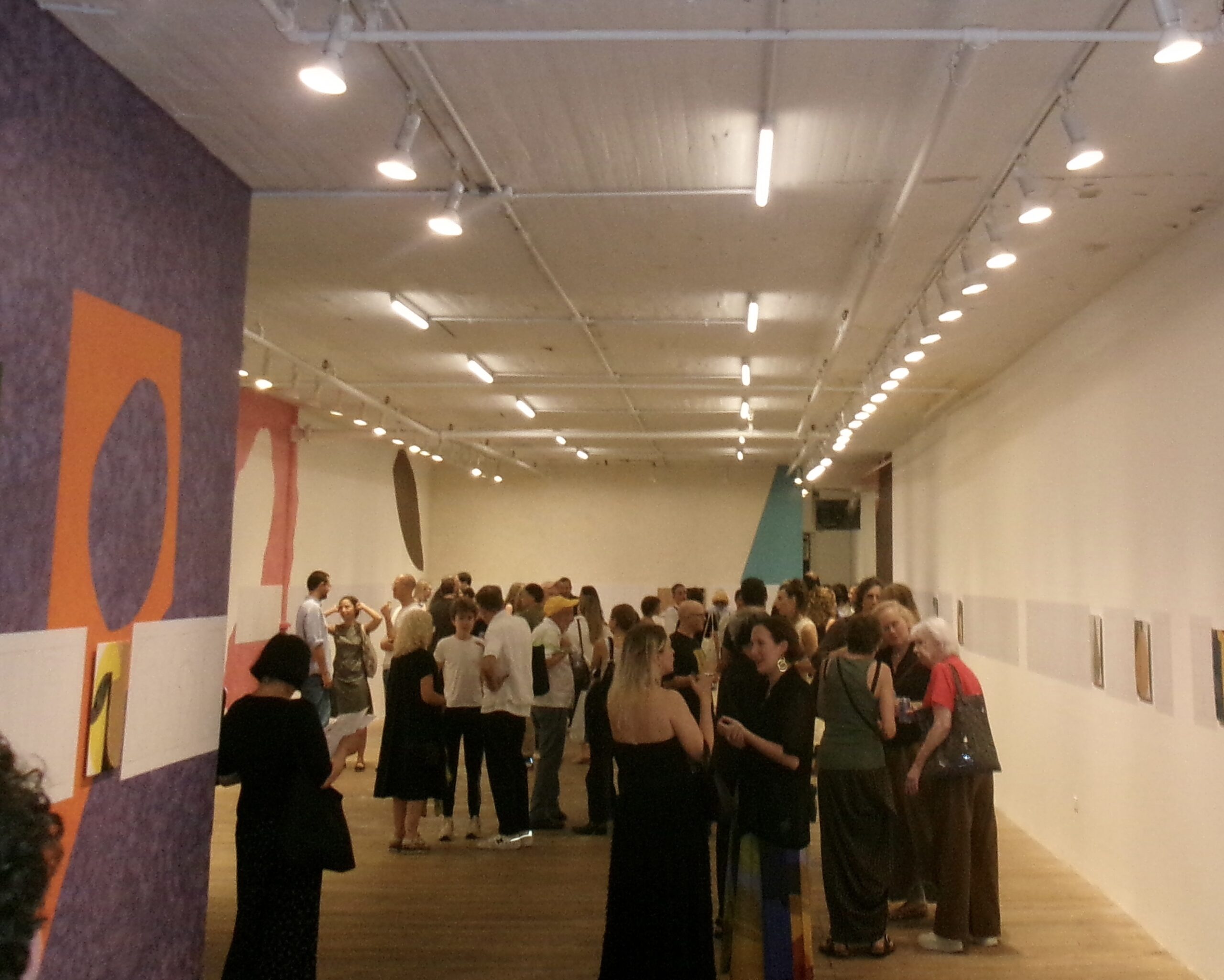
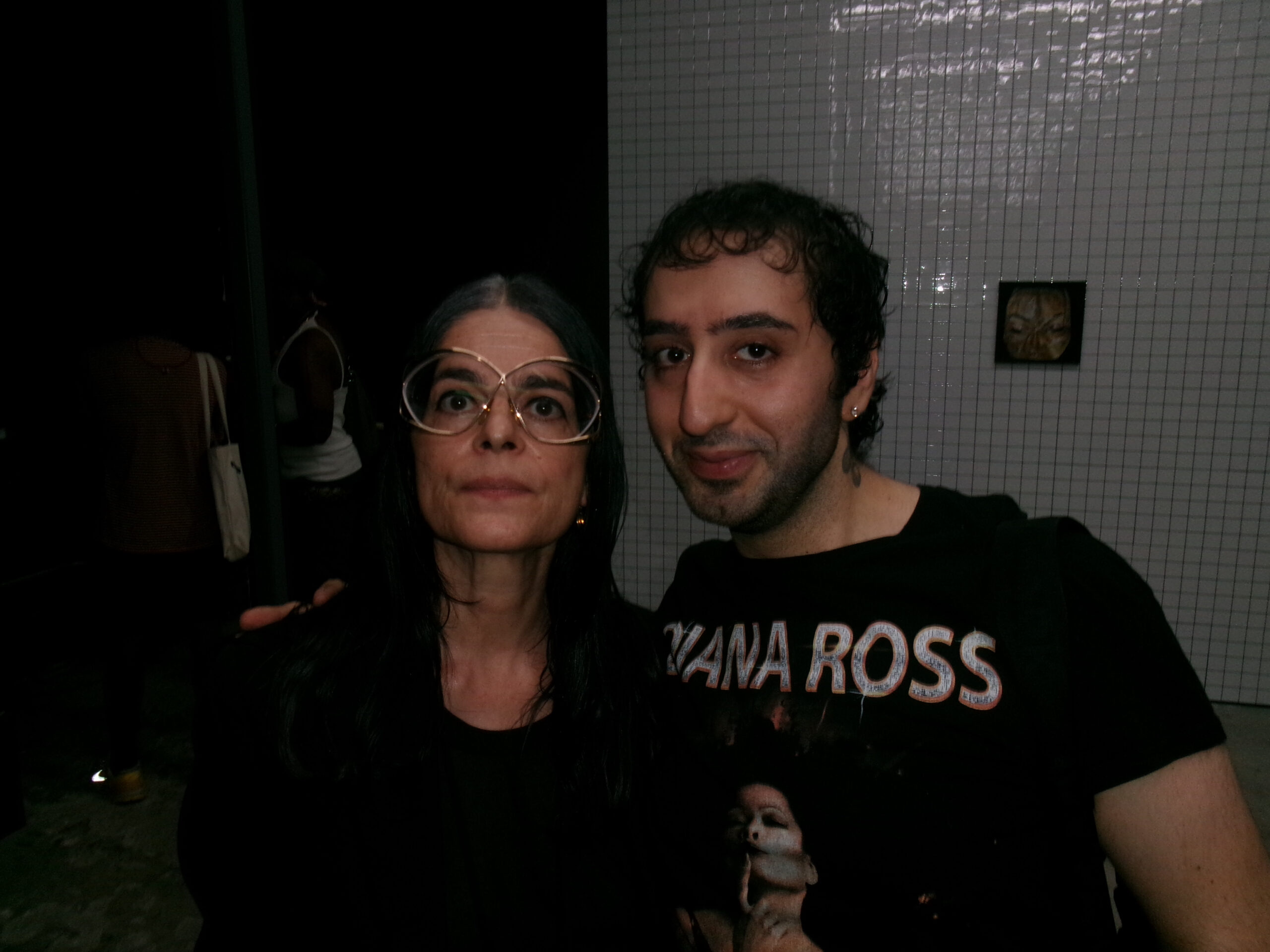
At the opening I chanced upon my editor Johanna Fateman (coming from the Rachel Comey fashion show, where the designer launched her collection inspired by the late Pop artist Rosalyn Drexler) and K8 Hardy (who worked with Müller on the early 2000s queer art journal LTTR). Also there: artists Nicole Eisenman, JD Samson, and Raúl de Nieves. Some of them had hit the Alix Vernet, Sarah Zapata, and Mark Armijo McKnight openings in Tribeca on the way, the crush of everyone’s ambitious social calendars in the air. Sylvia Kouvali, Müller’s London gallerist, was freshly landed with a suitcase of monographs. “You have to meet the woman who gave me my first and last big opportunity in the art world,” a friend of mine said by way of introduction.
The next night, I had Company Gallery and New York Life Gallery on my dance card, but first, I stopped by a couple of openings in Chelsea (Eric N. Mack and also George Rouy, who I did a talk with over the weekend). Then, I split a cab downtown with artist Jeanette Hayes, who piqued my curiosity about the Jerry Hsu show (gonzo street photography) at Rectangle Room. So I made a quick stop there, where more skaters crowded the street outside than could fit inside the humble bookshop and exhibition space housed in a storefront photo lab. Since opening Rectangle last December, Tim Barber is “running it like the Navy,” per Hayes.
John Edmonds
Company Gallery | 145 Elizabeth Street
Through October 24
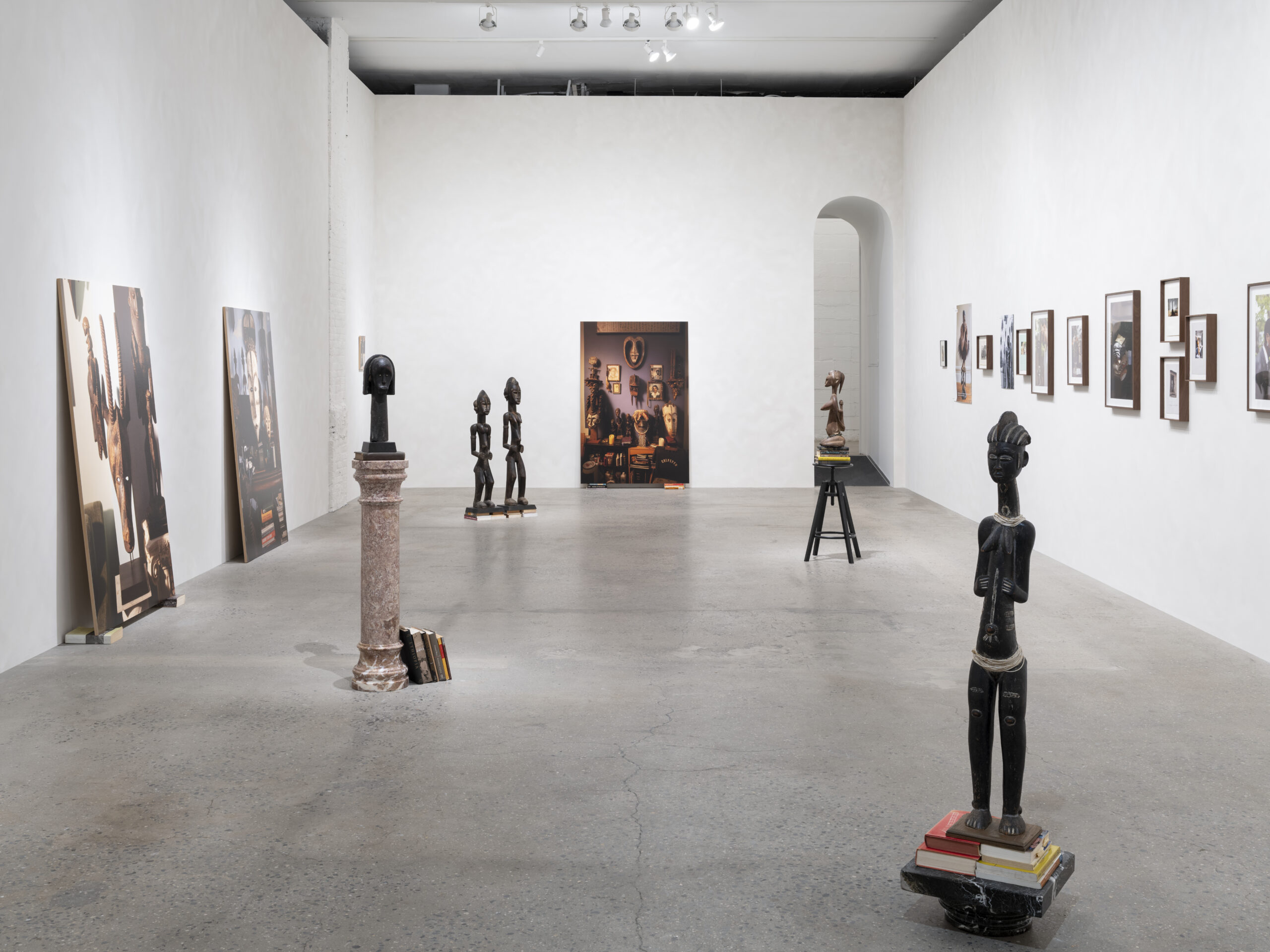
Finally, I made it to Company, which was opening two shows. On the ground level, John Edmonds (b. 1989, Washington, DC) stages a tribute to the Museum of Art and Origins, a by-appointment collection that scholar George Nelson Preston runs out of his home in Washington Heights. The show mixes photographs Edmonds took inside the museum and objects borrowed from the collection.
Books are everywhere in the installation. A Bamana wood-carved sculpture of a kneeling mother with a child on her back sits on a stack of them on a stool. A Fang reliquary sits atop a hardcover on a marble pedestal, another stack leaning against its base. Large prints leaning against two of the walls are lifted off the floor by these bibliophilic piles, three of their spines reading ZIMBABWE’S PROSPECTS, A CONCISE HISTORY OF SOUTH AFRICA, and AT THE COURT OF AN AFRICAN KING, respectively. A third wall mixes photos from Preston’s archive (a group portrait shot in Mamfe in 1970, a blacksmith’s child in Ghana, from 1997) with contemporary portraits Edmonds took inside the museum, Black men posing softly, tenderly with the artifacts. At least one, Chiani on Luba stool (Tearsheet from Fantastic Man No. 39), quietly nods to Edmonds’s editorial work, and—maybe because I’m a magazine nerd—I liked the implied storyline that the museum is somewhere he’s shot subjects for commercial jobs.
I was less enamored by the exhibition in the basement, mixed media paintings and works on paper by Leyla Faye (b. 1994, Minneapolis), but it was full of young people. Back upstairs, I chatted with artists E. Jane and Cajsa von Zeipel (sorry, can’t tell you what about) and air-kissed Ryan McNamara and Ambera Wellmann on my way out.

“Scene”
New York Life Gallery | 167-169 Canal Street, Floor 5
Through October 24
Worried about missing my last stop of the night, I hustled to New York Life Gallery, named after the insurance company sign you look out onto from its fifth-floor Canal Street windows. The gallery is a close-to-the-heart project of photographer Ethan James Green, who earns a living shooting campaigns for the likes of Prada, and covers for Vanity Fair. The new group show he curated functions as a compendium of sorts for the sensibility Green’s carved out over the last four years: moody expressionist painting, new and old; stripped-down photographic portraiture; and drawings that reflect a sensitivity to dress and style.
A defiant sexuality threads through several works, including a bodacious Daniel Arnold snapshot, all fishnets, sequins, and lamé on the dance floor, and a Drake Carr illustration of a diva in yellow polka dots. I ran into photographer Sam Penn, who shows with the gallery (in addition to having her own blooming commercial practice shooting for clients like Maison Margiela and Lorde), and Marcus Cuffie, an in-demand stylist whose father’s estate the gallery represents. New York Life has been working to bring Steven Cuffie’s personal photo practice into view, as most of it was never shown publicly while he was alive. I found out at the opening that a photo of his is set to appear in an exhibition at the Baltimore Museum of Art this fall.
Ridikkuluz
Salma Sarriedine | 116 Elizabeth Street, Floor 3
Through October 22
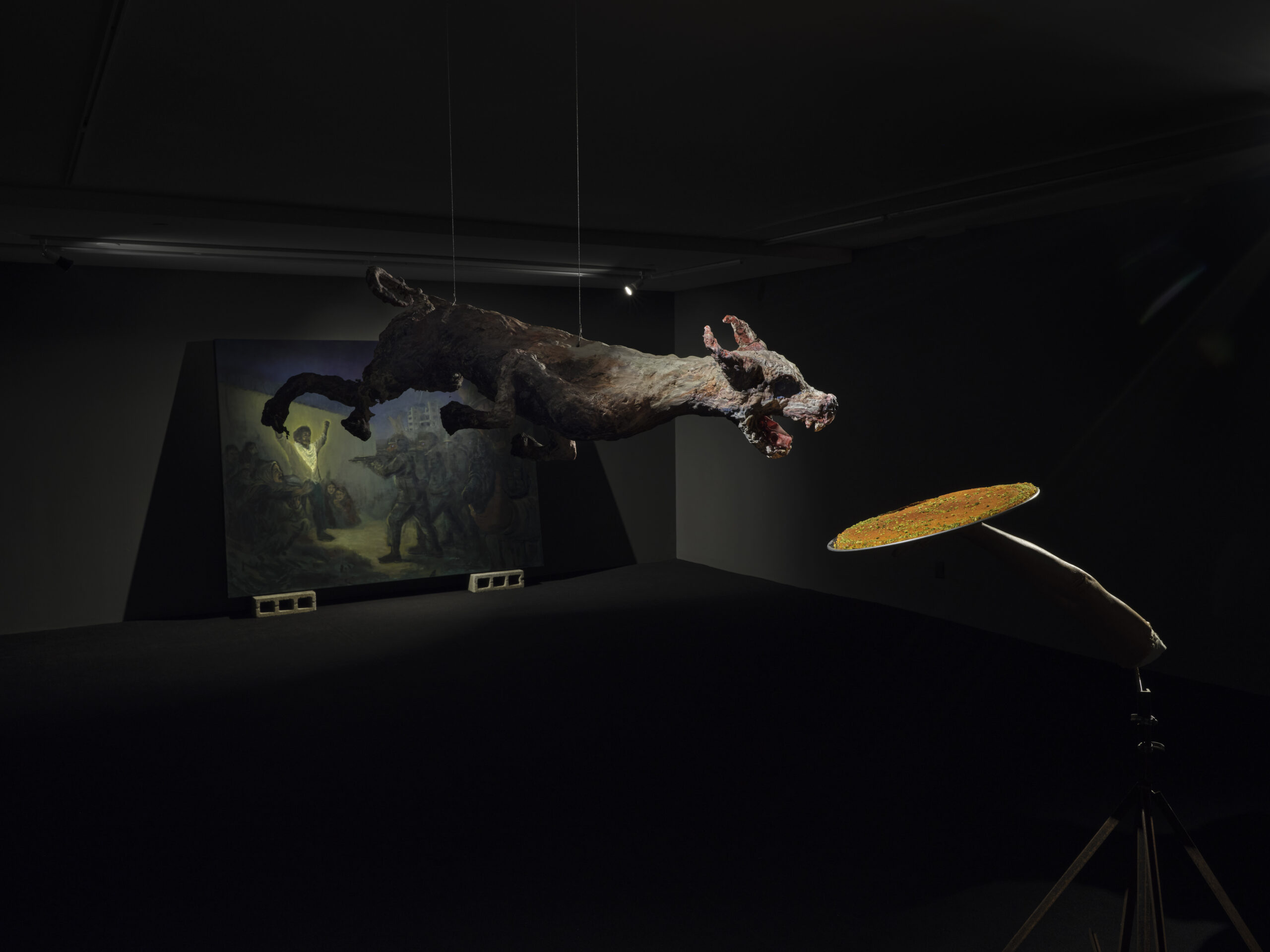
The Ridikkuluz (b. 1994, New York) show, “KLAB,” at Salma Sarriedine seemed deliberately timed to open on Sept. 11. A painting of George W. Bush circulated in advance as a teaser, showing him with a shoe in his mouth at an easel, painting a fluffy white dog, its eyes an ominous cybernetic blue. This is the painting that the elevator doors open onto when you arrive. It hangs at a square angle above a solid wood executive desk that’s precariously tilted, as if sinking into the floor. In the darkened gallery, both works are caught in a spotlight. As you move deeper into the shadows, dogs develop an unexpected significance. I could hear the people in front of me audibly registering the revelation as they encountered additional spotlit paintings depicting scenes of occupation and genocide in Palestine, in which the aggressors appear as anthropomorphized dogs, armed, in advanced tactical gear. The darkened space accentuates the K9 eyes, all shining the same Erika Kirk blue, a video-game tonality lending their violence a cartoonish evil (if the shoe fits). The question of who the human animals are expands into three dimensions in the final room, with a sculpture of a dog attacking a disembodied arm bearing a platter of Knafeh, a dessert traditionally served to welcome guests.
Ridikkuluz is queer and of Palestinian, Egyptian, and Jordanian descent. Earlier this year, they curated a group show that took over both Salma and its downstairs neighbor Participant Inc., featuring other queer SWANA diaspora artists. Many from that show were there Friday, including the twins André and Evan Lenox-Samour and Sultana, AKA the Queen of the Middle East Village, a downtown fixture who has been performing drag since the ’90s. (One of the paintings in Klab in particular jabs at Israel’s pinkwashing, showing IDF soldier-dogs stalking two Gazan men sharing a tender moment in an apartment window.)
Tyler Cala Williams
Participant Inc | 116 Elizabeth Street
Through October 25
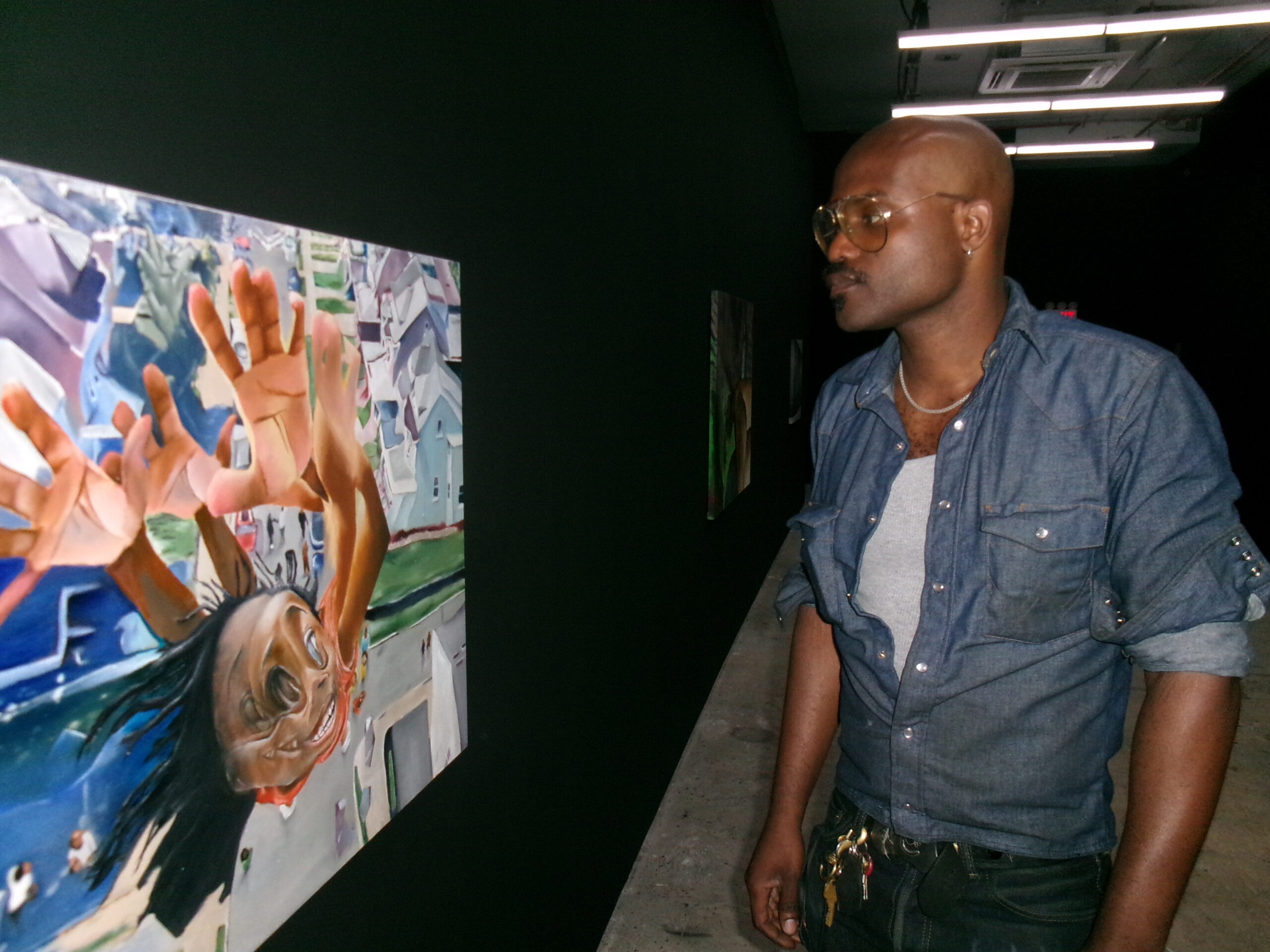
Sunday marked the final opening of the week for me on Elizabeth Street, at Participant Inc., which operates out of the same building as Salma Sarriedine, on the ground level, and regularly collaborates with it. Now at its third location, Participant has been a mainstay of downtown New York since its founding in 2002, its director Lia Gangitano a champion of risk-taking goth freak artists of the highest caliber. “Elastic Synapse” by Tyler Cala Williams (b. 1996, Trenton) is curated by Executive Care, an agency founded by Isis Awad in 2020 to service trans and queer artists of color from performance and nightlife communities. The show ushers in an evolution for Williams, combining oil paintings with inkjet prints of the digitally rendered photo-collages they’re best known for. Color pops in the ten wall pieces: lush, overripe, hyper-real. My favorite moment is a white tile wall where a small painting is mounted, its Blender warping (also echoed across the show) sharply juxtaposed with the rigid grid behind.
Ridikkuluz was in attendance, as were many familiar faces who’d been at their opening Friday. If I often felt I was swimming against the current—leaving neighborhoods with dozens of synchronized openings to make it back to this Nolita corridor—the overlapping programming and sense of camaraderie between Salma Sarriedine and Participant ended things on a high note. And, while some of the other Elizabeth Street spots—Martos, Whaam!, and newcomer Turquoise—didn’t have their September shows open at the time of this writing, now you could easily hit all eight galleries on a single afternoon.
More of our favorite stories from the Critics’ Table
Speed Round! 19 Critics Pick the NYC Shows to Add to Your Map This September
Conceptualism’s Resurgence, a Growing Critics’ Table, and More Reflections on This Season in Art
Betty Parsons, the Artist-Dealer Who Set the Scene for Abstract Expressionism, Gets Her Due
Does a New Exhibition at the Tate Dim the Power of Ana Mendieta’s Legacy?
Sign up for our newsletter here to get these stories direct to your inbox.




 in your life?
