



“Betty Parsons: An Expanded World”
Hessel Museum of Art | 33 Garden Road, Annandale-on-Hudson, NY
Through October 18, 2026
“A gallery is constructed along laws as rigorous as those for building a medieval church,” critic Brian O’Doherty wrote in “Inside the White Cube,” a much-quoted 1976 essay that contests the neutrality of display mechanisms for modernist art. “The outside world must not come in, so windows are usually sealed off. Walls are painted white. The ceiling becomes the source of light,” he continued. As happens when an unexpected diagnosis hits a vein of truth, over time his observation has come to seem so axiomatic as to be banal. But at the time of its writing, O’Doherty was also an artist—showing under his alter ego Patrick Ireland—who was represented by Betty Parsons, the renowned New York gallerist who in no small part created these laws. His essay comments on the very specific aesthetic vocabulary she implemented when she first opened her 57th Street space in 1946, which soon became the default industry-wide.
While Parsons’s name is known to those familiar with the emergence of first-generation New York School painting—she was an early champion of Jackson Pollock, Barnett Newman, Mark Rothko, and Clyfford Still—her accomplishments as a maker are less acknowledged. For the magnificent exhibition “Betty Parsons: An Expanded World” at the Hessel Museum, curator Kelly Taxter and artist Amy Sillman focus on the artistic aspects of her legacy, gathering 81 of the paintings, works on paper, and sculptural assemblages that she created on the days she had off from being a dealer. Across these objects, her confident use of color and her assured gestural marks demonstrate that she was driven to make art, and did so in abundance, despite the time constraints of running a business promoting others.
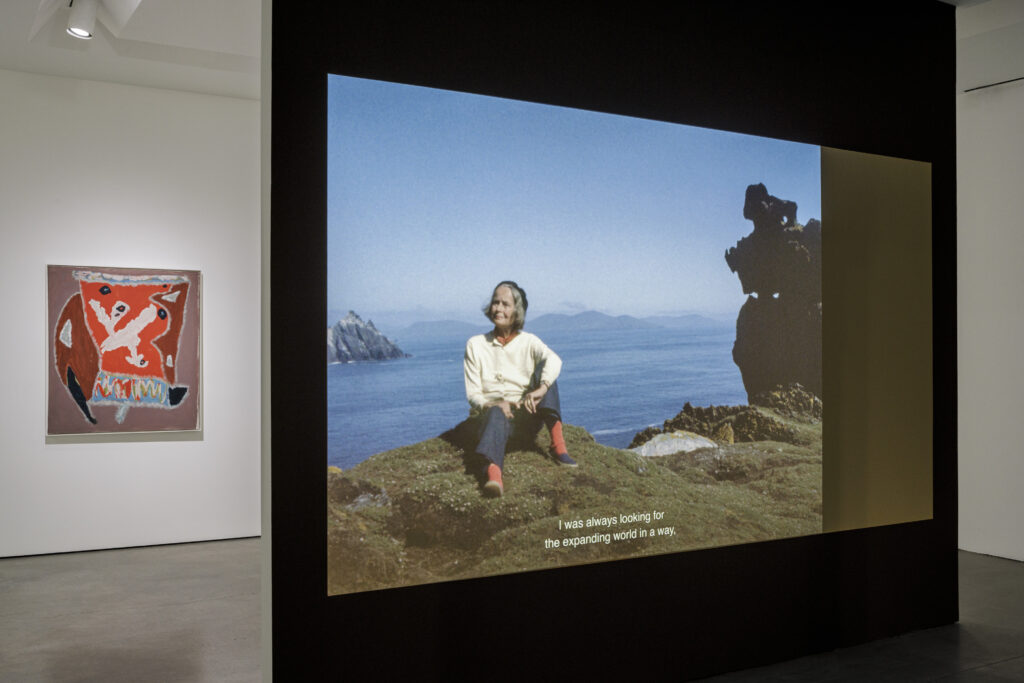
A woman with an excellent eye and a genuine zeal for visual culture of all kinds, both within and beyond narrow categorizations of modernist art in her pace-setting gallery, Parsons exhibited far more than what she termed “the four horsemen” of Abstract Expressionism (Pollock, Newman, Rothko, and Still), and until her death in 1982, she was steadfast in her support of women artists, queer artists, and artists of color. Her gallery’s inaugural show, organized with Newman, featured Pacific Northwest Coast Indigenous painting. She never pursued market trends and was repeatedly abandoned by the white men she showed, such as Hans Hoffmann and Robert Rauschenberg, as they clamored for fame and more lucrative opportunities.
Born in 1900 to a patrician East Coast family, Parsons was a teenager when she experienced a pivotal encounter with avant-garde art at the legendary 1913 Armory Show. In her own accounts, she calls it a “crazy-quilt” that blew her world open (decades later she would create witty found-wood sculptures that, like quilts, have a pieced-together logic). As was expected for her station, she married a wealthy socialite, only to be disowned by her parents when she moved to Paris, divorced her husband, and began dating women; her lovers included Irish painter Adge Baker and art critic Rosalind Constable. Parsons’s trajectory thus differs from that of her contemporary Peggy Guggenheim, another famed female gallerist. Guggenheim was secured by the dual anchors of a bottomless inheritance and her heterosexuality, which afforded her frictionless social prominence, while Parsons was financially adrift without family support or alimony. Perhaps these precarious circumstances fueled the tenacity and risk-taking that distinguished her both as a dealer and an artist.
In each role, she followed her own instincts and eschewed dogma about salability. The diverse roster of shows the Betty Parsons Gallery mounted is without parallel in the 20th century—she exhibited such luminaries as Barbara Chase-Riboud, Chryssa, Ad Reinhardt, Kenzo Okada, Agnes Martin, and Roberto Matta, often when they were unknown. It was a place governed by her internal sense of what was best suited for the beholding of art, rather than chasing trends. In correspondence with the artists she supported, she didn’t mince words: When Forrest Bess wrote her to propose that his highly eccentric medical “thesis” about self-surgery be shown alongside his canvases, she replied, “I do not feel I want to.” Instead, she preferred to focus attention on his paintings showcased in a stripped-back room, a move that ran against the prevailing lavishness of gallery spaces.
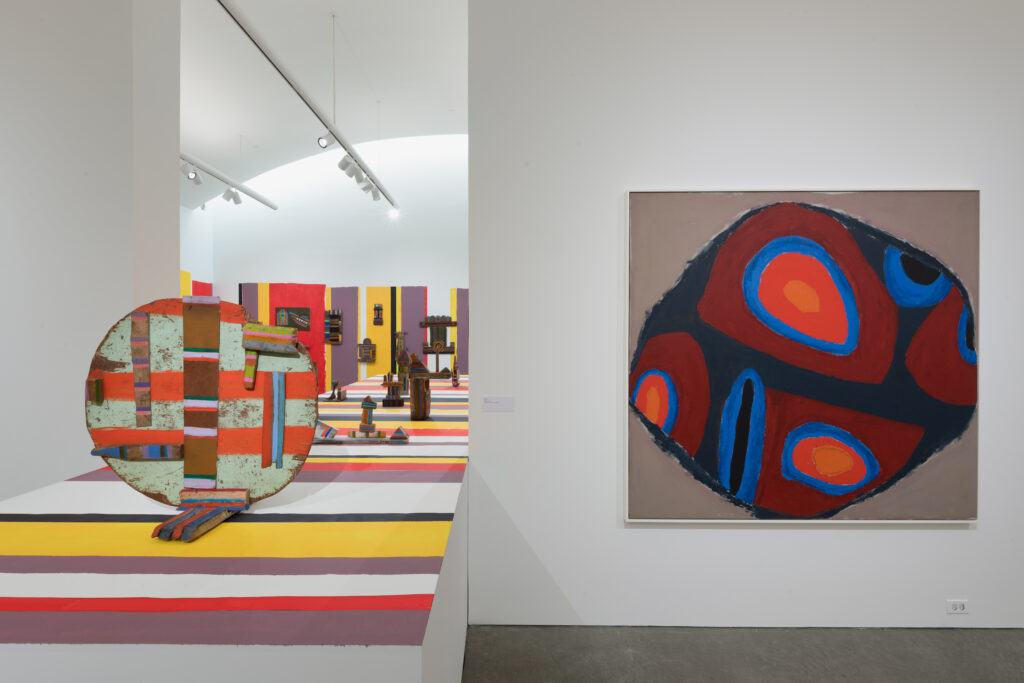
In her own practice, Parsons embraced abstraction early on as an expansive idiom, prefiguring artist-filmmaker Barbara Hammer’s 1974 manifesto, “The Politics of Abstraction,” about the queerly limitless sensualities of non-representational art. Drawing inspiration from the Long Island surrounds where she retreated on the weekend, Parsons salvaged wood scraps from the beach and configured them into playful assemblages. These water-weathered sculptures radiate with an inner animacy, and the striated texture of their grain is further enlivened by her saturated color application and striking compositional choices. They suggest affinities with two other fiercely independent women, Louise Nevelson (particularly her early circus-themed works) and Beverly Buchanan, and serve as a reminder of the political potency of gleaning: the ways people with scarce resources become adept at making worlds out of detritus.
Parsons’s paintings are commanding and authoritative; they bear few registrations of hesitation, with no repainted passages or signs of her scraping things off and starting over. These are aesthetic choices of course, but they are also qualities possibly born of material conditions: Parsons squeezed her own practice into moments between her tireless advocacy of others—no time to overthink. Small homages to some of her artists occasionally seep into her canvases: a curve like Bess’s, a little gesture reminiscent of Hedda Sterne. A stylish colorist, Parsons had a special affinity for stripes, savoring the way a line of pigment butts up against another to recall domestic objects like rugs, tilework, and wallpaper.
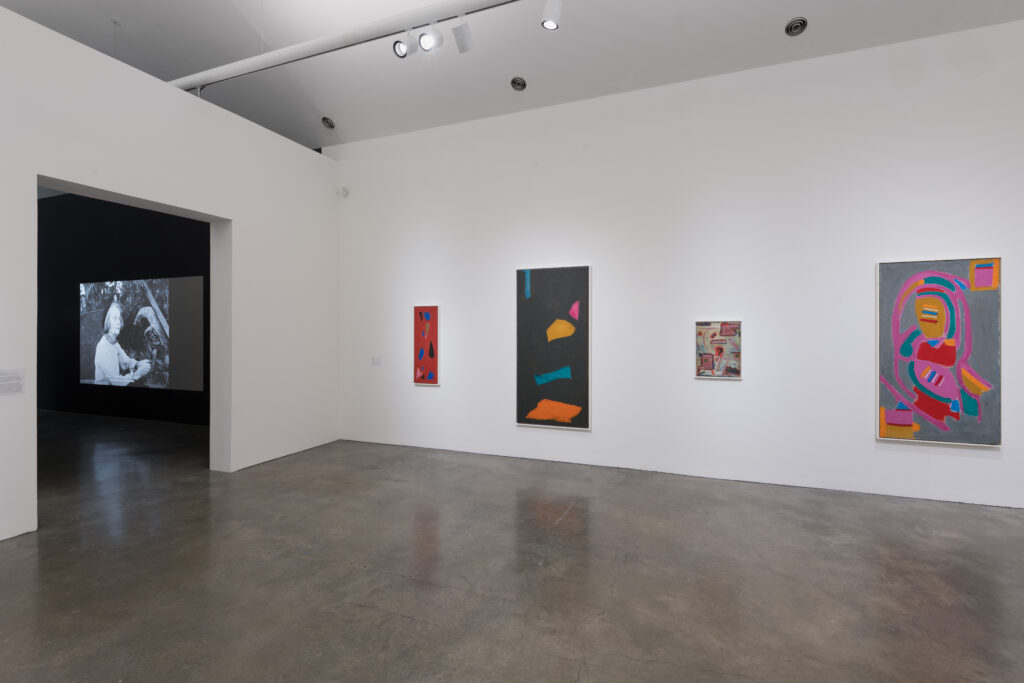
The exhibition is enriched by a commissioned film by G. Anthony Svatek and Kaija Siirala that provides insight into Parsons’s biographical trajectory; split into two parts, it bookends the display. But the meat of the show is Parsons’s art itself, its riot of clashing hues and wonkily painted sculptures. Amy Sillman, one of the most energetic and innovative abstract painters working today, produced a striking mural and plinth based on Parsons’s 1967 lavender, yellow, and red vertical stripe painting Early Morning that are highlights of the exhibition. Sillman’s closely observed interpretation amplifies Parsons’s visual vocabulary, providing a kind of theatrical backdrop to showcase the lively wooden works and brings her role as an influential choreographer of display into focus. Though some press coverage of the Hessel show has been critical of this design decision—which runs so counter to the conventions the dealer established in her own gallery—the mural is an unmitigated success, because it is wholly in the spirit of Parsons’s own risk-taking. It also chimes with Hammer’s take on queer abstraction as a route to “perceptual pleasure and the multiplicities of meaning” that also fosters more active viewers.
O’Doherty’s point in “Inside the White Cube,” which he articulated exactly 30 years after Parsons established her white-walled norm, is that she embraced the then-unconventional choice in order to see the art more clearly. Sillman achieves a similarly unconventional, clarifying effect with her bold stripes. A typewritten narrative of Parsons’s life—held at the Smithsonian Archives of American Art—emphasizes just how much she embraced the unorthodox. In a paragraph about being forced to dress according to her parents’ wishes as a child, she states, “We always had to wear white in the summer….How I hated white! If only my socks could be colored, I thought” (there is mystifying underlining in the original). Loud, exuberant, and opinionated, Sillman’s mural honors Parsons, artist to artist, as an eccentric visionary.
More of our favorite stories from CULTURED
How Bella Freud, Sigmund Freud’s Great-Grandaughter, Reinvented Psychoanalysis
The 15 Must-See U.S. Museum Shows in Fall 2026
Rosa Elena Curruchich Made Paintings Small Enough to Smuggle. Now, They’re Seeing the Light.
Does Gen Z Have the Patience for Fine Dining?
WAG-onomics: How Women Took Over the Business of Men’s Sports From the Sidelines
Sign up for our newsletter here to get these stories direct to your inbox.




 in your life?
