



Ana Mendieta
Tate Modern | Bankside, London
Through January 17, 2027
An exhibition that begins with refusal would seem in keeping with Ana Mendieta’s life and art. During her short career of just around 15 years, she refused to be defined by a single context—as a woman artist, though she was deeply involved with the feminist art movement in New York in the late 1970s and early ’80s; as an immigrant artist, though an exploration of place was central to her work; or as a Land artist in the dominant terms of that movement. The Tate Modern’s current presentation, curated by Valentine Umansky and Michael Wellen, billed as the first “in-depth” U.K. show of the artist’s work in over a decade (note how the museum avoids using the words “survey” or “retrospective”), rejects any biographical reading of Mendieta’s work, offering instead a focus on the way she engaged with nature, spirituality, and material culture.
Mendieta’s life has often been centered in discussions and exhibitions of her work. Born in Cuba, she moved to the U.S. without her parents, in 1961, at the age of 12, fleeing the Castro regime. The loss of a home, dislocation—these are major currents in her work. She often placed her own body in relation to the world, most famously in her long running “Silueta” series, initiated in 1973. It’s a varied group of earth-body works for which she carved, burned, or otherwise traced outlines of her figure onto or into the land. These performances were documented in films or photographs, joining a body of work in sculpture and drawing that, early on in her career—especially as a student at the famed, experimental Intermedia arts program at the University of Iowa—directly explored difficult subjects of the body, gender, and violence.
She was 36 when she died, in 1985, falling from the window of the 34th-floor Manhattan apartment she shared with her husband, the prominent Minimalist artist Carl Andre. The circumstances of her death remain divisive after Andre, who died in 2024 at the age of 88, was charged with her murder and acquitted—and have threatened to overshadow her legacy as an artist.

Considering this fraught history, the Tate exhibition begins with a surprising sense of calm. It opens with a series of works Mendieta created on a visit to Cuba after 20 years living in exile, large black-and-white photo-documentation related to her series “Esculturas Rupestres (Rupestrian Sculptures),” 1981–82, for which the artist carved images in the limestone of a rocky, forested area outside of Havana. (“Rupestrian” refers to wall drawings and carvings made by prehistoric humans, such as those in the Lascaux Caves in Southwest France.) These are shown next to Mendieta’s last moving-image work, Ochún, 1981, which features video footage of an open “Silueta” sculpture composed of two sand ridges. Made in the straits separating Florida from Cuba, the film shows water flowing through the roughly symmetrical islets.
The sound of the ocean waves to-ing and fro-ing floods the room, creating a meditative space where viewers take in the work and its subjects—the female body, the landscape, the passage of time. You could see this as small-scale Land art. Or you could see its insistence on the female form, its direct references to Mendieta’s place of origin—that is, as work that is inherently “personal.” Of course, there need not be a contradiction between the biographical content and form, though, or between various thematic readings of the work: Any artwork can operate on multiple levels, any viewer can choose how to interpret it.

But the curatorial insistence on not mentioning gender, immigration, or violence makes this exhibition an odd introduction to the artist, one that presents her—almost exclusively—as a spiritual inhabitant of nature. The refusal to deal with biography corresponds to a rejection of chronological order as well. And so, the exhibition moves from mature works to youthful ones, sidestepping a framing of the artist through her more brutal, early works. Halfway through the show is an early iteration of Body Tracks, from her student years, one of her most recognizable works, and an idea she returned to several times in drawing, performance, and photography. The video version here, from 1974, shows the artist from the back, with her arms high above her head at first, then dragging them down the wall in front of her, leaving behind a trace of her movement in animal blood.
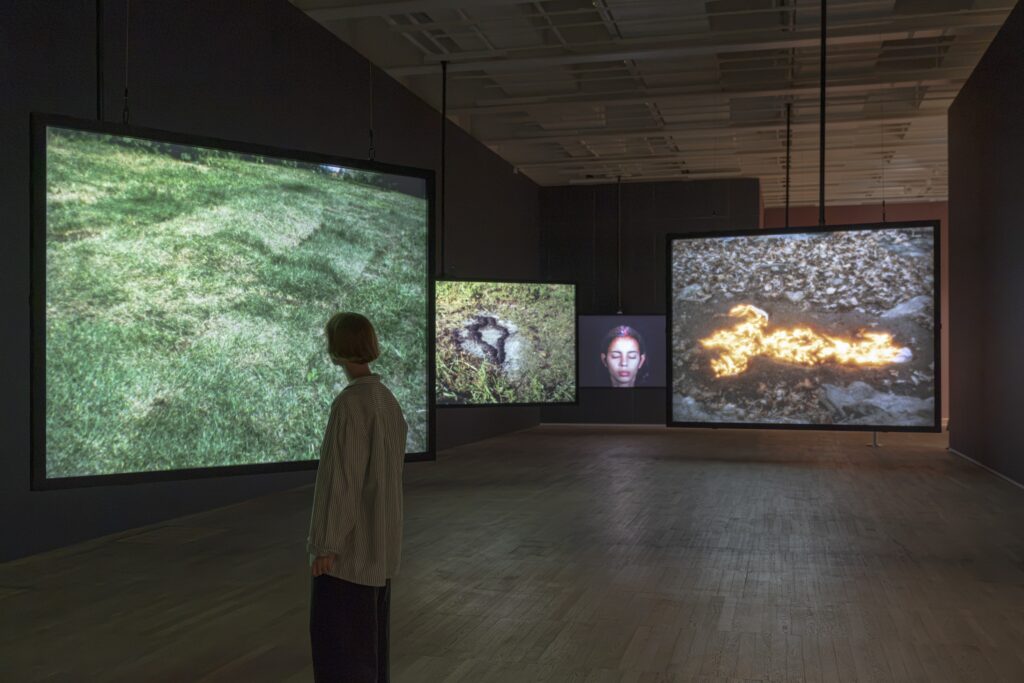
Also among the exhibition’s highlights is a group of film works, in a beautiful display of screens, hanging from the ceiling, like a forest of devices. The imagery grows in intensity from Grass Breathing, c. 1974, in which a patch of green earth rises and falls as though it’s breathing, or struggling to breathe (the artist lies beneath) to Untitled: Silueta Series, 1978, where Mendieta’s silhouette is traced in flames, to Sweating Blood, 1973, featuring her face, in close-up, with blood dripping down it. This rising edginess is the only linear progression in the show, as if we need to build up to looking at Mendieta’s art in all its power.
Or perhaps we need to be protected from it. For Moffitt Building Piece, 1973, Mendieta spilled animal blood in front of the door of a building in Iowa City. Made after a fellow student at her university was sexually assaulted and killed, it looked like a crime scene, and Mendieta and her sister sat in a car across the street, watching and documenting the people walking past it, capturing their responses to the implied violence. A film version of this work exists, but here it is presented as 15 small-scale photographic prints hung behind benches, seating for viewers to watch an (unrelated) video projection. You have to really want to see the photo series head-on (unlike the avoidant onlookers who Mendieta documents in the experiment) in order to encounter the disturbing images.
Why should we be so scared of an artist’s story? Why downplay the early work? In its attempt to avoid foregrounding the themes that have often framed (or haunted) Mendieta’s work, this exhibition deprives viewers of both her historical significance in a lineage of feminist artmaking, and a range of powerful, potential readings. The story it ends up telling is: Here is an artist who (by the way) made these very intense, violent works in the mid-1970s, then retreated into a spiritual relationship to nature from the late 1970s until her death (which shall not be mentioned).

Looking away from the artist’s biography—looking away from a woman’s life—makes this show an incredibly polite formal experiment. The other two exhibitions on view at Tate Modern at the moment are “A Second Life,” a major Tracey Emin retrospective, and “Frida: The Making of an Icon,” which considers, among other things, the posthumous rise of Frida Kahlo as an international figure. The Mendieta exhibition could, and should, have joined these two shows in reflecting on women artists’ lives and how societal forces shape them.
“Biography” is not simply what happens to one person; it is also the lens through which the profound effects of larger social and political forces such as immigration, environmental degradation, violence (and violence against women) become clear. Viewers know how to look at these issues, how to think about them, and how to see their own power and powerlessness reflected in art. They’ll reach to make these connections here, despite the curatorial trepidation to enrich such understandings. No rhythmic roaring of waves can quiet these inquiries.
More of our favorite stories from CULTURED
Audacious Ghosts and Sunbaked Villas: How to Make the Most of 36 Hours in the Veneto
Is ‘I Want Your Sex’ Actually Gregg Araki’s Tamest Film to Date?
What One Angeleno Learned From a Six-Week Bender With the Downtown NY Art Scene
McNally Jackson’s Sarah McNally Breaks Down the Modern Bestseller
The Best Parks and Pools in New York, According to Luke Evans, Sohla El-Waylly, Bowen Yang, and More
Sign up for our newsletter here to get these stories direct to your inbox.







 in your life?
