


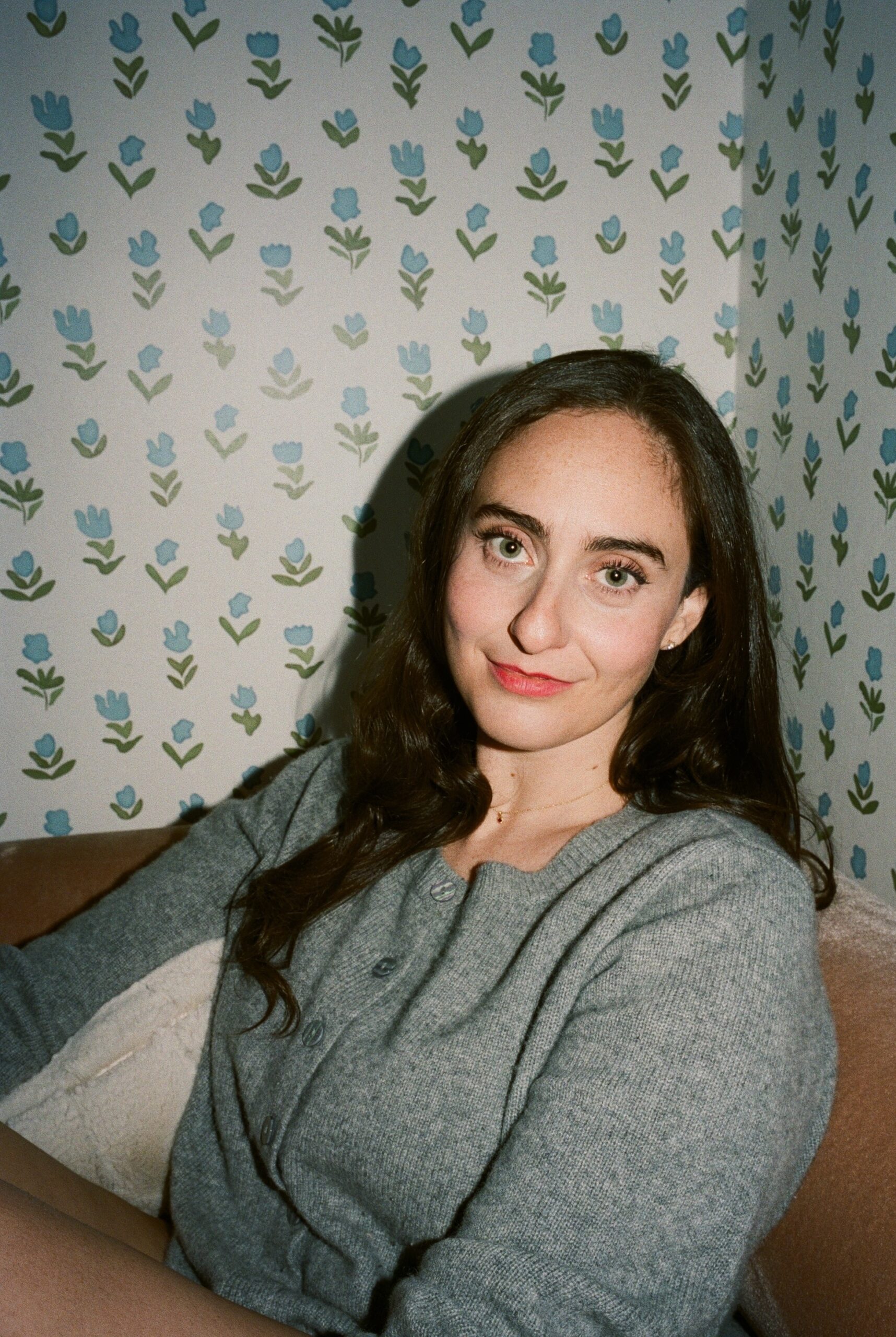
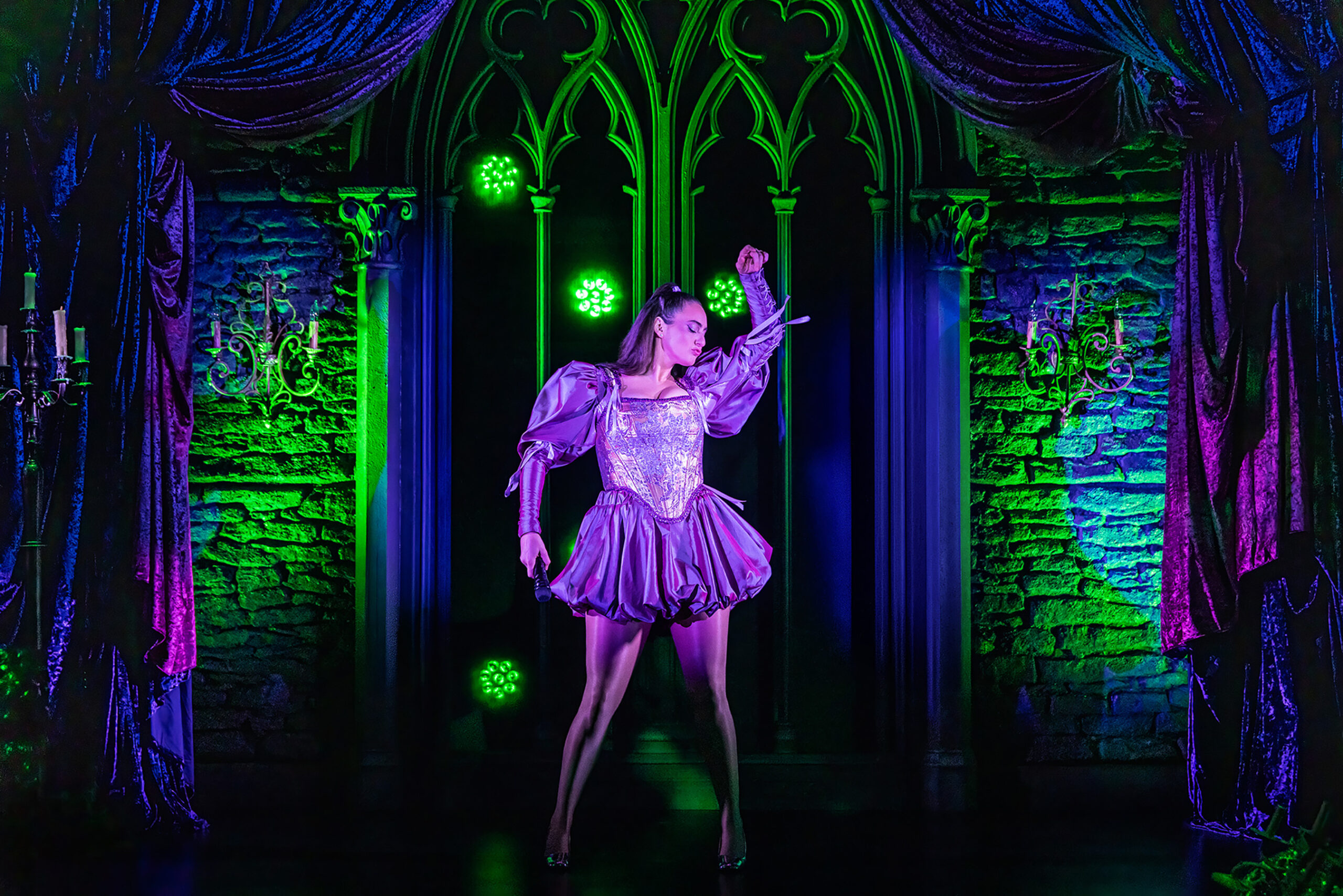
Cat Cohen is in a corset, sipping hot chocolate. Now, she is manspreading on a throne, pantomiming removing a tampon. She is singing about Labubus, body dysmorphia, female hysteria, Tamagotchis, and MRI machines. She is hitting the high notes with panache while her lyrics riff on the lowest moments of her life. In her new one-woman musical comedy show, Broad Strokes, Cohen recounts the harrowing experience of surviving a stroke, bravely asking: How can a girl suffer a stroke at 30 when she is young for her grade?!
With her signature raucous mix of self-deprecation and self-aggrandizement, Cohen connects this encounter with mortality to seemingly minor, even mundane brushes with social, romantic, and creative death. At once chaotic and convincing, she punctures a story set in the operating theater with a “theatrical emergency”—being called basic by a casting agent. She is as lighthearted in adversity as she is earnestly terrified, a relatable role model ardently questioning the roles she’s been playing her whole life. Is she a “Normal Girl” destined for the suburbs and a husband who “could kill me with his hands but won’t,” or is she a “Lady Who Needs to Be By the Sea,” one in a long line of angst-ridden artistic geniuses afflicted by amorphous ailments that are, of course, accompanied by strokes of existential insight?
Texts left on read and cruel comments on Instagram are poignantly rendered with the same witty, vulnerable brush as sexual assaults and medical emergencies. Optimism lurks beneath worry. Hope and fear are both predicated on a conviction that change is possible. A revelation in verse: If something bad can happen, so can something good. These days, Cohen might still “Live in Fear,” but she’s happy to be here. So are her audiences; the critically lauded show is packed nightly, and was recently extended an extra month, now running through Sept. 25.
Last week, Cohen and I met up a few blocks from her stage at the Lucille Lortel Theatre to talk terror, tangents, modernity, millennial angst, fainting couches, ZzzQuil, and more.
Your show fully infiltrated my subconscious. Apparently inspired by your “Are You Mad at Me” ditty, I had a dream in which you unfriended me for asking idiotic questions in this very interview. This show is about vindicated medical hypochondria, but I also thought it was playing with the concept of interpersonal hypochondria.
I’m scared of dying a physical death, an emotional death, a social death, a communal death. I’m like, Is being ousted by your community scarier than dying physically? In moments of crisis, the question is: If life is over, is all the shit I’ve been chasing worth my time? What if I just enjoy my fucking life like everyone else I grew up with? I think of how every celebrity, at the end of the day, ends up moving to an estate and having a giant garden. On the other hand, there are artists like Lena Dunham who are always writing, writing, writing.
Your work proffers what I’m going to call a credo of basic bitch solidarity. One that boldly manages to call in Pick Mes… It’s a big tent philosophy.
Everyone’s a basic bitch. We all want the same things. The TikToks that make us laugh are doing so because we’re all doing the same behaviors. We’re all asking our boyfriend to fill up our water bottle before bed. We don’t like the big light. Wanting to be picked and chosen is a basic thing, a foundational behavior. Who doesn’t want to be a guy’s girl? Who doesn’t want all the guys to be laughing and thinking she’s cool?
Your aesthetic choices in this show, set and costume-wise, were interesting to me in light of that ethos—they felt rooted in your imagination and historical references, rather than pandering to a male gaze. Also, someone DMed me and described the aesthetic as very “Count Chocula.”
Oh, I am Countess Choculina. That idea came from the opening number, which is about being by the sea, wanting to be a great heroine from literature, which involves romanticizing all these ailments you have. It’s about my feeling that maybe that was more acceptable in the past, and my yearning for an era when it was acceptable or even idealized to retire, lie down, disappear, abscond. Romanticizing all that, with a modern twist. The set feels like the inside of my brain.
I’m imagining collabs. Maybe Restoration Hardware will make a Broad Strokes fainting couch.
I’m ready. I’ll post it. Derek McLane did the set, and when I walked into the theater I was just completely blown away. [My costume designer] Kelsey Randall and I knew we wanted a corset. That was our starting point—we wanted something conveying pleasure and pain, implying the performance of womanhood, which demands constant fixing of oneself.
What are corset strings for, if not tying up both the literal, diagnosed physical hole in your heart, and the emotional holes you’ve been writing about throughout your career? Given another one of your glamorous feminized ailments is Polycystic Ovarian Syndrome, maybe there’s also something here about tampon strings of the heart…
[Laughs] What are corset strings if not sutures of the pussy? The costume is a real corset that I have to get sucked into every night. I’ll say this: We tied it tighter for the pictures. Taffeta fabric doesn’t stretch, but underneath it, there is a body suit made of spandex so I can still writhe with severity.

You are a master of physical comedy. It’s Chaplin-esque, but make it modern girl. Your show is rife with contemporary references, which collide with a historically-rooted aesthetic and vaudeville tenor.
I just happened to be born in this time, so that’s what I’m talking about. Some of the references are already nostalgic, despite their recency—me saying I refuse to sell my Labubus to pay for my surgery, for example—I wrote that last summer, and at this point I’m like, Does that even really ring true anymore? But it still gets a laugh, almost because it’s old. I’m always playing with nostalgia and self-awareness: Remember how we went crazy for that?
Your first special riffed on your fixation with nostalgia, and this one focuses on worrying—both phenomena can be attempts to maintain some existential control, do you see a throughline there?
So often with my shows, the themes emerge so naturally because I’m thinking about things in the normal progression that they happen. I’m in my 30s and I’m settling down now, but as the saying goes, anxiety is a fly that needs something to land on. So if not this, it’s the health. After the stroke, there is a blank. What’s it going to land on today?
In your first special, you sing about digging a deep hole, in your second you sing about The Void, and in this one, you discover a literal hole in your heart. What was it like for the anxiety to land on a literalization of your art?
I think, A, it can always get worse. So I’m glad that it hasn’t. But B, I almost find comfort in the moment when you can name it. Once I was diagnosed and I knew I was having the procedure, I was almost eerily calm. This is what’s happening, and you just buck up and move forward. Whereas afterwards, when I was throwing myself back into work and trying to live in the world again, that’s when the anxiety really kicked in: Oh God, what if, what if, what if, what if?
This is cheesy, but every night when I sing the Complete Control reprise, where I say “That’s it, that’s all, I have no choice but to let go,” that’s a prayer to myself because I’m still battling these things in real time. Every night, I’m like, All I need to be happy is just to let go completely, and when I say that every night I’m not announcing I’ve done it, but asking: Please make it true, make it today. It’s a mantra.
Your work plays with temporality in a way that reflects the actual experience of going through a difficult event, in terms of how the past intrudes in protective, painful, and utterly mundane ways. You’re kind of like, Huh, turns out having a stroke was actually as traumatic as when my ex dated someone after me.
[Laughs] Having a stroke was less traumatic than many things that have happened to me. As I’m writing, it’s always at a tempo of: This reminds me of that and so I’ll just say it. There were many more tangents originally, and what was so amazing about my director—legend, icon Alex Timbers—he was incredibly helpful dramaturgically, asking, “How are we going to tell a story?” I’ve never done a show that’s a chronological story. How do we keep the audience’s attention while still being able to go off on these fun tangents? But of course, we can jump back in time to when I’m 12, because that shit was part of this.

This show includes multiple jokes about tree species, which I found quite touching given the show’s philosophical interest in not losing sight of the forest for the trees, while also staying closely observant to individual branches of our lives.
One of the jokes is about Aspen trees in Aspen, Colorado, where I have spent too much time. It’s a really difficult place for me astrologically. I had an astro-cartographer read my chart, and she was like, “Something something about Saturn and Denver, it’s not a good place for you.” But I think in any moment of crisis, this is obviously cliche, but you’re going to want nature. I remember vividly looking up at the trees and being like, Whatever happens, at least I’ll look at a tree.
I know you’re prone to sleep-talking—do you remember your dreams?
Thank you for asking. I’ve been having insane dreams because I’m newly addicted to ZzzQuil because I can’t sleep and I don’t want to get too addicted to Xanax. Last night I had a lot of sexual dreams. I always have dreams about college and school.
Okay, she’s a public intellectual. While we’re talking dreams and astrology, are you aware that you are a literal fortune-teller? There’s a joke about you googling stroke symptoms in your first special.
It’s insanely spooky. A friend of mine texted me that he re-watched the special, and he’s like, “There’s a line about having a stroke.” I was like, “Holy shit.” I remember that because I used to read my poem that mentions a stroke all the time. It would always get the biggest laugh. I actually had a premonition about a stroke all the time in college. I would have extended déjà vu that I couldn’t explain that would make me really nauseous. I feel so grateful. It could have been so much worse. Not to be so cheesy, but I am literally Mrs. Gratitude now. Countess Gratitudina.
Oh my God, we should have done this at Café Gratitude. Wait, can one be a Lady By the Sea in Los Angeles, or does proximity to Nobu disqualify the Pacific?
No. It needs to be more like Cape Cod or England. It needs to be a rocky beach. Lady By the Sea implies a cable-knit cardigan.
If you were to write a memoir, what would you title it?
This Is Not Hyperbole.
I have to ask: After all this, do you still feel young for your grade?
Yes, forever. I’m a baby; I feel so new to the world. Even though I do feel like a baby, I also feel like this process required a certain maturity, especially the realization that it’s amazing to have strong creative conviction. To have been through enough to trust your gut feeling.
What are things you find overrated, accurately rated, and underrated?
Overrated: going on vacation. The concept of going somewhere for three or four days is more stressful than staying at home. A two week adventure, that’s different. Perfectly rated: stone fruit in the summer. Underrated: soup in the summer. And a silk neck scarf.
More of our favorite stories from CULTURED
Audacious Ghosts and Sunbaked Villas: How to Make the Most of 36 Hours in the Veneto
Is ‘I Want Your Sex’ Actually Gregg Araki’s Tamest Film to Date?
What One Angeleno Learned From a Six-Week Bender With the Downtown NY Art Scene
McNally Jackson’s Sarah McNally Breaks Down the Modern Bestseller
The Best Parks and Pools in New York, According to Luke Evans, Sohla El-Waylly, Bowen Yang, and More
Sign up for our newsletter here to get these stories direct to your inbox.




 in your life?
