


Georgica Pettus has a “can’t-teach-it” facility with language. It’s something you notice in great playwrights: They attach themselves to certain words and speech patterns that have an unusual music. You notice it when it’s not there, and you appreciate it when it is.
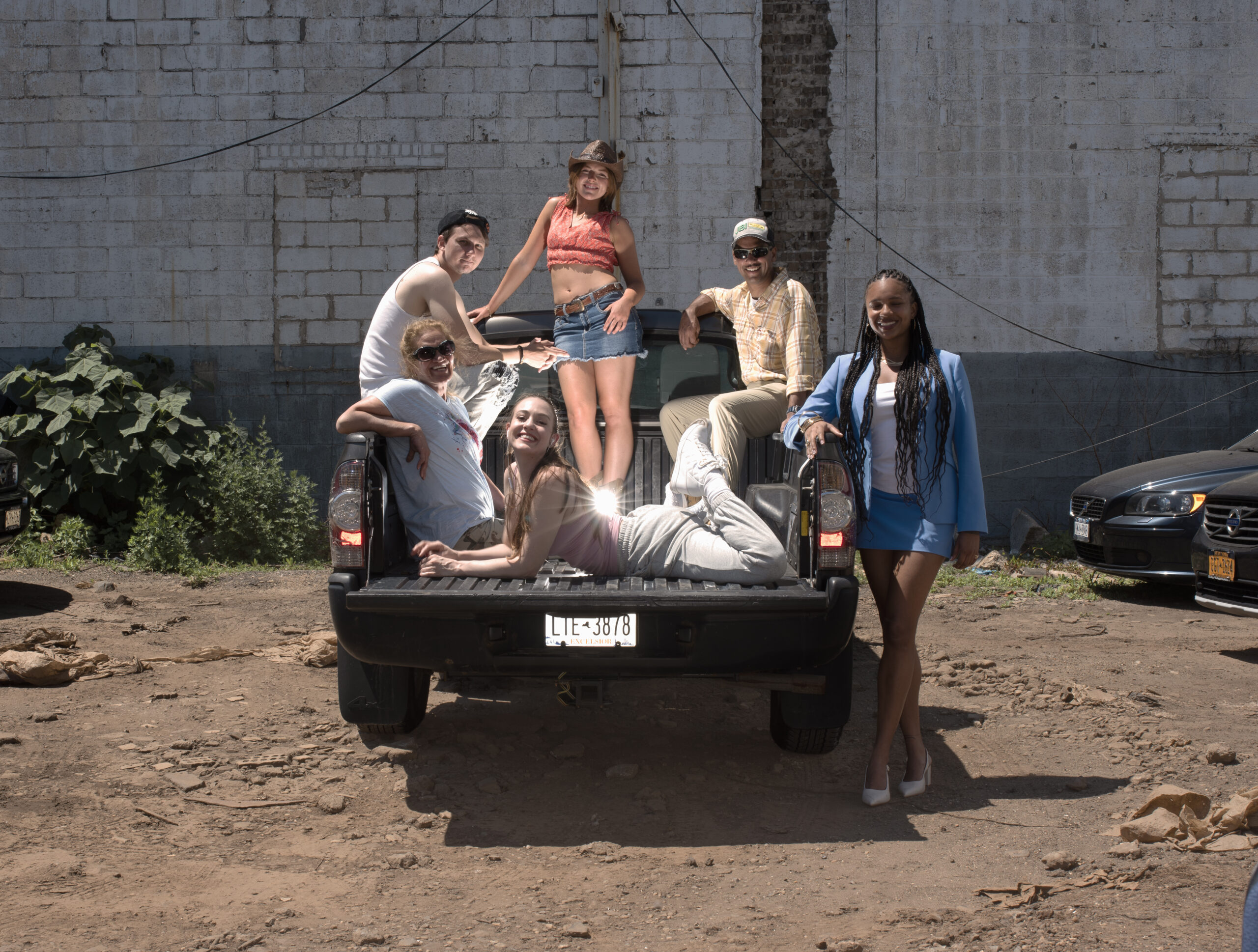
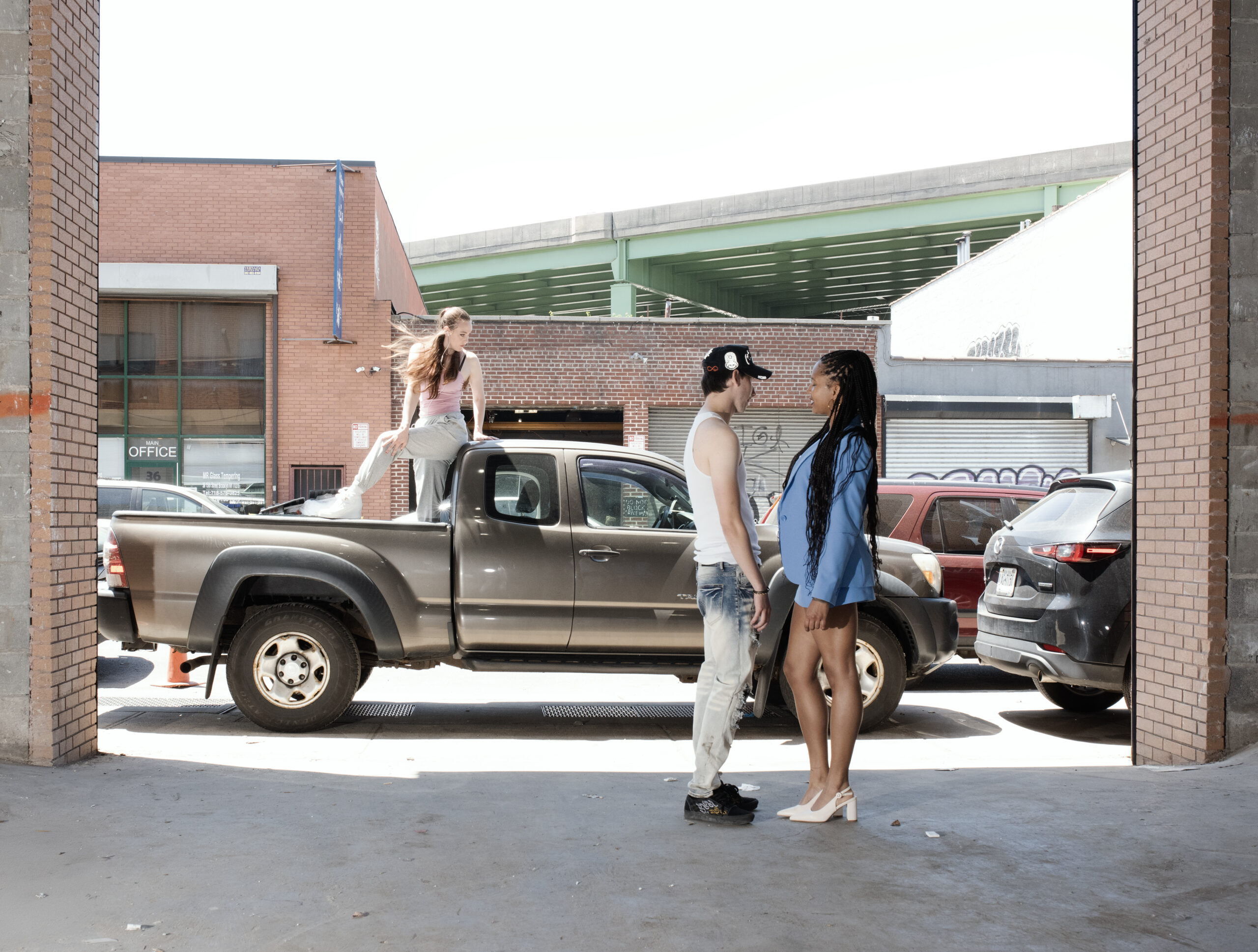
Pettus’s new play, Truck, has just this kind of lively musicality. Set at a used car dealership in Texas in 2021 (which feels like very long ago), it is centered around a farcical, if morbidly serious, contest: The last person to take their hand off a truck gets to drive it home for free. It’s unusual for a playwright who grew up on the West Coast and went to school on the East Coast to slip into the verbal texture of the Southwest and the rural. A playwright has every right to try to sound like anyone, but Pettus also has the unusual skill of being able to sound like someone she is definitively not.
In conversation, the 28-year-old reveals a holistic interest in the theater, yet it’s not surprising to find out that her background is art school rather than drama school. Truck is a composition for stage: The rhythm of the writing implies movement, design, and atmosphere without necessarily prescribing it. Like most good plays, Truck could be staged in an empty space, even if it isn’t—the world is in the language and the sound-sense of the language. Pettus is undidactic, likes her characters, and is interested in our common humanity. The play will make its world premiere in the courtyard of MoMA PS1 in Queens on June 27.
Tell me about the play.
It’s called Truck. It takes place at a 2021 Hands on a Hardbody competition in Liberty, Texas. My costume designer, Natasha Simchowitz, and I consider it a period piece. It’s a true ensemble—eight characters, all significant—and it’s really just about their relationships to each other, and the various things the truck symbolizes to them. But it’s also about chance, fate, whatever you want to call it.
How did it start?
Someone told me, “You should watch this documentary, Hands on a Hardbody.” It was made in ’97, the year I was born. It’s people standing around a truck for as long as they can in order to win it. An endurance competition. They’re illegal now, but these competitions used to happen all the time, mostly in the South, basically to get more people to come to the car dealership and maybe buy cars. This huge spectacle was really just a trick, which I think is so funny. In the documentary, you see the audience surrounding the contestants, and you get to know them. I thought, This is the best premise for a play, because all the attention goes to the dialogue. When the action is limited, what they say better be pretty damn interesting.
How do you know when you’ve started writing a play?
It’s either the first line that comes into my head or a title. For Truck, I saw the documentary and all of a sudden I had five characters in my head: Mike, Will, Carla, Georgie, Partly. Those are the contestants. And then I had an image of an announcer talking to the camera, because the thing is televised. Then the salesmen duo came later.
How long does the writing take?
My three previous plays, I wrote in a week or two. Very little editing. This one took a year and a half, because I didn’t know the characters. I had to get to know them.
What was your first play, 4,000 Dollars, about?
Me having no money. It was very much making fun of my situation, which felt tragic at the time, but I was also able to recognize that it was funny because it was never truly dire. A lot of people connected to it really fast.
You wrote, directed, and starred in your first three plays, but not this one. Were you an actor before this?
No. The reason I was in the first three was that I was writing myself, so I figured I may as well play it. I’m not in this one, and it’s been the best experience I’ve had. Working with actors is so cool.
You also work with a composer.
Three of my four plays have had an original score, yeah. This one is a string quartet, and it’s going to be bananas. The composer is Marcello Palazzo, an Italian-British guy. He’s 27, a wunderkind, in the London Symphony Orchestra Young Composers Program. I was freaking out this morning on FaceTime because he was playing a section for me on piano and it’s just insane.
You want to be a conductor, a composer, not the pure wordsmith-playwright—
When I was 21, I saw Simon Rattle conduct the Berlin Philharmonic. I was devastated, because I thought, I’ve thrown my life away, this is what I want to be doing. I have no musical skill, no musical anything. But that was the feeling. And the music is integral to the work, it’s everything.
Are your parents artists?
My dad’s a musician, a producer mostly. I grew up with him making jingles for commercials. He’d always say, “You could be the girl singer on this.” The one you might know is Hershey’s, the animated chocolate commercial, “I’ll stop the world and melt with you.” My mom was always in the music business, A&R and artist management, so she understands artists really well. They’re both incredibly supportive. But they also both said: “Don’t be an artist, that’s not a valid way to make money, do your thing, we love you, but do something else, too.”
And here you are, teaching and tutoring.
The hours permit you to do other stuff. And I find teaching extremely grounding because it’s not about me at all, so they balance each other.
The great 20th-century acting exercises come down to two things: verbal repetition or physical miming. How do you actually work with actors? Do they all need the same thing?
They need such different things. Some actors want to psychologize the characters, some don’t at all. Jim Fletcher [who plays Salesman One] said to me in rehearsal, “I’ll take the literal notes only.” As in, tell me how fast or loud to say the line, not what the character is thinking. I can psychologize a character ‘til the cows come home, but I’m also happy to not say a single word about why I wrote anything. The main thing is trust. I really trust them, and I think they know that. Memorizing a text is honoring it, and it changes because of that.
You can’t be directing a play and be a playwright at the same time. As a director, you need to forget you wrote the play, I think.
At this point in rehearsal, the play doesn’t even feel like mine anymore. That’s how I know it’s working. The actors have taken it somewhere else.
You tap into a very deep collective soul doing this—
This whole play is a waiting game. It’s eight characters, and I took a year and a half to write because I was basically waiting for them to come into my life. Then the casting felt like God just put people in front of me who were very close to the characters. So many of the actors will stop in rehearsal and be like, “I lived this.”
Your last play did something unusual with time.
It was two people played by four actors, a man and a woman who each had a mind and a body. The bodies are in a bed, they’ve just slept together for the first time, and they don’t speak to each other the entire play. It takes place over 10 minutes. I was making the argument that there’s so much talking going on in your head that time really slows down. So 10 minutes became 70.
What’s something personal you feel like playwriting lets you work through? In other words: what’s your shadow?
It’s hard to be asked that in a public interview. [Laughs] My fear of being disliked, I guess. It’s funny, when I made [my first play], 4,000 Dollars, about a girl spending all of her money in one day, I had this panic about the fact that I was totally outing my shadow. I think that’s a big part of why I write plays, it’s kind of a compulsive exposure of my bad sides.
Is there room to be bad in contemporary culture? How do you navigate that as the self-confessed Gen Z do-gooder who’s also drawn to the tragic?
Of course there’s room. Everyone has both, always. One of my actors texted me out of the blue and asked if I was ever the good girl who liked the bad boy. I said, “Only my entire life.”
Why should people see this play?
Because they’re in it somewhere. Beyond that, this play is me thinking about America in 2021, and about America right now. It’s about people and their various belief systems, and them not necessarily being bad people for having certain beliefs.
More of our favorite stories from CULTURED
Sienna Spiro, Your New Favorite British Belter, Loves It When a Musician Puts Her in Her Place
The Stars of Art Basel: Four Artists Having a Moment on the Fair Floor
15 Must-See Gallery Shows on View in London This Summer
How Chef Julia Turshen Cooked Up the Season’s Spiciest Queer Romance Novel
Sign up for our newsletter here to get these stories direct to your inbox.





 in your life?
