


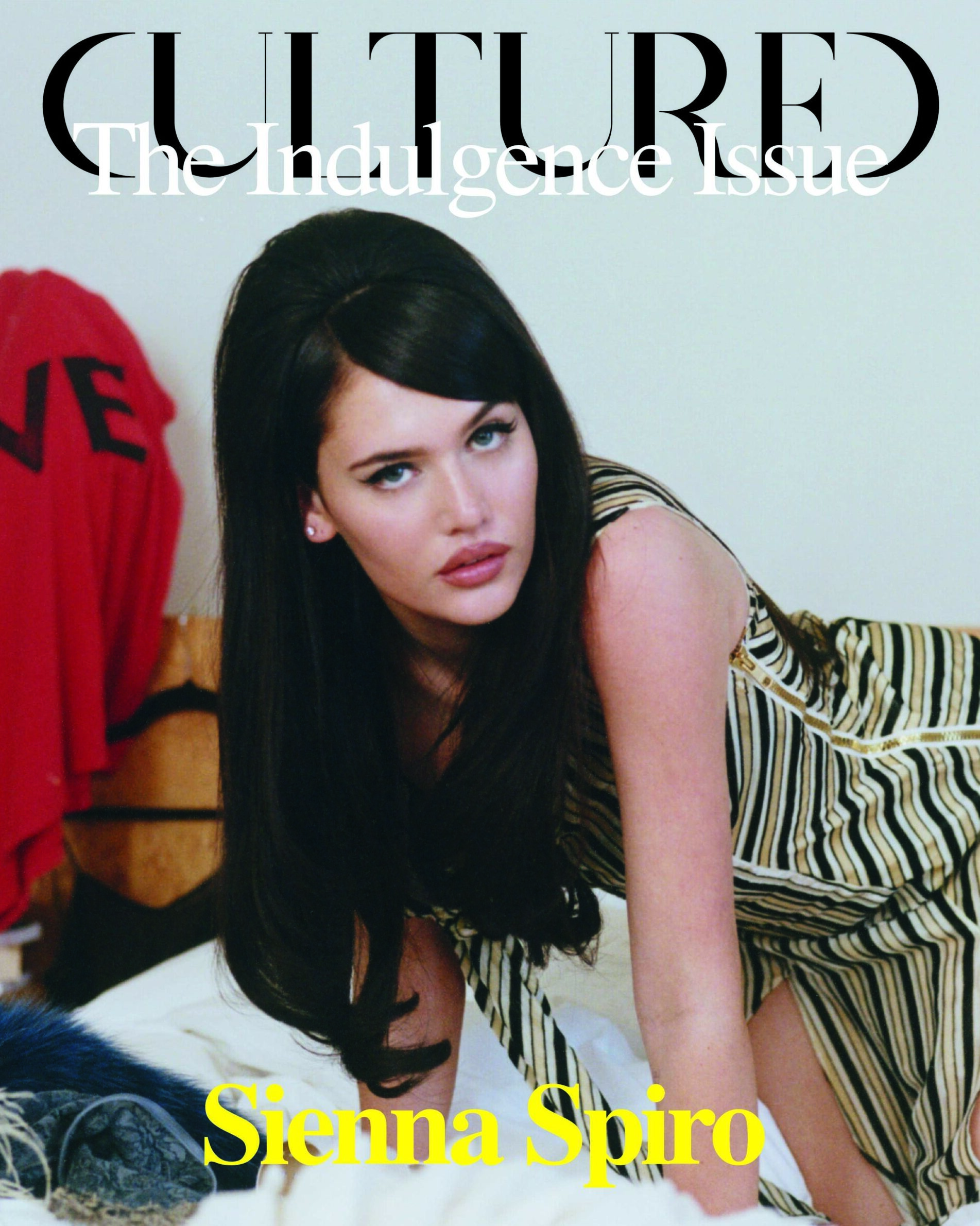
Every generation has its belters, the ones whose voices fill a whole room and then some. No Gen Z star has yet claimed the title as their own. Sienna Spiro, who turns 21 in September, is angling for it.
The London-born soul singer’s voice is mature beyond her years—world-weary with a raspy nuance so rarely heard in the age of AutoTune. A textbook ingénue, she has little formal training; she began writing songs at 10 before dropping out of a performing arts school at 16 to pursue music full-time. Spiro credits studying the records of the greats, listening attentively for every quaver, with teaching her how to telegraph the deep-seated longing all of us contain but few can crystallize.
This gift granted her a smash hit just over a year after she released her first single. The runaway success of “Die On This Hill,” amassing over 489 million Spotify streams at the time of writing, has thrust Spiro onto the stage of the Royal Albert Hall and earned her a cosign from SZA, all before she’s even dropped an LP. Ahead of the release of her debut album, Visitor, on July 3, Spiro connected with another torchbearer for jazz in the digital era, Jon Batiste, to discuss why crooning is so much more than a nostalgia trick.
Jon Batiste: How are you?
Sienna Spiro: I’ve got the flu, so I’ve felt better.
Batiste: Touring, you’ve got to keep your body together and your spirit. I get so much stimulus just from living life and walking around on tour. It’s heightened.
Spiro: What do you do if you’re, like, dying?
Batiste: At first, I was very against the idea of canceling or postponing things. I would even do stuff when I would be deathly ill. That’s an important muscle to build too. You can go out and do the show, and nobody knows. The old-school cats would play four or five shows sometimes in a night. We can learn from that, and also understand that’s not sustainable and that’s a cautionary tale.
Spiro: I feel like you’ve got to do it for a little while to earn your stripes. So I’ll just keep going.
“When I sing, I honestly black out a bit.” —Sienna Spiro
Batiste: When or where did you realize that you could perceive life and form it into a song?
Spiro: I’ve been surrounded with music for a lot of my life. When I was 10, I started writing songs because I wasn’t very good at articulating myself.
Batiste: I relate deeply. I didn’t speak until I was, like, 10. If it wasn’t for music, I don’t know if I would’ve got there because it’s a way to learn how to project what’s inside and communicate. I was listening to your record. It’s not jaded, even though there’s heartbreak.
Spiro: A lot of people immediately go to romantic heartbreak when they hear songs like that, but it is about the lessons you learn from those situations and the self-awareness that comes with that. That fear has come from being disappointed so many times. A lot of passionate people give a lot of themselves, which ends up in a lot of disappointment. You end up gaining this fear. The whole album is written about this fear of impermanence and of things being temporary.

Batiste: Were you listening to anything when you made the record, or were you not trying to channel a specific thing?
Spiro: The thing is, I’m not really a trained musician. Everything I do is instinctual. How important is knowing technical things versus being intuitive and emotional, do you think?
Batiste: The thing that you know the most is the thing that you do. I’m on this kick right now: there’s wisdom greater than logic. The most important thing is the stuff that you can express and execute.
Spiro: When I sing, I always feel like I’m connected to a higher source. I honestly black out a bit.
Batiste: Everybody since the beginning of the first drum has been trying to figure out what you’re calling a source. I believe it’s a divine stream of consciousness where all ideas come from, and it just flows through us. We’re the vessels.
Spiro: I always refer to myself as a translator.
Batiste: You’re handling fame with a lot of grace. I just saw that someone covered one of your songs online, and you brought them to the concert?
Spiro: In Indonesia. Oh my God, she was the sweetest girl I’ve ever seen in my life. She was 8 years old.
Batiste: Right now, I’m coming from an elementary school. They did a concert of my music at their school. I feel like we’re so kindred, just embracing the community and having them be a part of what you’re presenting in a way that feels like family.
Spiro: My mom would always just tell me, “Do to people as you would want to be done to you.” That is the way I felt being a fan of music as well.
Batiste: I remember, when I was in university, transcribing Prince’s parts on the Dirty Mind record. A year after that, by this crazy sequence of events, I was playing a jazz club, and Prince was there. After, he invited me to join him on tour. I was like 19 or 20.
I learned from how he listened and the way that he was able to be fully present in the music. There’s an intensity to it. It almost feels like working out. After, you’re exhausted emotionally and mentally because you focused so much on what’s happening.
Spiro: I had something similar with Sam Smith. They allowed me to sing “Lay Me Down” with them last October in New York. I get so nervous around other singers, especially ones as good as Sam. I remember when I came off [stage] I’d never felt that grateful in my life. I threw up, actually. I had no one to talk to about it. No one was with me. So I went home, and I just threw up.
“Everything’s too soft. I actually love people being mean to me, and I love a musician who puts me in my place.” —Sienna Spiro
Batiste: That feeling is of being overwhelmed with gratitude—it’s really intense.
Spiro: Especially when something you didn’t think would happen, happens. Do you know who David Attenborough is? He’s my hero. For some reason, at the last minute, they let me sing at his 100th birthday at the Royal Albert Hall. That was my first time singing with an orchestra, and I was so off time. The union musicians had absolutely no patience. They were laughing at me.
Batiste: That vibe with the union musicians—it’s business. I love it.
Spiro: I actually love people being mean to me. Everything’s too soft, and I love a musician who puts me in my place.
Photography by Fausto Elizalde
Styling by Lara Savill
Makeup by Marina Andersson
Hair by Jack Luckhurst
Production by Sara Boork
Photography Assistance by Maria Trajtenberg
Styling Assistance by Phoebe Palmer
Production Assistance by Kornelia Eklund
Order your copy of the Indulgence issue here.
More of our favorite stories from the Indulgence issue
Introducing CULTURED’s 2026 Young Writers List
‘I’m Less Vain Than I Am Tired’: Amy Adams Opens Up to Amanda Seyfried About Aging Onscreen
What Nicolas Winding Refn Learned When He Died and Came Back to Life
Andrew Rannells Has Had His Own Reappraisal of Girls, Too
A New Photo Book Sketches a History of Queer Nightlife—and Where It Might Go Next
Sign up for our newsletter here to get these stories direct to your inbox.







 in your life?
