


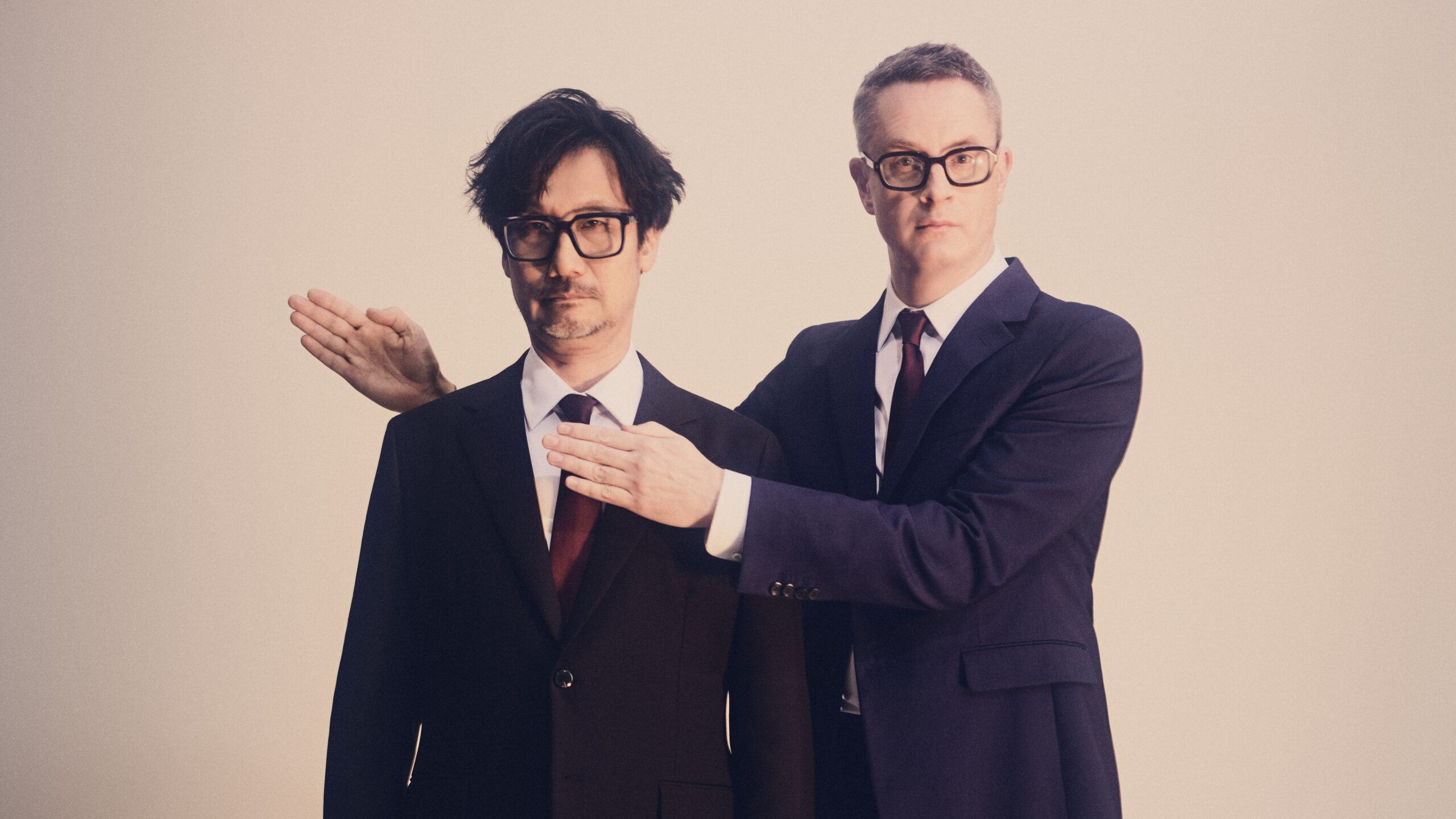
In 2019, Nicolas Winding Refn’s heart stopped. Or, at least, a virtual version of it. The director provided his likeness for a character in the video game Death Stranding, created by longtime friend Hideo Kojima. Refn’s character, a grieving researcher, artificially stops his heart to scour the afterlife for his lost family. Just a few years later, in real life, the storyline took on a startling new relevance: Refn was diagnosed with a leaky heart valve. He underwent surgery and died on the table for 30 minutes.
The director awoke recovered, but the experience imbued him with a newfound urgency to create. Within the last month, he premiered Her Private Hell, his first solo feature film since 2016’s The Neon Demon, at Cannes and unveiled a new installation alongside Kojima at the Hotel Chelsea for Prada Mode New York.
A Copenhagen-born, New York-raised film director known for saturated, ultra-violent thrillers like Drive and a Tokyo-born video game creator hell-bent on reinventing the form, Refn and Kojima have technically never even had a direct conversation, as they share no common spoken language. (Still, two decades into their friendship, the pair share a bond so deep they sometimes refer to each other as “twins.”) At the heart of their collaboration is instead a shared obsession with the boundless possibilities of the digital image.
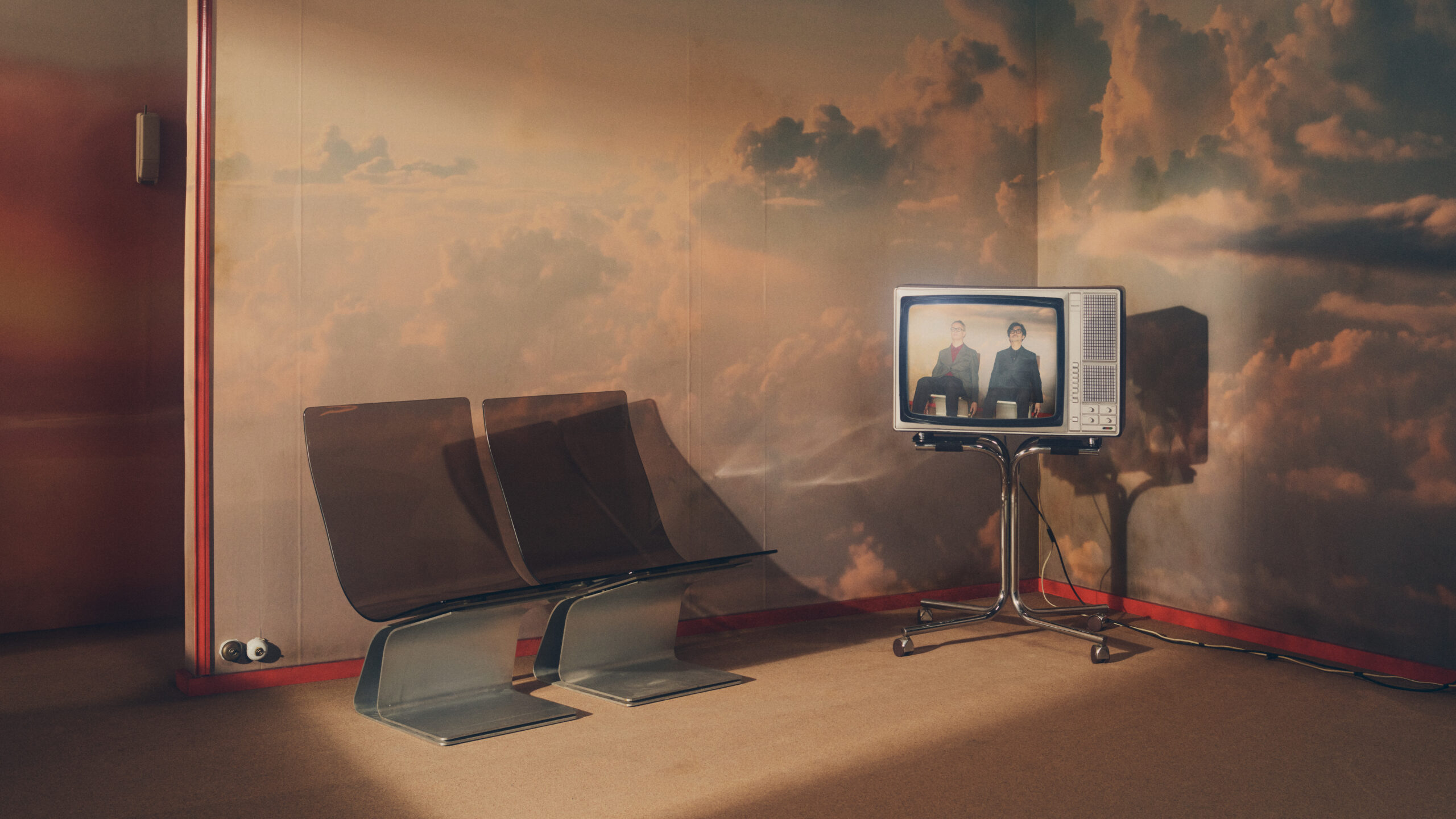
This took physical form in their Prada Mode commission, Satellites II, the sequel to the pair’s Satellites, 2025. The piece stages a conversation held through midcentury modern tube televisions spanning several floors of the Hotel Chelsea. It’s also a departure for the two artists, more personal than their other work. “Instead of constructing a narrative, we spoke of our daily lives,” Kojima told CULTURED via email. “It was the sort of thing ‘edgy’ creators like us, who express ourselves through our work, typically don’t do.” Across languages, cultures, and visions for the future, Satellites II reveals us for what we are: objects caught in each other’s orbits, subject to collisions and near misses with life and death.
Below, Refn unpacks his evolving relationship to the image, what optimism looks like in practice, and why dying was just the beginning for him.
Nicolas Winding Refn: I met Hideo about 15, 20 years ago by email. He had written me a very nice message asking if we could meet up one day, and I said, “Of course.” He was coming to London from Tokyo, and we’re so close to the U.K. here in Denmark, I just flew over, and we had a blind date dinner. We met on very neutral grounds. We never spoke directly because he doesn’t speak English and I don’t speak Japanese, so we had an interpreter between us, which in the beginning is a very awkward moment, but at the same time it’s very intimate. You end up in silence, really staring at each other. It was the beginning of a very beautiful friendship.
What was it, creatively or personally, that you think drew you and Hideo together?
Refn: I’d been approached by Fondazione Prada about the idea of collaborating on an artistic experience. I had this idea about television because television was very formative in my life because of my dyslexia. I wanted to create an installation that was about communication. The way that Hideo and I have always spoken is through images and music because we’ve actually never had a conversation. We’ve had many very in-depth experiences together, but we’re very separate universes. I like the idea of us as satellites, basically being our own little tin cans flying around the universe and then communicating through language, which neither of us really understands.
It’s almost like going to a confessional booth through the television screens. TV had always been hugely influential for Hideo because of video games. We were both screen addicts.
How did you take the initial spark of that first show and build upon it for Satellites II?
Refn: We did the first one in Tokyo where Hideo was born and raised, and now we’re bringing it to New York where I had grown up. You can say that New York created me. Obviously, the third part of the installation is going to be on Mars or something.
Having grown up in New York, what was your relationship to the Hotel Chelsea before the project?
I used to go to gymnastics at the YMCA across from the Chelsea Hotel when I was little, and there was a comic book store across next to Chelsea Hotel that I would go to every time I would visit the YMCA. For me, it was just another hotel. I was way too young to understand the significance of who lived there.
But when it got time to move the installation to New York, I wanted a place that has iconography but is also part of my past because so many things have changed and closed and moved. I remember that neighborhood. I walked that neighborhood 1,000 times as a child. Coming back, it felt like a very easy decision to make.
I’m curious to hear you talk about childhood as being an inspiration for this. I don’t necessarily think of your film as that childlike or rooted in childhood.
When I came to New York from Copenhagen, in ’78, I was 8 years old. Besides the tall buildings, which obviously was very unique, and the enormous amount of different cultures that didn’t exist in Copenhagen that same way, what really exploded my mind was that I came from a society that had one television station with one hour a day of children’s programming for half an hour. Television didn’t really exist in my earlier days because there was nothing to see, which is probably a healthy thing. Then, coming to the US and seeing a thousand channels—or at least that’s what it felt like—that was my introduction to the creative space, the idea of the image. I could control it with a remote control. I could flick between emotions and ideas.
I could see many different inputs and, in a certain way, was able to create a narrative from that. Because of my dyslexia, I was always drawn to the visual medium because it was easy for me to work with, whereas anything to do with words was just incredibly difficult and took a lot of energy. Hideo is the same way. He loves the idea of using the digital image to create a sense of boundless opportunities in a game.
Satellites and now its sequel are your only installations. How is it different making a film?
We had collaborated a few years earlier when I was helping Ms. Prada and Raf on one of their fashion shows. From there it grew into more of an installation or environment for the show, and then we built a film inspired by the philosophy of the show. That was my first introduction to installations away from commercial narratives of cinema, streaming, and television to a more purely artistic endeavor.
Do you struggle with that commercial aspect of filmmaking?
Oh, absolutely. You change with your life too. I don’t know if I have the same desire as when I was younger. I was very much drawn to the cinematic image. But I think that film or television or streaming, screen narratives, are… It’s not becoming stale, but you change. You look at other opportunities to be able to express whatever is inside of you. And I must admit that these more artistic expressions are in a way more satisfying for me, or have really nurtured a certain sensibility, in my endorphins, so that I can now see a whole other life.
But it’s not to say goodbye to the past. It’s more taking what I am moving towards and helping to shape what’s in my filmmaking universe. In a way, it just becomes on giant installation.
That’s somewhat similar to Hideo’s approach to video games too, right? He’s very interested in dissolving boundaries.
It’s very true what you say about Hideo. I think one of the many reasons why we’re so connected is we have similar philosophies. And, because we’re in different mediums, we’re never competing or clashing. We’re in different settings. We’re different planets, which makes it easier to discuss and analyze what the future is going to look like. He is as interested as I am in trying to blur the lines of what is normal and what is possible.
He has one enormous advantage, which is that his canvas is still being invented. Gaming is based on what you can do technically. Film and television, unfortunately, has stagnated in a sense for many years. Even though it feeds a sensibility that obviously is very satisfying, it is always constantly fighting for its existence to be relevant. It’s interesting if you begin to see how those limitations can be turned into an advantage. I don’t know the answer yet, but it’s somewhere out there, in the future.
I think creativity is, in its essence, limitation because the tools you have to create with have limited potentials. So the fun part is to change those limitations into advantages. You turn it around into an opportunity to make it a strength, to make it an object, to make it an experience. This has nothing to do with the result. The result is just space. Whether you’re a painter, a writer, a musician, a gamer, the results are now in the hands of the audience and the world. It’s really no longer yours to say much about because it’s now somewhere else.
The process itself is where you’re alive, are the memories you take with you when you die, are the times when life becomes living. The pleasure of creativity is your own process. That doesn’t mean the meeting of the audience with your work isn’t pleasurable. It’s just more about information and communication and less about creativity.
When you talk with Hideo about the future, what do you envision?
I personally believe—and I think he does too—that the future is always expanding. You don’t get anywhere if you’re not an optimist. We can have the worst experience of our lives, but it doesn’t mean that life isn’t worth living the next day. We go through our pains and joys.
But as a person, I am just a natural optimist, even though I certainly have had my share of challenges and hardship. I still always am very happy to be alive every morning. And with having kids, you have to be positive for them. I think most people are placed on the world in certain ways to make it a better place. We just sometimes spend a lot of time arguing about how to do it.
Would you say that your work in general is optimistic? I don’t know if it’s the first word I would use to describe, say, Pusher.
Pusher and that trilogy is more about authenticity. But still, having been dead once, which I have, you really understand when you’re brought back to life how amazing it is to be alive.
Most of the time, we go through life not understanding the end. We may fear it. We may discuss it. We may experience it through family or friends, but it’s secondhand, like trying to explain to somebody what it’s like being in love. But when you try it yourself, you come to an understanding that everything is so goddamn short. You better have a good time all the time. If you’re lucky enough to come back, you have a different view on many things.
My dear friend Alejandro Jodorowsky is 97 years old, and every time I speak to him and ask him how he is, he always says, “I’m so happy I’m alive today.”
Does it change the way you make art or the projects you say yes to?
Oh, absolutely. It changes everything about you.
I think you become more sensitive to time and what time means, the value of time. And you get really annoyed at so many people that waste their time because they’ll never get it back.
Is there one project or one particular thing that you want to do now?
No, because I came to the end of the line in terms fo what I wanted to do, and then I died. But I had the privilege of starting over again. Like Donkey Kong, I’m back to square one.
More of our favorite stories from CULTURED
At 101, the Chinese American Artist Ce Roser Is Finally Getting Her Big Break
Yes, Kane Parsons Directed ‘Backrooms.’ Here’s How It All Went Down.
The Gayest Places in New York, According to Queer Culturati
Director Boots Riley and George Clinton Disagree About the Future of A.I.
The 8 Must-See Movies at Tribeca This June, According to the Ultimate Insider
Sign up for our newsletter here to get these stories direct to your inbox.





 in your life?
