


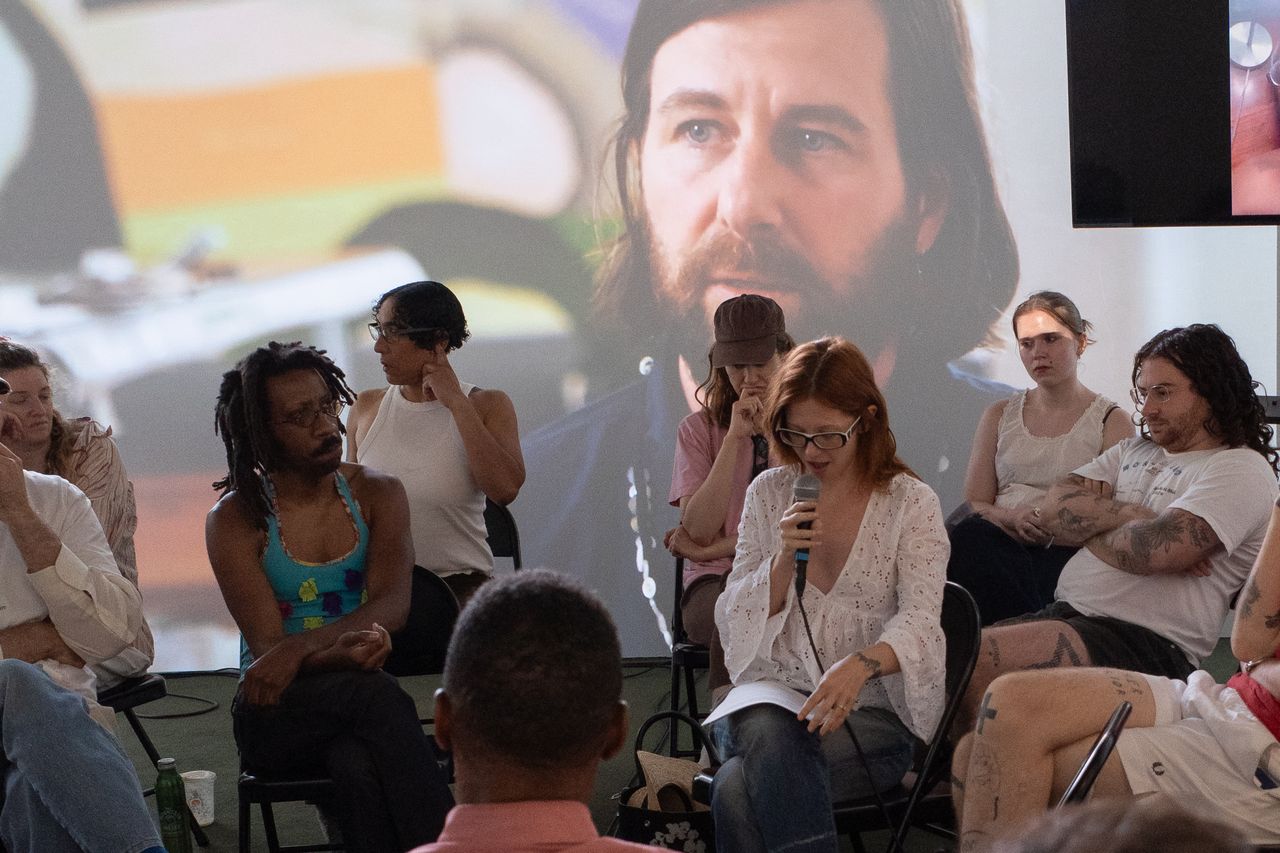
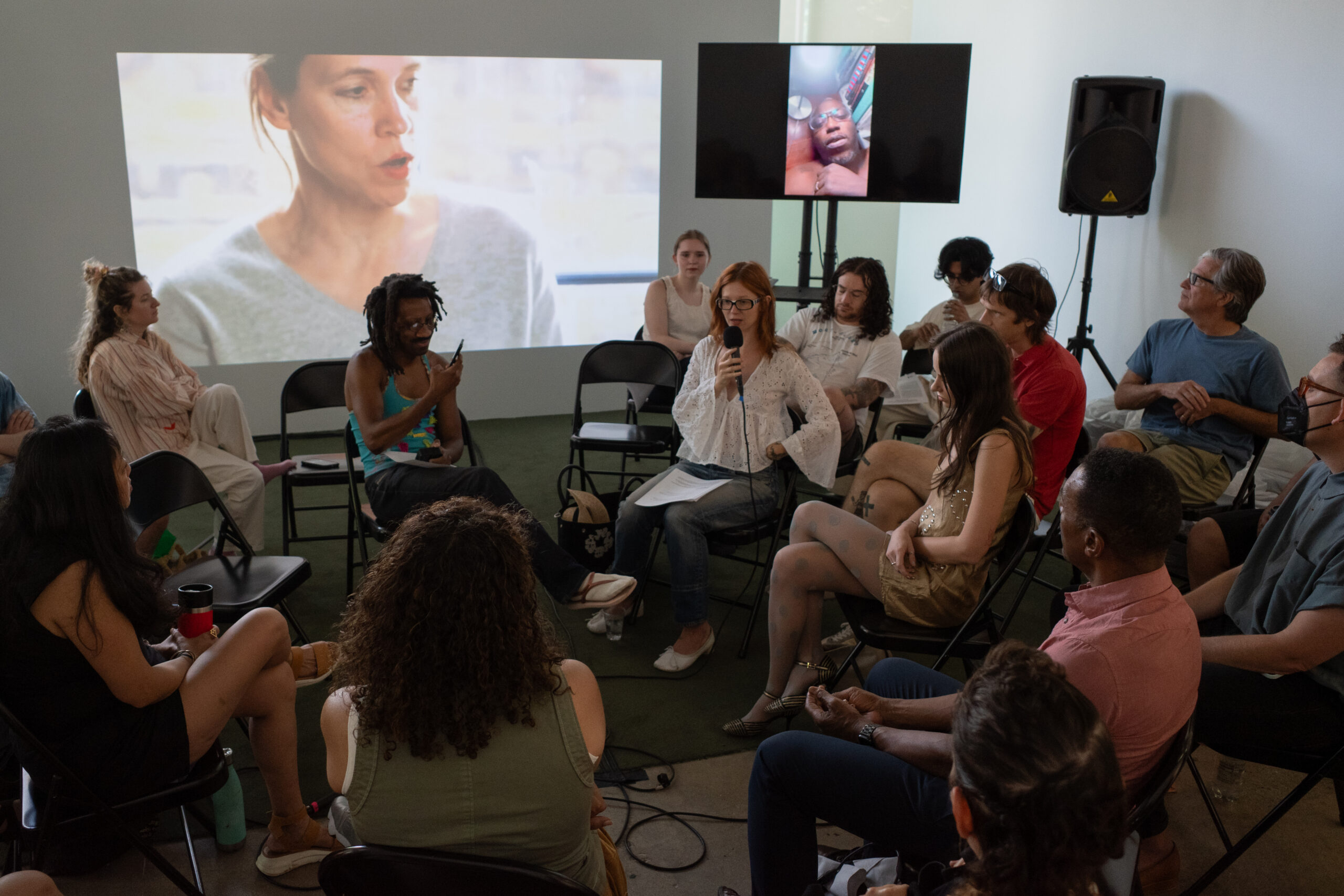
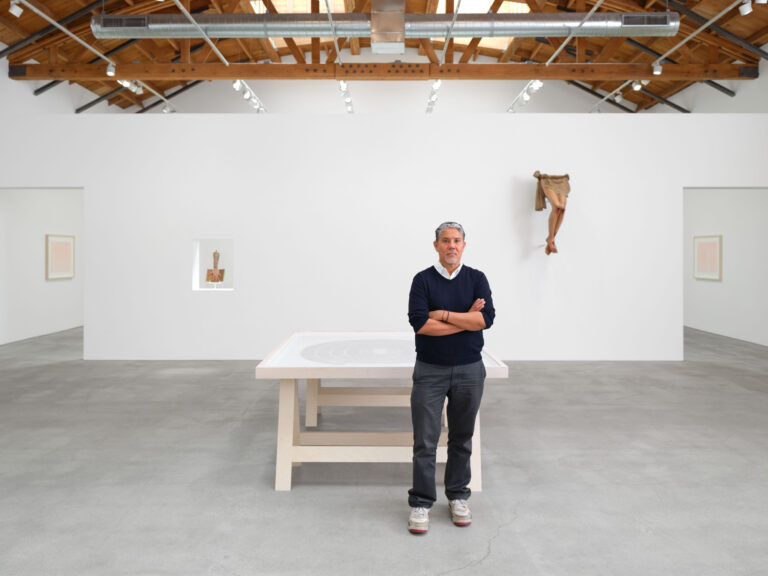
A cozy, circular arrangement of folding chairs was set up in the main gallery of artist SoiL Thornton’s Swiss Institute show, “Metabolizing eviction try, work_mp3 and other games of topping,” on June 14. The occasion: a live-event follow-up to Fiona Alison Duncan‘s finger-on-the-pulse essay “The Nine Circles of Artist Housing Hell (and How Artists Survive Them.” Duncan—the writer and organizer behind the ongoing event series Hard to Read—joined forces with Thornton to stage the intimate public talk, bringing together experts in community organizing, housing policy, displacement, racial capitalism, the local history of arson-for-profit, and more.
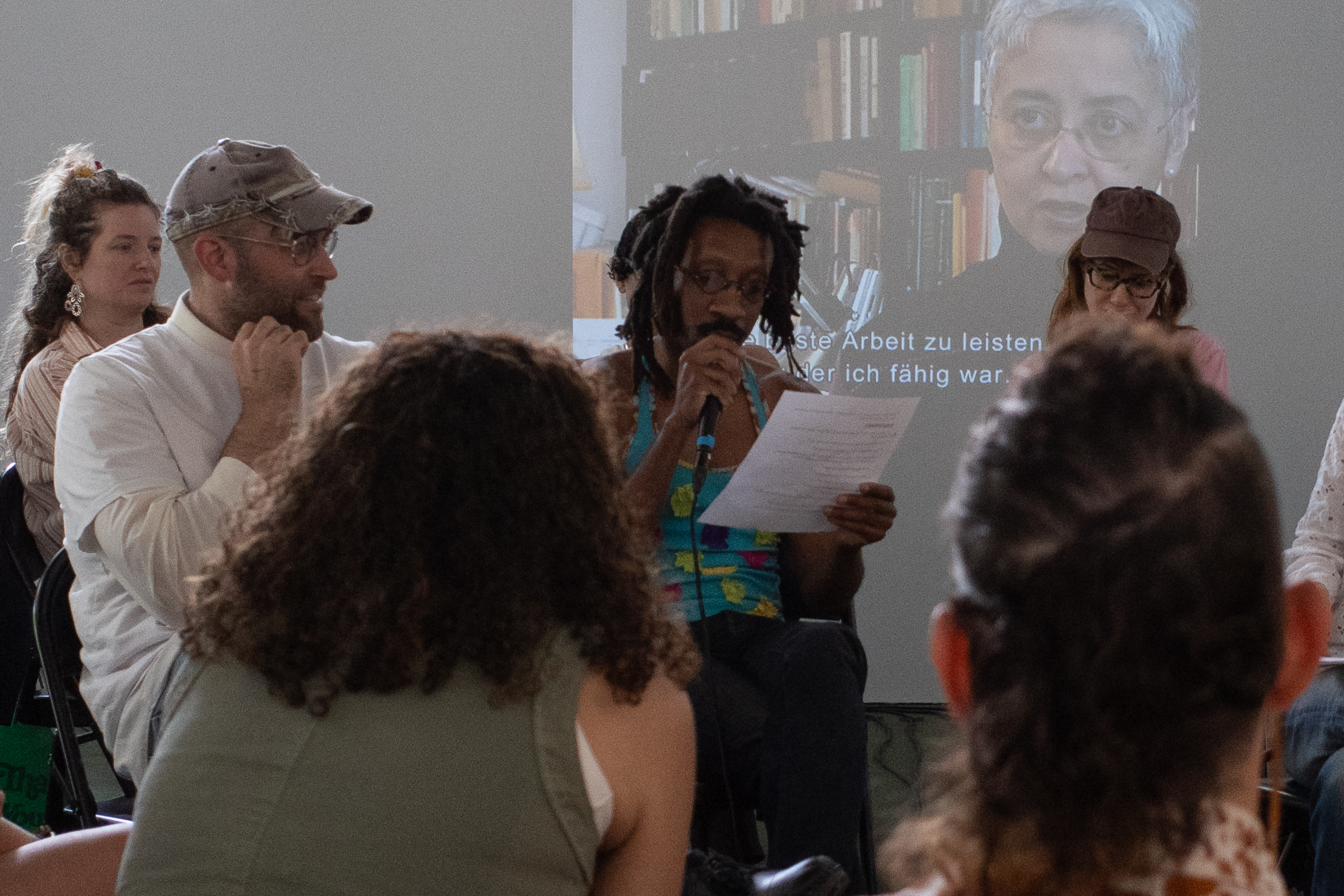
Thornton’s new video piece, the large-scale projection realization suppression / Rihanna_work.mp3, 2026, looped silently in the space, providing an apt backdrop for the conversation. A collage of 79 clips ripped from YouTube recordings of lectures and interviews with artists—each one trimmed to feature only the word work, and edited together to correspond to Rihanna’s rhythmic vocal delivery in her 2016 hit of that title—becomes a collective performance of and about artistic labor. With the sound on, it’s a halting dirge, blurring work, the verb, and work, as in “art object,” until repetition drains the word of any meaning at all.

On a facing wall, framed documents (and a worn kitchen towel) track Thornton’s recent eviction proceedings and their use of Swiss Institute exhibition production funds for relief. The piece recasts subsistence, or survival itself, as a kind of artistic practice—a concept that dovetailed nicely with the theme of the event’s pre-recorded preface, courtesy of writer, dancer, filmmaker, and choreographer Brontez Purnell.
In his video dispatch, the Oakland, California-based Purnell lies supine on the floor while riffing on his laugh-until-you-cry Substack post about applying to Starbucks as a middle-aged artist (“In one week, I got a rejection letter from the Guggenheim, the PhD in Performance Studies program from Stanford, AND Starbucks, but admittedly the Starbucks one was the only one that REALLY REALLY REALLY hurt”). “How am I paying rent?,” he asks the camera, “I’m not paying rent. I am actually three months behind. How am I surviving this year? I am not, and some years we don’t survive, right?”
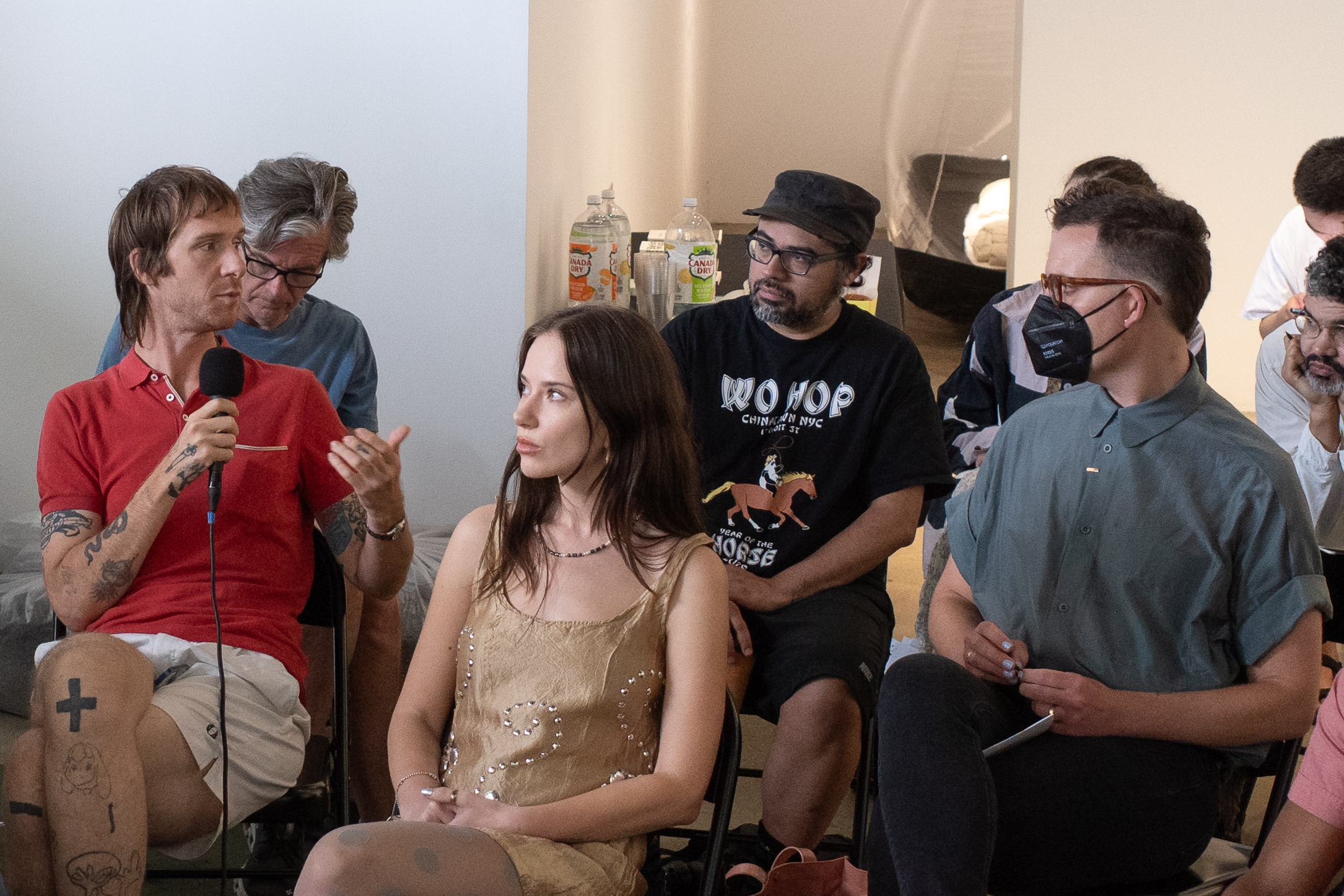
The two-hour workshop, featuring speakers Ariana Faye Allensworth, Bench Ansfield, Matt Hilvers, Marc Norman, and Betty Yu, culminated in a dialogue with the attendees that, among other things, questioned the construct of the side-hustle, asked why artists often don’t think of themselves as workers, and argued that the creation of new cultural institutions must happen in parallel with the creation of affordable housing. The excerpts included below have been edited for length, and a little bit for clarity. And while they represent the distinct perspectives of the thinkers in the room, they only hint at the afternoon’s nuanced and heartfelt exchanges.
Fiona Alison Duncan
Writer, organizer behind the ongoing event series Hard to Read.
We’re here today to workshop creative solutions to the tenant and unaffordability crises in New York, the U.S., and the world more broadly … We want to see what would happen when artists are in conversation with civic practitioners, people who work in finance, infrastructure, community organizing, et cetera. Many of us here do both. We do art, we do it all.
When we talk generally about artist struggles with money and housing, we are talking about the struggles of working people at large—the majority of people now who aren’t getting their basic needs met, whether that’s in terms of health care or housing. Given the odd, often creepy structures of the art market and creative industries, and given artists’ heightened sensitivities and creativity, we have both unique struggles and models to offer regarding how to get by. In the Mamdani administration’s housing plan, “Block to Block,” there’s a list of renters who make New York great and deserve to have fair rents. [As the plan reads,] “They are taxi workers, bus drivers, teachers, nurses, service workers, artists, and more.” So, artists make this list, and there’s a lot we could talk about today.
Bench Ansfield
Assistant professor of History at Temple University, author of Born in Flames: The Business of Arson and the Remaking of the American City.
This is an amazing exhibition—and so needed. There’s so little cultural conversation around housing outside of very specific silos. That’s true in my world, the history world, but it’s also true in the art world. The book that I wrote is about the way landlord arson coursed through U.S. cities in the 1970s—not just in the Bronx, which people know more about—but also in other parts of New York and in Philly, Phoenix, Los Angeles, all across the country. These fires are commonly confused with the uprisings of the 1960s—I’m not talking about fires that were started for protest. These were for profit, most of which flowed into—ironically—the fire industry, finance, insurance, and real estate. At the center of the project is a state-subsidized fire insurance program called the FAIR Plan that was created ostensibly to end insurance redlining, but it was actually more of a bailout for the insurance industry. It incentivized landlords to burn their buildings down. I’m really interested in how the rise of financialization happened right on the heels of the major legal and legislative victories of the Civil Rights movement—what does the coinciding nature of those two things tell us about this moment in racial capitalism in the late 20th century?
Ariana Faye Allensworth
Artist, designer, and cultural worker from San Francisco whose practice explores interwoven histories of land, power, displacement, and Black spatial memory.
The Anti-Eviction Mapping Project is a volunteer-run housing justice collective. We’re artists, cultural workers, geographers, and community organizers. The project started in San Francisco in 2013 around a table at the San Francisco Tenants Union, among community organizers who were grappling with the impact of the tech boom 2.0 of the early 2010s.
For those not familiar with the geography, Silicon Valley is an approximately 30-mile drive from San Francisco. The tech companies were facilitating these reverse-commutes for workers, so they could live in the hip, cool, gentrifying center of San Francisco … One of the early maps that we made visualized evictions and their proximity to these tech bus stops … Landlords were really incentivized to promote their proximity to the stops, to attract a new corporate class of workers. This was happening in parallel with the rise of corporate landlordism and in the shadow of the foreclosure crisis, where folks were being evicted by anonymous LLCs and shell companies … A lot of our early work was disentangling the webs of property ownership to support organizers in their direct-action work. That continues to drive our work. We now have chapters in LA and here in New York. We are not producing maps for maps’ sake; we are producing maps that support tenant organizing.
I am a descendant of the founders of a historic Black agrarian community called Allensworth, California. It’s in the Central Valley of California, which is at the heart of the big agribusiness industry that feeds a lot of our country. The town was started in 1908 by formerly enslaved folks who were trying to reclaim their relationship to land and build their own self-determined autonomous community free from the terror of the Jim Crow era … There were hundreds of Black towns after Reconstruction that started under a separatist model to respond to the failings of Reconstruction and the false promise of emancipation. I’m currently in the process of starting an artist cooperative [in Allensworth] to support some of the ongoing struggles of land sovereignty and climate precarity that the region is experiencing now.
Marc Norman
The Larry & Klara Silverstein Chair in Real Estate Development & Investment, Associate Dean of the Schack Institute of Real Estate at New York University.
I’m from Los Angeles. I came to New York during this post-abandonment and displacement era, when the city was still the largest landowner. So, the work I did in New York was at the tail end of the time when the city had the ability to give land to nonprofits for a dollar. My job as part of a community-development financial institution was to help fund housing that would be permanently affordable. I did that for 10 to 11 years before moving to a consulting firm to help other cities across the country think about how to use their land, how nonprofits could skill up to actually build housing, so that it wasn’t built by private developers, and so that it stayed permanently affordable.
Some of these programs, which had a 30-year affordability period—it sounded great in the late 90s—are now expiring. I think there was a misplaced notion that, well, the crisis would be solved by the 2020s. A lot of private affordable housing reached the end of its mandated affordability period and is now being sold, being converted to market-rate housing.
Right now, the Mamdani administration is mapping all the publicly owned land, primarily for affordable housing. I think the next step is to ask, “What’s the process for getting it, developing it, owning it?” Who gets access to that? Because it’s one thing to map it; it’s another thing to have the capital ready to build it. Also, can we imagine an apartment or another dwelling unit that doesn’t look like a conventional one-bedroom, that looks somehow different? Where you might be able to live or work or have a studio? All these things that prevent experimentation and innovation are in the building code, which I think we could also look at.
Betty Yu
Award-winning socially engaged multimedia artist and activist; co-founder of Chinatown Art Brigade, a cultural collective using art to advance anti-displacement fights.
I was born and raised in New York, raised in Sunset Park. Chinatown Art Brigade was founded in 2015. We worked very closely with the Chinatown Tenants Union and CAAV [Committee Against Anti-Asian Violence]. CAAV is a 40-year-old pan-Asian organizing group that started out initially showing solidarity with people of color who face police brutality, and over the years has become an organizing group around all issues. Housing is one of the big ones, because in Chinatown, as you probably all know, after 9/11, we saw the land grab by real-estate developers. A lot of what we’re seeing now in Chinatown and the Lower East Side is a result of policies and zoning laws that changed in and around after 9/11…
Often artists, who are in the vanguard, as well as cultural institutions, are part of the problem. We were finding that, as we were doing this work, a lot of artists and galleries were looking to us. And we honestly wouldn’t have anything to do with the commercial galleries in Chinatown at this point. The galleries were replacing mom-and-pop storefronts—the bakeries, the restaurants, all the affordable places. We had a big town hall meeting in 2016 at Artists Space, which was hosted with Decolonize This Place, an organization that we worked closely with, especially at that time. And all these galleries came. It was right after Trump was elected, and there was all this white guilt … But the art galleries themselves are not the problem, right? They’re the Trojan horses that the real estate developers use in every single neighborhood in NYC, from Harlem to Bushwick to every other neighborhood…
Our big fight now is against the jail that’s being built, which folks probably know about—the tallest jail, they call it “the jailscraper”—in Chinatown. We’ve done a lot of organizing, cultural organizing bringing folks together, connecting issues like Land Back and Palestine, gentrification and abolition, because all these issues are completely related.
Matt Hilvers
Artist from Chicago, based in New York.
It’s hard for me not to think about housing as a collective issue the same way that I think about transportation in New York as a collective experience that we’re all sort of working through. When I’m walking on the streets, I’m painfully aware that cars have more space than people do. The only reason that we’re bumping into each other is that because we’ve given so much space in the city for cars to move. I think of cars as creating these really isolating experiences, conversely, buses create the collective.
I understand that free public transportation is the way forward, and in the same way, I think the only way forward for an artist to live in New York City—to be a part of my community, to be in this place that I love, to live and work—is with the lowest overhead possible. The only way that I’ll be able to exist here is by maintaining the lowest overhead. I’m painfully aware that some investment syndicate can buy a building 10 times more easily than a collective of artists could purchase a building together. But I’m wondering, what would it take to have some sort of low-equity city-sponsored collective housing purchase exist? You want to believe, like Brontez was saying, that you’re a few months away from having that great year that allows you to exist in prosperity, but the likelihood is that we’re all a month away from living in the place of not surviving. Finding that place of stability requires that kind of capital. How could we get to that point?
More of our favorite stories from CULTURED
America Is Turning 250. These 13 Must-See Exhibitions Are Grappling With Its Legacy.
Is This 28-Year-Old Our Next Great Playwright?
Tiny Can Be Mighty. These Cottages Are Here to Prove It.
Paul Thek’s Difficult Afterlife: David Rimanelli on the Cult Artist’s New York Shows
Olivia Wilde Takes a Second, More Successful, Swing at Failing Marriages in ‘The Invite’
Sign up for our newsletter here to get these stories direct to your inbox.




 in your life?
