


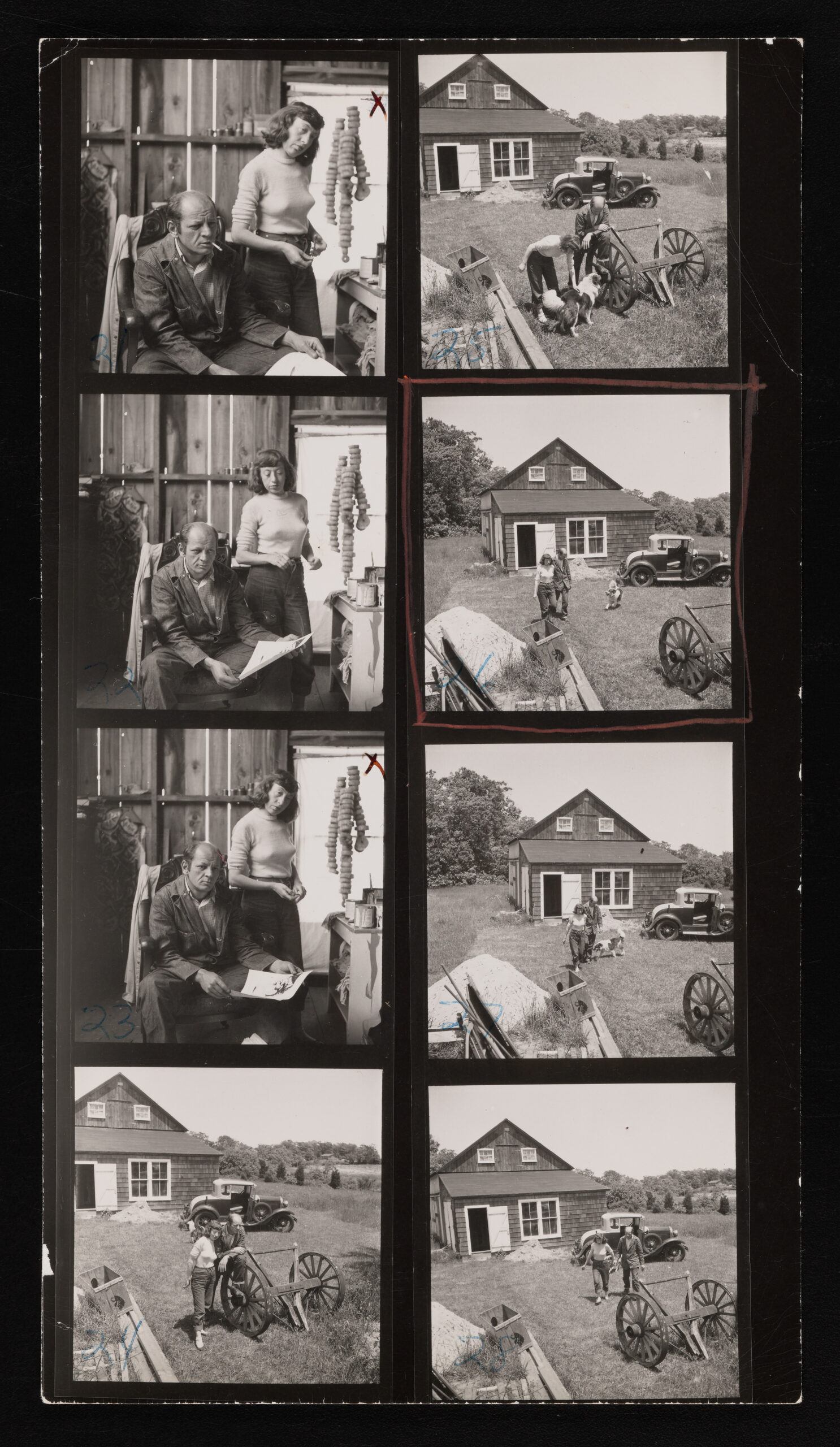
In late 1941, a 33-year-old painter named Lee Krasner reviewed a list of artists included alongside her in a group show in New York. She recognized them all except for one: Jackson Pollock.
It didn’t take long for Krasner to show up at the unfamiliar artist’s studio on Eighth Street to introduce herself. Before long, the two were in a relationship. “It was only later I learned that people don’t just walk into Pollock’s studio—not even his brother, who lived just across the hall,” Krasner said in a 1972 interview.
For nearly 15 years—until Pollock drove into a tree while drunk, killing himself and another passenger—the two formed one of art history’s most consequential and tumultuous unions. They were something of an odd couple: a Brooklyn-born Jewish woman who grew up poor and clawed her way into an elite arts education, and a Wyoming-born transplant who had been expelled from high school twice.
You’re probably familiar with the key beats of their story, at least as they were captured in the lush Life magazine profile from 1949 or the 2000 biopic starring Ed Harris and Marcia Gay Harden. (Jennifer Connelly plays the artist Ruth Kligman, Pollock’s paramour, who survived the 1956 car accident.) There was Pollock’s descent into alcoholism and depression; their escape from the city to a farmhouse in Springs, New York; and his famed artistic breakthrough in their barn, flinging paint across canvas to create his iconic “drip” paintings. In one photograph published in Life—under the headline “Is he the greatest living painter in the United States?”—Krasner wears a plaid apron, smiling blankly while washing dishes. Pollock sits beside her, drying a plate, cigarette dangling from his lips.
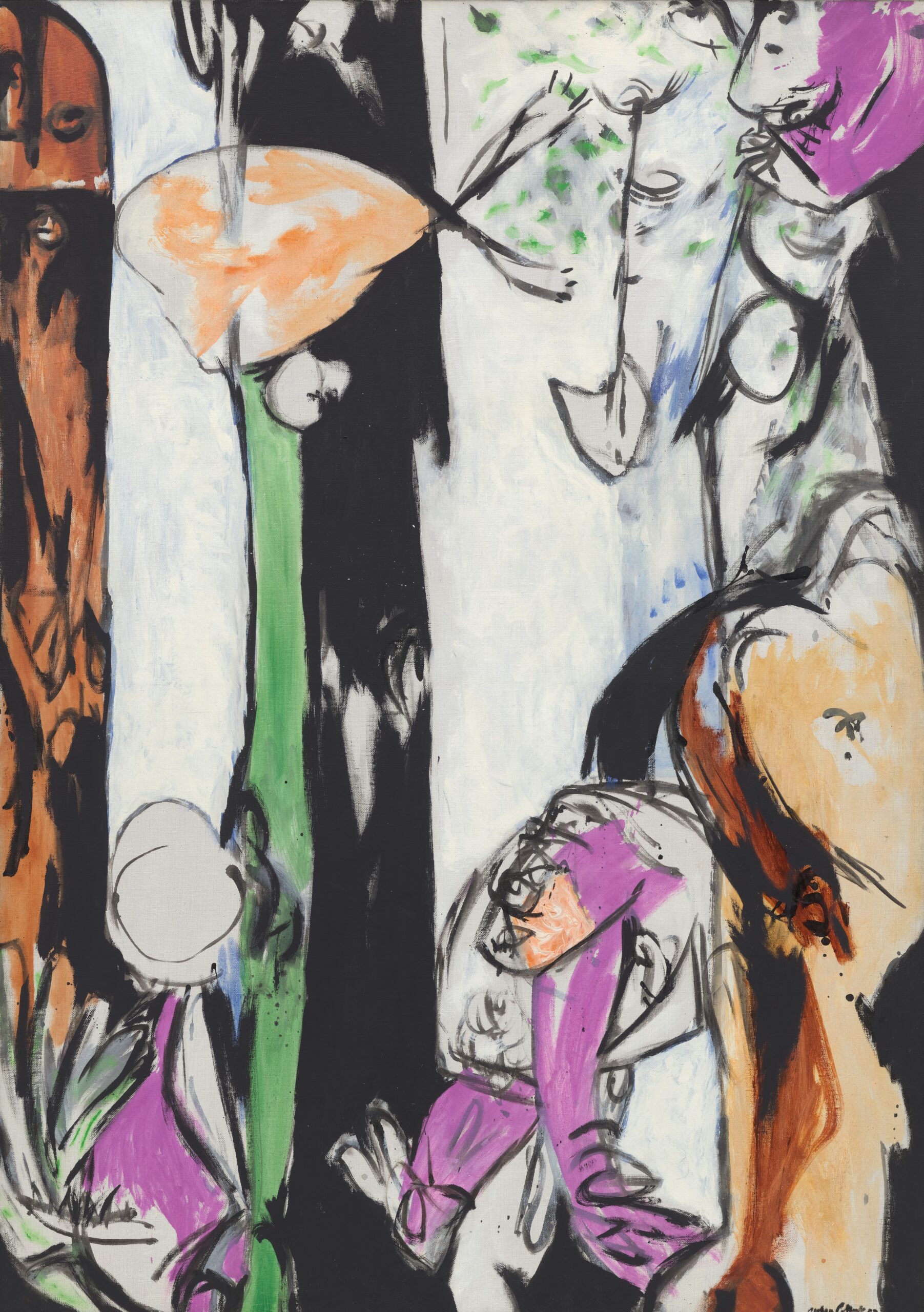
This is the first draft of history: heroic and tortured artist, doting wife.
Then came the second draft: a counternarrative. A few months after Krasner’s death in 1984, the Museum of Modern Art in New York debuted her first full-scale museum retrospective. Her vast, relentlessly inventive body of work—from small collages to mural-size abstractions—snapped into focus. Critics proclaimed Krasner’s brilliance using phrases like “out of the shadow,” “long overdue,” and “in her own right.”
The problem, according to David Breslin, the curator in charge of modern and contemporary art at the Metropolitan Museum of Art, is that this story has failed to evolve any further. Even when the Barbican staged an acclaimed Krasner retrospective in London in 2019, the language around her contributions remained similar. Decade after decade, she emerged from Pollock’s shadow, but was never entirely free of it.
With “Krasner and Pollock: Past Continuous,” which opens at the Met on Oct. 4 (through Jan. 31, 2027), Breslin and the show’s co-curator Brinda Kumar hope to close that chapter once and for all. Through more than 120 works by the artists, the museum will present the couple’s parallel lives and oeuvres, capturing their distinctive contributions to Modernism. It is the first major New York presentation devoted to either artist in more than 20 years and the first show ever to look at the full arc of their careers side by side.

It might seem ironic or counterintuitive to pair two artists with the ultimate goal of freeing them from being inextricably linked. But Breslin maintains that a thorough accounting of their equally rigorous practices is the best way to “get the ghost out of the room.” He describes the objective as “putting the two bodies together and letting the shadows play against each other.”
This approach enables the curators to consider two different, equally rigorous approaches to painting and archetypes for what artistic genius can look like. Over a long career, Krasner moved through many iterations, wrestling with the legacy of Cubism, cutting up old paintings to fashion new works, and realizing her own unique version of Abstract Expressionism informed by the rhythms of the natural world. She was an experimenter, committed to painting as a practice.
Pollock, on the other hand, was a performer, shaman, and channeler who saw painting as a puzzle to be solved. But after he broke the mold with his all-over compositions, he had a crisis of confidence; he could not push the medium any further. “Krasner created a way for more painting to be,” Breslin says. “Pollock created a way for a type of painting to end.”
Although it focuses on their individual achievements, the show does not shy away from the fact that the two artists also pushed and shaped one another. Krasner was just as, if not more, responsible than anyone for creating the myth of Pollock as a lone tortured genius. After he died, she wanted to name their foundation after him, only agreeing to add her name after a friend persuaded her. (It is now known as the Pollock-Krasner Foundation.)

Krasner constantly pushed lawyers to increase the insurance valuations on Pollock’s work, raising the bar not only for his market but for the market of Abstract Expressionist painting writ large. (It’s fair to say the record $181 million sale of Pollock’s Number 7A, 1948 at Christie’s this spring would not have happened without her savvy.) “She knew the gender politics of the moment she was living in—the house wasn’t big enough for two artists,” Breslin says.
After Pollock’s death, Krasner moved into the famous barn where he had made his monumental drip paintings. There, she achieved her own artistic breakthroughs, working bigger and looser, in a more vibrant palette. “Those works that she made immediately after his death are some of the most joyful,” Breslin notes.
After Krasner died in 1984, the foundation removed the winterized panels added to the walls, restoring a Pollock-era time capsule. Today, visitors may not recognize that the barn is not only the place where he made Autumn Rhythm (Number 30), but also where she made The Seasons, 1957. As the artist Rachel Harrison notes in the show’s catalog, “You don’t see many reminders of Krasner’s paint except on her boots, perched on a stool, where they likely never sat before.” With “Krasner and Pollock: Past Continuous,” perhaps the two ghosts finally have an opportunity to coexist.
More of our favorite stories from CULTURED
12 Plays and Musicals You Need to See in New York This Fall
This Artist Has Been Quietly Painting From the Top of the World Trade Center for Over 25 Years
Are Reddit Boys’ Struggle Apartments Actually the Future of Design?
At 76, Artist Carroll Dunham Is Starting Over
Naomi Klein and Astra Taylor Explain Why Trump Bet His Entire Presidency on A.I.
Sign up for our newsletter here to get these stories direct to your inbox.








 in your life?
