


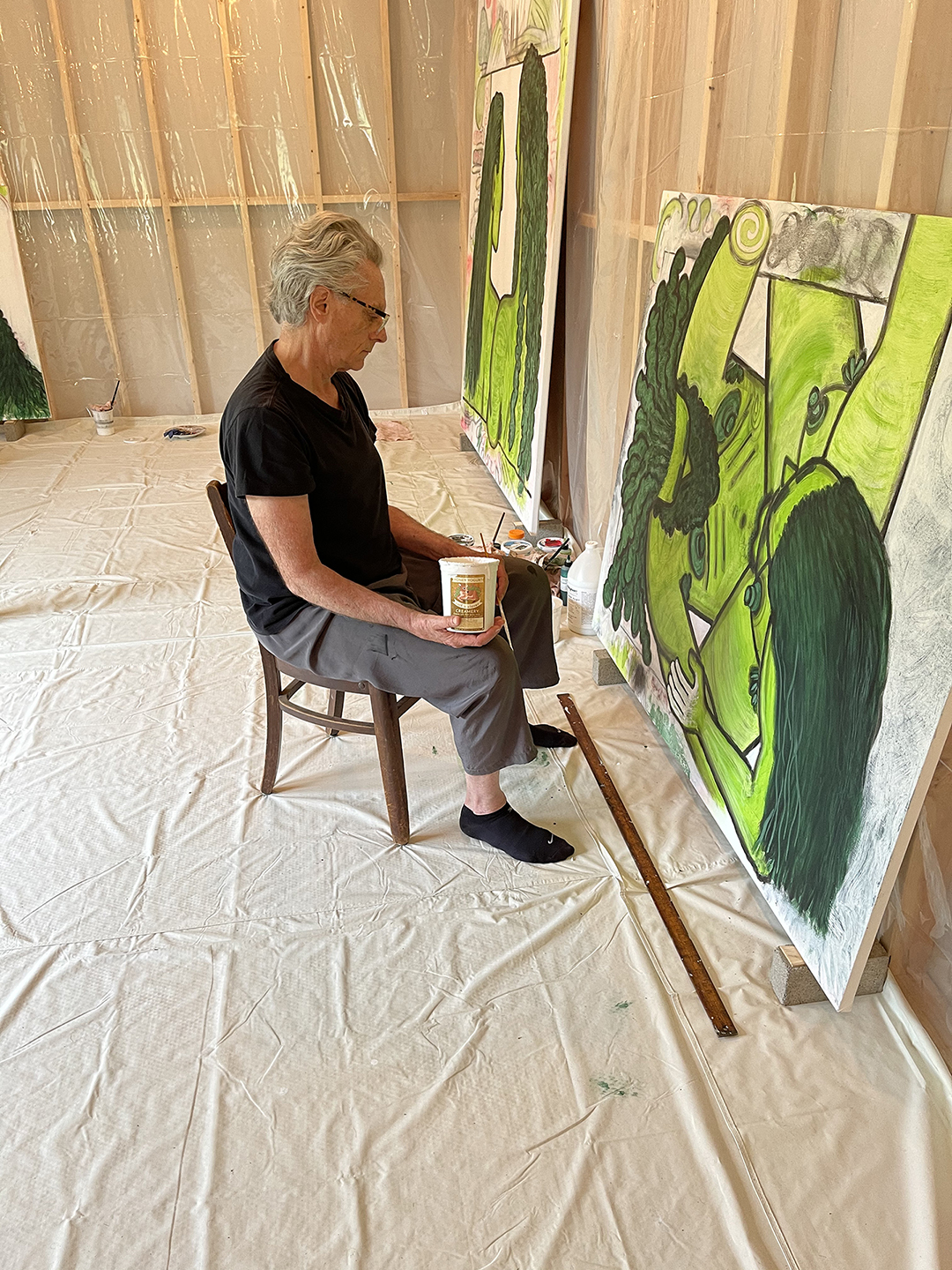
In the early 2000s, after decades of painting surreal, unnerving images in cartoon-bright colors, Carroll Dunham decided to give sculpture a try. A fabricator fashioned silhouettes from steel, with cut-outs and black paint that gave them a shadow-play feel. Dunham still keeps some around, but he didn’t much like making them. Or, to be more precise, having them made.
“Needing to have these fabricators involved made me feel disconnected from the objects,” Dunham tells CULTURED from his pine-paneled studio in rural Connecticut. So he quickly abandoned the project. But he adds, “I’ve thought about them a lot over the years.”
Fast forward two decades, and Dunham found himself making paintings and drawings featuring a sculptor at work. The series will be on view at Matthew Brown Gallery in an exhibition opening Sept. 9.
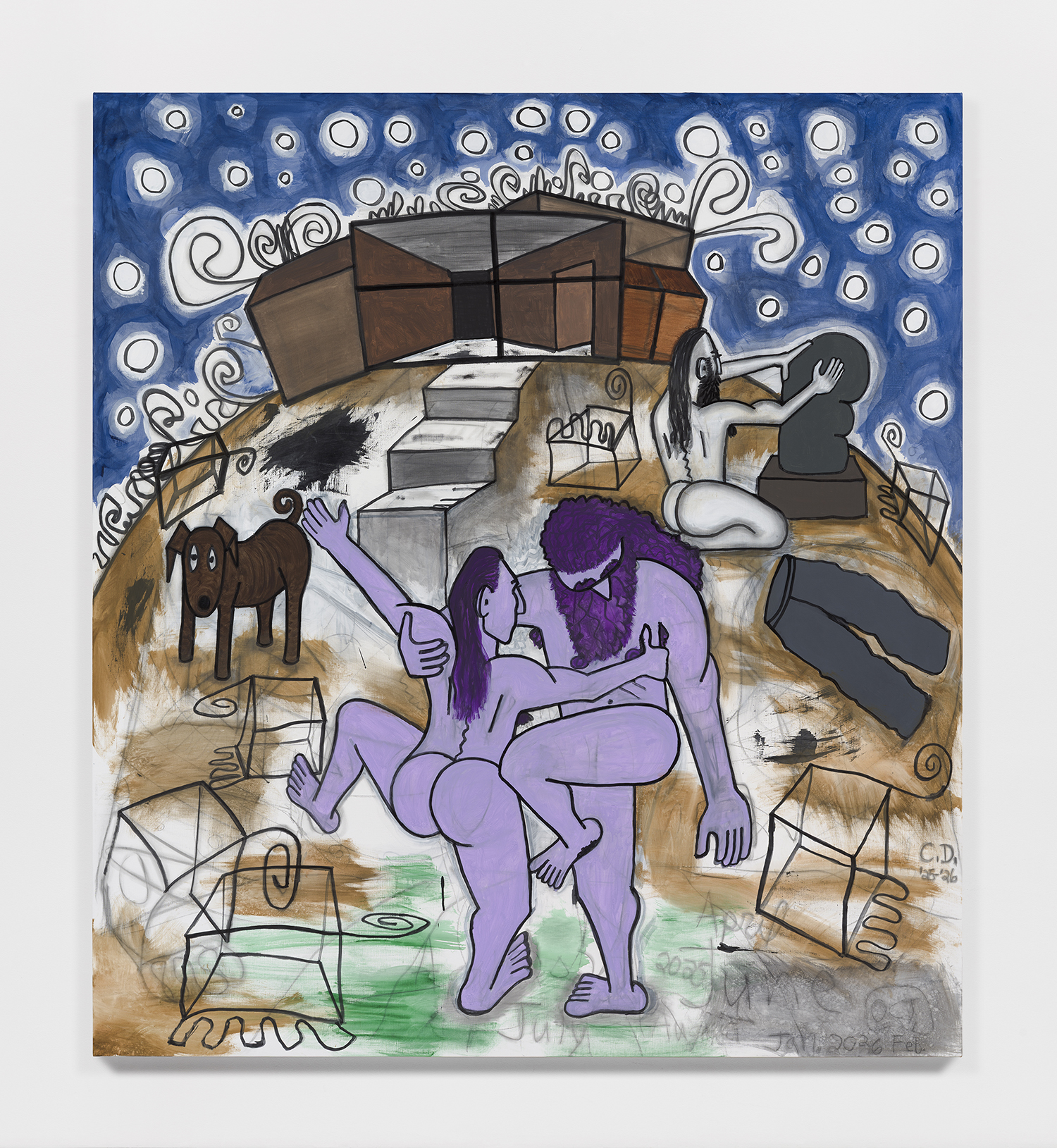
The body of work envisions a parallel universe where a space-traveling artist has landed on a planet inhabited by purple-hued figures who seem at turns friendly and menacing. Just as the rendered artist is intent on exploring his creativity, the paintings had the very real-world effect of coaxing Dunham back into sculpture—and a new career phase—in his 70s.
The show marks a fresh beginning for Dunham in more ways than one. It is the artist’s first outing with a new gallery in New York after a two-decade run with the better-established Gladstone. Dunham says he made the switch not out of discontent but in pursuit of a “vibe shift.” “I’m 76,” he notes. “I thought it would be interesting to have a change.” (Gladstone’s founder, Barbara Gladstone, died in 2024, although her business remains operational.) He is also preparing to open a retrospective of his paintings at the Institute of Contemporary Art, Miami, on Dec. 1. And behind the scenes, he is returning to making sculpture. Those works will make their public debut at the Chicago gallery Corbett vs. Dempsey in May.
As he tells it, Dunham had tired of painting but was intrigued by details that recurred in the canvases—curvy rococo flourishes, some resembling Js or Gs. He began to draw them incessantly, like doodles, eventually realizing “that I could imagine them as real things,” he says.
Friends connected him to Maxwell Heiges, who runs a Brooklyn metal workshop. This time around, the process felt less like handing over instructions and waiting for the finished product and more like collaborating with master printers, “where I have ideas, they have skills,” he says. “We’re in the room together, and we figure it out. It’s much more improvisational.”
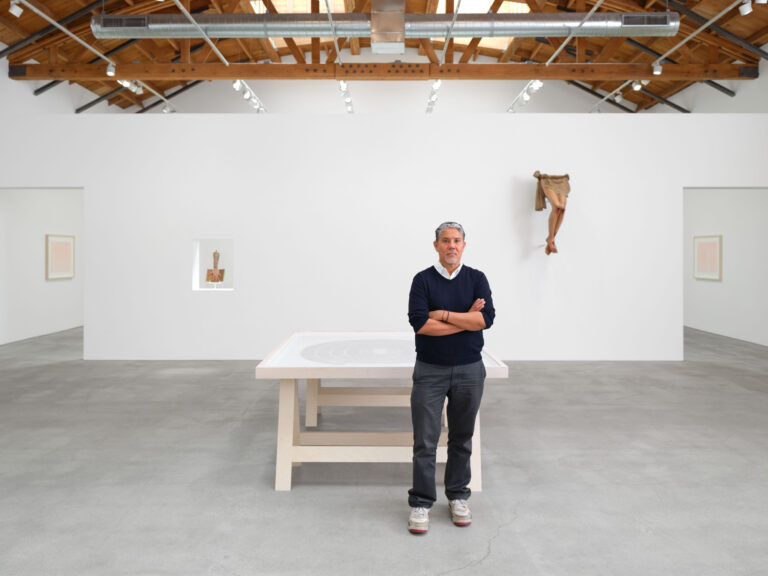
Compact in size, the pieces sit in Dunham’s studio atop wooden tables he also designed. “I like to work on things that I can handle, that I can relate to as within the scale of my body,” he says, his white hair swept back off his high forehead.
But, he admits, he’s still trying to figure them out. “If I just walked into a room and saw one, I wouldn’t necessarily jump to the conclusion that Carroll Dunham made this sculpture,” he says dryly.
Dunham has always defied easy categorization. Even for him, it’s easier to list what his work is not: For starters, he insists it’s neither humorous nor pornographic, even though some viewers have described it as both.
“I still have this idea, which sounds disingenuous, that it’s this mistake that I ended up making figurative painting,” he says. “I never imagined it when I was younger. I was completely committed to abstraction.”
Growing up in Connecticut in a family of diminishing wealth, Dunham drew as a hobby and majored in studio art at Trinity College, mainly because he had friends in the department. “A lot of it was getting high and reading Artforum,” he says. Thanks to a couple of teachers, by the time he graduated in 1972 and moved to New York, he was familiar with the art scene.
After a few years as the artist Dorothea Rockburne’s assistant, he left in order to discover his own vision. While working as a layout artist at Time in the late ’70s by day, he gained some traction in the studio. Soon, phalluses started showing up, followed by a unique vocabulary of biomorphic shapes and beings in colors reminiscent of the comics he read in his youth. Eventually, he leaned more explicitly into the figure in images that could be alternately violent and sexual. His subjects came to include bathers, trees, and wrestlers.
Matthew Brown, who is 45 years Dunham’s junior, says he and the other artists he represents—all more than 20 years younger than Dunham—are drawn to the artist’s constant evolution. “What I respect so much is, 50 years in, he’s still taking risks in a way you don’t see a lot at that stage,” Brown says. “He’s never afraid to get uncomfortable.”
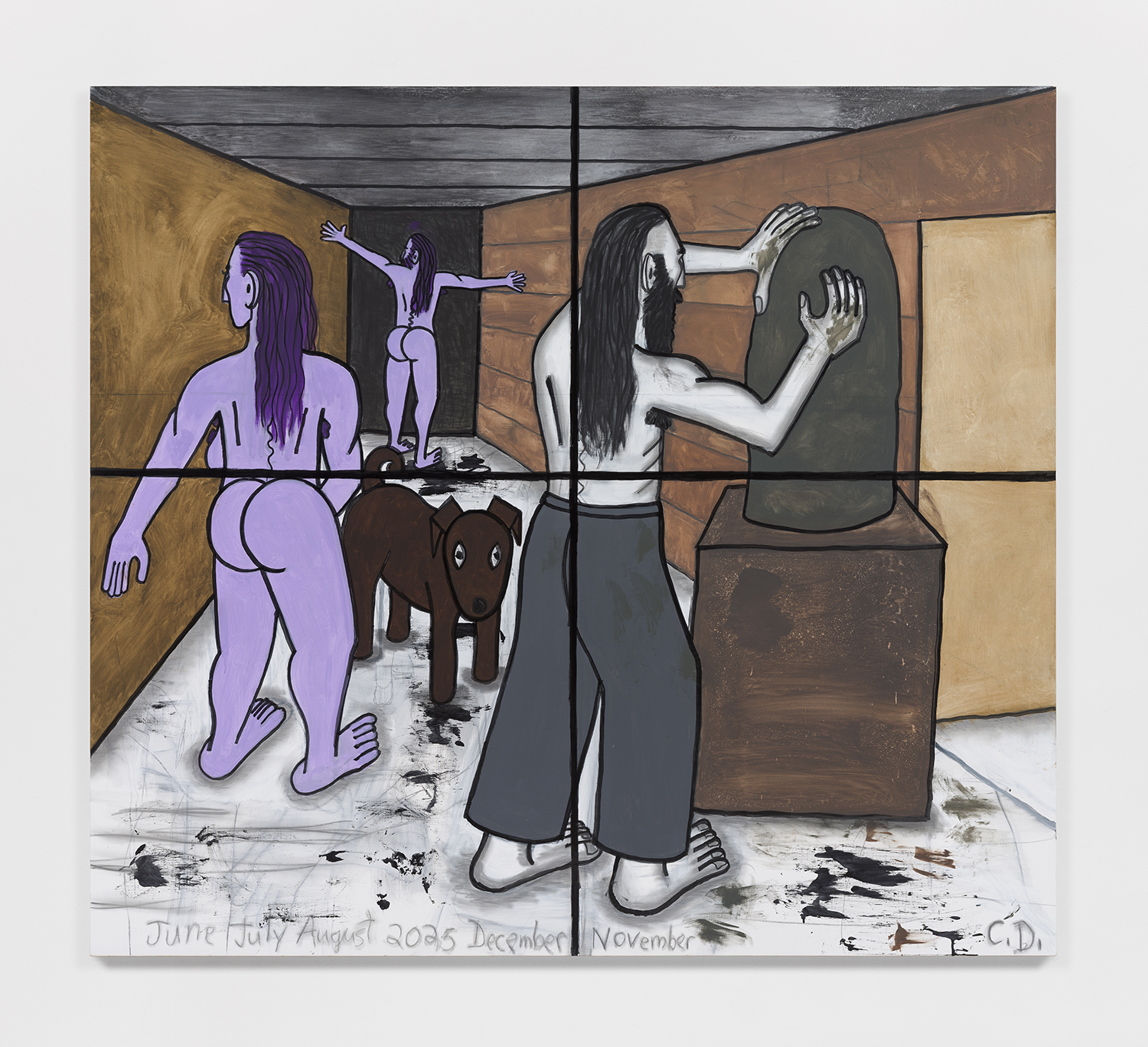
Dunham, though, is not altogether comfortable talking about his creative machinations. “I don’t think I’m the last word on the meaning—quote unquote—of my work,” he says. He winces at the suggestion that the white male artist he depicts in a wood-paneled studio is his alter ego. “But it would be pretty ridiculous for me to act as though these paintings have nothing to do with me, because I am in fact in a studio with wooden walls making sculptures,” he acknowledges. “I’m not the person to unpack this.”
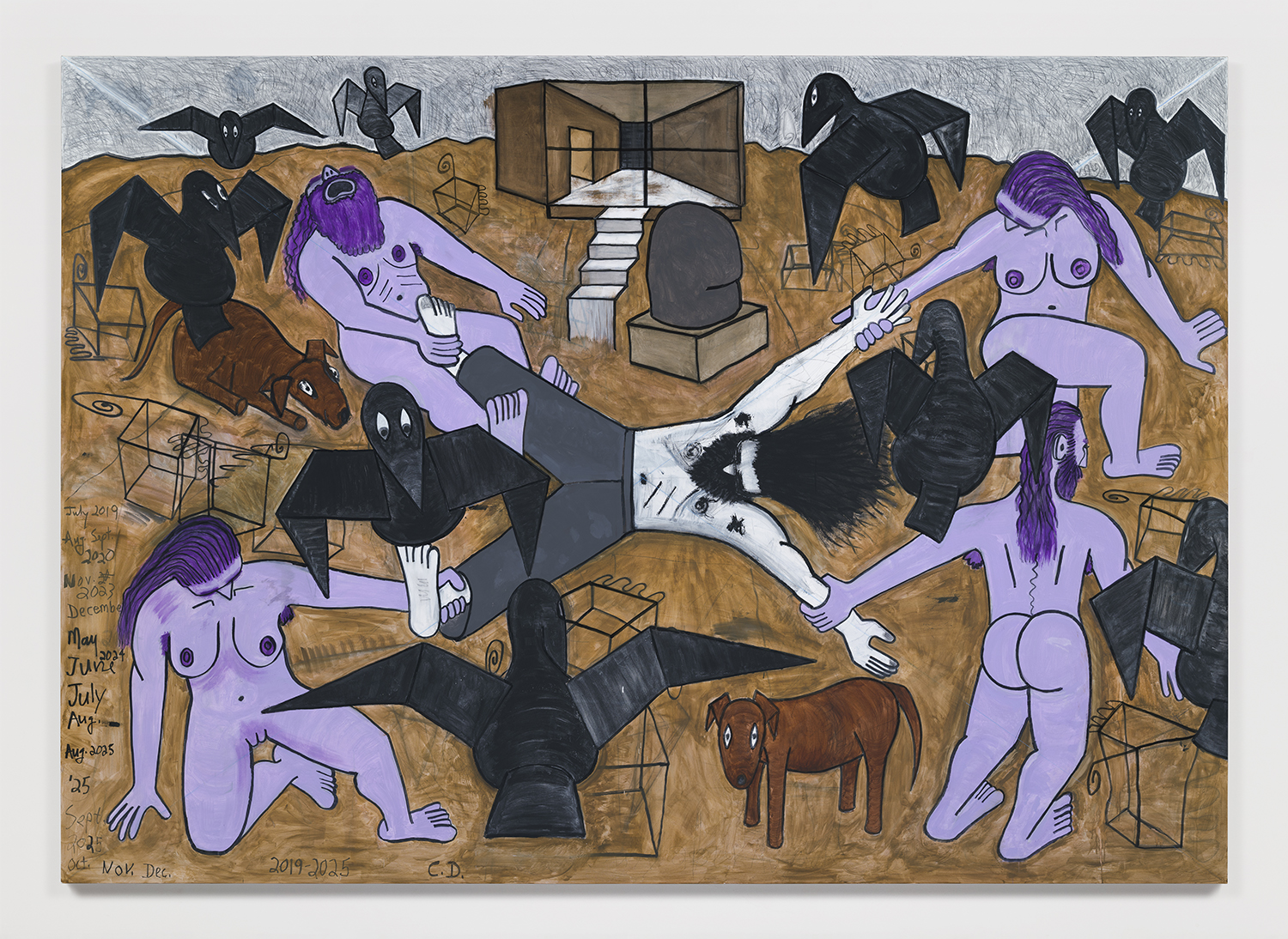
Perhaps the canvases could serve as visual aids in a therapy session. While the artist in the paintings appears almost myopically focused on fashioning the lump of clay before him, ominous black crows hover outside the studio. In what could be the series’s magnum opus about the creative process, the 12-foot-long Finished, which Dunham painted from 2019 to 2025, the artist is being ripped apart, four purple one-time muses each grabbing a limb.
In some ways, the studio may be where the drama in Dunham’s life plays out most. He has been with his wife, artist Laurie Simmons, for nearly 50 years. They raised their two children—actor, writer, and director Lena and Cyrus, a writer—in New York but now live full-time in Connecticut. Simmons’s studio is below his in the barn. Though artist couplings can prove contentious, he says non-artists typically “don’t understand the life.”
Getting recognized in public was never an issue: “What, 500 people know who you are?” So Lena’s fame came at a cost, introducing him to the scrutiny that accompanies a higher level of celebrity. “Lena and I used to go for walks a lot in New York,” he says. “We like to browse in bookstores. We like to stop for coffee. There was a point when that was no longer feasible. I consider that a loss.”
One thing he appreciates about being an artist is that there’s no pressure to retire. He’s having a busy year, with a recently concluded drawing retrospective at the Art Institute of Chicago ahead of the major ICA Miami show this winter.
Dunham says he’ll be happy to see canvases that left the studio years ago, but he also attributes his current painting hiatus and sculpture practice to the retrospective. “It’s a good problem to have, but these kinds of shows are famous for fucking people up,” he says. Seeing your life’s work in one place at one time—and reading critics’ assessment of it—can paralyze even the most confident artist.
“If it were in New York, it would be a lot worse,” he continues. “Even so, it opens the week of [Art Basel Miami Beach]. A lot of people are going to see it. It’s quite intense, I will admit it.”
More of our favorite stories from CULTURED
Everything You Need to Have On Your Cultural Calendar for Fall 2026
How Cow’s Milk and Missing Checks Brought Down Brooklyn’s Burgeoning Vegan Empire
Which Film Has the Best Fashion of All Time? We Asked Our Editors to Weigh In.
America’s College Dream Is Dying. Why Is the Campus Novel More Tempting Than Ever?
What Does It Really Cost to Be an Artist in New York? Here Are the Numbers.
Sign up for our newsletter here to get these stories direct to your inbox.







 in your life?
