


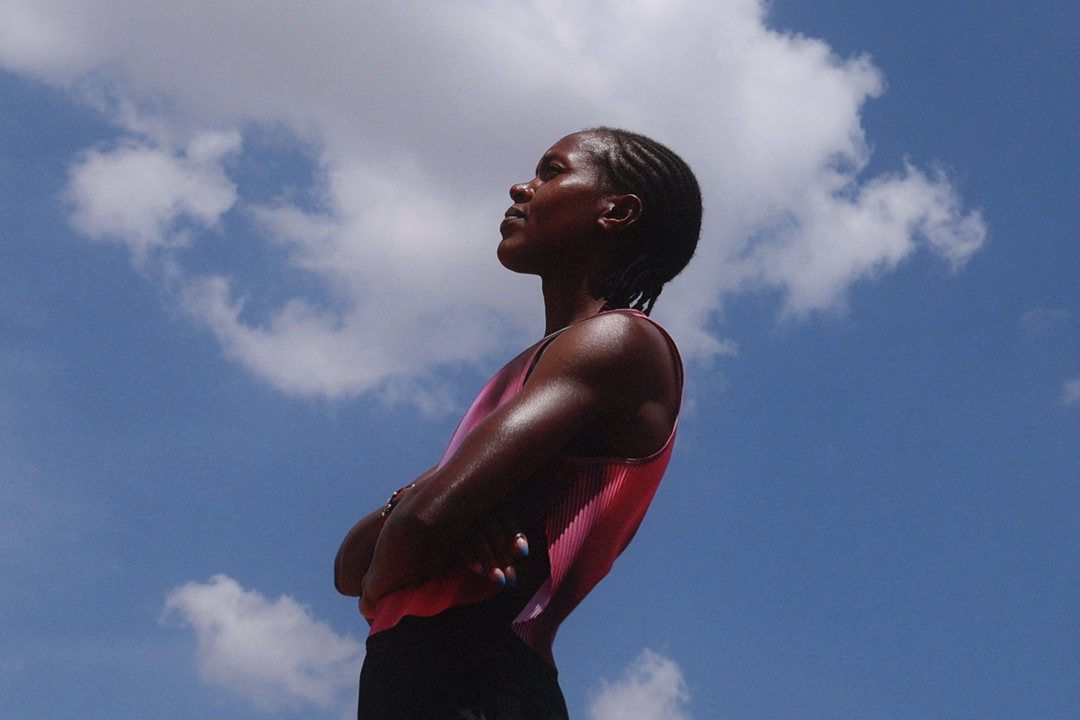
For Faith Kipyegon, there is an art to athletics. The 32-year-old middle-distance runner is the first to win three consecutive Olympic 1,500-meter titles and holds the women’s world record for the mile (a meteoric 4:07.64 seconds). Like many artists, Kipyegon grapples with her legacy: Will it be determined by the races she has won, or by the opportunities her success creates for those who follow?
With over eight major global gold medals, Kipyegon’s path to victories has demanded its share of resilience. After taking up competitive running at 14 in Kenya’s Rift Valley, she rose from racing barefoot to setting multiple world records, even after giving birth to her daughter in 2018. Last year, she attempted to become the first woman to run a four-minute mile. Despite missing the historic benchmark by just over six seconds, the effort became part of a legacy extending well beyond the track. In January, she partnered with Nike to break ground on a maternity facility in her hometown of Keringet.
“I don’t have anything else to prove to the world,” Kipyegon says. “I’m so happy that upcoming athletes are like, I want to be like Faith Kipyegon.”
The same questions animate textile artist Bisa Butler, whose quilted portraits recover and celebrate Black life and history across generations. After a recent health scare, the 53-year-old former high school art teacher—now a full-time artist—sat down with Kipyegon to talk about her own legacy and the pressure the two women feel to sustain the communities that, for so long, sustained them.
Fine art and professional sports are notoriously difficult fields to break into. What eventually made you take the plunge?
Bisa Butler: Art was the thing that I did the best.
Faith Kipyegon: In Africa, I was running away from problems. I got into sports thinking about changing the situation for my family and the community. When one girl is educated, the whole neighborhood benefits, and I thought, I have to do this to change my community. That is what has really driven me to where I am today.
Butler: My father is from Ghana. With the schooling system, if you don’t pass certain levels, you’re relegated to farm work. So by the time you reach certain levels, there is that expectation. He said he always knew that it was a prophecy in a way: You’re the one. With that, he became a college president.
Kipyegon: In Africa, you always find ways to help each other. I was raised in a humble background where finding $10 was tough. I had to work very hard to earn that $10, especially with running. I was like, I want to achieve this. I think sport will drive me to get this $10.
“We’re here for now, but we’re not here forever.” —Bisa Butler
Breaking down barriers can also make someone a figurehead. How do you think about your responsibility to your communities? Is that a source of pressure?
Kipyegon: It’s a little bit of pressure, but at the same time, it’s enjoyable. When I won my first gold medal in Rio, my community benefited: 31 families got electricity. From many years of darkness to, boom, electricity. And I was so grateful when Nike committed to putting up a maternity ward in my community. It’s a little bit much, I will say, because my community now expects more and more, knowing that this one person can change our community completely. It feels a little tough.
Butler: In the U.S. right now, African-American women have been dismissed from their jobs in the past year because it’s no longer in vogue to make sure that you have a certain number of Black employees. A lot of people are looking at me like, Okay, she found a way to sustain herself. She makes quilts. I find entrepreneurs looking to artists for this way out. What are those things that were taught to me outside of the system that are now gonna sustain me?

Do you feel a responsibility to bring up the next generation?
Butler: My students mean so much to me. About four months ago, I had a brain aneurysm; immediately, my students who had graduated years earlier came back home from college and helped me finish my projects. I want young people to realize that the skills they have are inside of them. Don’t look for external validation. You have to reach the well within; it’s absolutely possible that you can find something and make a life for yourself.
Kipyegon: I’m so happy that my name is out there now. You have to be patient and disciplined to achieve what you want. I would love to see the next generation dreaming of big things.
How do you grapple with setbacks, whether it’s health or a goal that you weren’t able to achieve?
Kipyegon: Setbacks are always there. I don’t think challenges are permanent. You have to think of new goals to drive you to what you want to achieve.
Butler: Our thought processes, although we do different things, are exactly the same. I know people who are way more talented than me who gave up on those dreams a long time ago. I’m not saying that they are not successful in their lives, but they gave up on the magic that I saw in them. It’s within yourself to believe that you’re going to get back up.
“I don’t have anything remaining to prove to this world.” —Faith Kipyegon
What’s driving you forward at this moment?
Kipyegon: The love of sports still gives me the courage to continue. I don’t have anything remaining to prove to this world. I want the next generation to have the mindset of, I want to achieve more than Faith Kipyegon.
Butler: I’m super ambitious, and this time of recovery has taught me to calm down. Don’t forget that part of your ambition is taking care of your own body, your own spiritual sense, and getting that rest. I’ve always felt like the ultimate artists I see usually start a fellowship, create a residency, or open a school. There has to be life after yourself. We’re here for now, but we’re not here forever.
Faith, you are able to provide that electricity and OB-GYN care for the women in the community. I still haven’t gotten that thing yet, and for me, I’m not successful until I can help people. Long after I’m gone, the legacy will remain, and people will still be able to live and succeed because of something I’ve done to help.
More of our favorite stories from CULTURED
Here’s Where Media Insiders Actually Get Their News
Is LA Still a Painter’s Town? Juliana Halpert on the City’s Fall Gallery Openings
Art-Market Guru David Schrader on What Young Collectors Really Want
Want to Dress Like An Architect? 16 Design Industry Insiders Share Their Wardrobe Workhorses
You Can Tell Lindsey Vonn to Slow Down. You Just Can’t Expect Her to Listen.
Sign up for our newsletter here to get these stories direct to your inbox.







 in your life?
